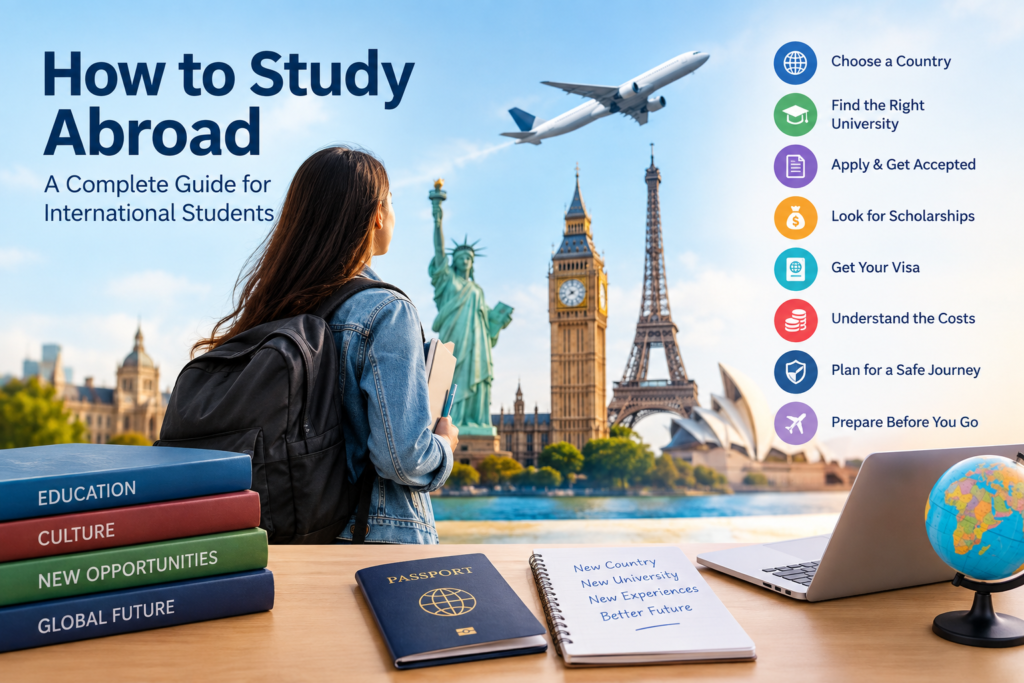
Studying in another country can sound exciting until you start dealing with applications, tuition, visas, housing, and travel plans.
Many students know where they want to go but do not know where to begin. Others choose a university first and discover later that the total cost or admission requirements do not fit their plans.
A better approach starts with research.
You need to compare countries, programs, universities, costs, funding options, visa requirements, and practical considerations before making a decision.
This guide explains how to study abroad step by step. It covers the process from choosing a destination to preparing for your departure.
What Does It Mean to Study Abroad?
Studying abroad means completing part or all of an educational program in another country.
Students can study abroad through several options, including:
- Bachelor’s degree programs
- Master’s degree programs
- Doctoral programs
- Exchange programs
- Short term programs
- Language programs
- Summer programs
- Research programs
- Internships connected to academic study
The application process depends on the country, institution, program, and student’s academic background.
Students should therefore avoid assuming that one country’s process applies everywhere.
Step 1. Decide Why You Want to Study Abroad
Start with your academic and personal goals.
Ask yourself what you want to gain from the experience.
Your reasons might include:
- Studying a specific subject
- Accessing a particular academic program
- Learning another language
- Experiencing another culture
- Building international experience
- Preparing for a specific career
- Completing an exchange semester
- Conducting research
- Expanding your professional network
Your reason for studying abroad can help narrow your choices.
For example, a student interested in engineering may prioritize universities with strong programs in a particular specialization.
Someone interested in language learning may care more about location and immersion.
Do not choose a destination simply because it is popular. Look at whether the program supports your actual goals.
Step 2. Choose a Country
Once you understand your goals, start comparing countries.
Consider more than the university’s reputation.
Look at:
- Tuition fees
- Cost of living
- Language of instruction
- Admission requirements
- Student visa requirements
- Housing options
- Health insurance rules
- Transportation
- Climate
- Cultural environment
- Safety information
- Opportunities available after graduation
The cost of studying can vary significantly between countries and even between cities within the same country.
A university in a major capital may have very different living costs from one in a smaller city.
Create a comparison list before making a decision.
Step 3. Research Universities and Programs
The program should be one of your main priorities.
Look beyond general university rankings.
Check the actual course structure and academic requirements.
Review:
- Degree title
- Required courses
- Elective options
- Program length
- Faculty
- Research opportunities
- Internship options
- Class format
- Location
- Accreditation or recognition
- Total estimated cost
A university may have a strong overall reputation but still lack the specific program you need.
The U.S. Department of State’s EducationUSA advises students researching U.S. institutions to consider academic, financial, and personal priorities rather than relying on a single ranking system. It also recommends beginning research well before the intended academic year.
The same principle applies when comparing institutions in other countries.
Step 4. Check Admission Requirements
Every university can have its own requirements.
Read the official admissions page for each institution before preparing your application.
Requirements may include:
- Academic transcripts
- Diplomas or certificates
- English language test scores
- Other language test scores
- Standardized test scores
- Recommendation letters
- Personal statements
- Essays
- Resume or CV
- Portfolio
- Application fee
- Passport information
- Financial documents
Some programs require additional materials.
For example, an art program may request a portfolio. A research degree may require a research proposal.
Do not assume that meeting the general university requirements means you meet the requirements for your chosen program.
Step 5. Create an Application Timeline
One of the easiest ways to create problems is waiting until the last minute.
Create a calendar containing every important deadline.
Include:
- Application deadlines
- Scholarship deadlines
- Financial aid deadlines
- Test dates
- Recommendation deadlines
- Document submission deadlines
- Housing deadlines
- Visa appointments
- Enrollment deadlines
EducationUSA recommends that prospective students research U.S. study options 12 to 18 months before the academic year they plan to attend. It also recommends keeping track of application and financial aid deadlines.
Deadlines vary by institution and country, so always verify them directly with the school.
Step 6. Prepare Your Documents
Start collecting documents early.
Some documents may take time to obtain, certify, translate, or send.
Depending on the program, you may need:
- Academic transcripts
- Degree certificates
- Passport
- Test scores
- Recommendation letters
- Personal statement
- Resume
- Portfolio
- Financial documents
- Proof of language ability
Keep digital copies of important documents in a secure location.
Use consistent information across applications.
Check names, dates, grades, addresses, and other details carefully before submitting anything.
A simple mistake in an application can create unnecessary delays.
Step 7. Prepare a Strong Personal Statement
Many study abroad applications ask students to explain their academic goals and reasons for applying.
A strong personal statement should answer the questions that matter.
Why did you choose this field?
Why does this program fit your goals?
What academic or professional experience has prepared you?
What do you hope to accomplish?
Avoid turning the statement into a list of achievements.
Explain the connection between your background, your goals, and the program.
Be specific.
Instead of saying that you want to study at a university because it is “excellent,” explain what attracts you to the actual program.
Step 8. Look for Scholarships and Financial Aid
Cost is one of the most important parts of planning how to study abroad.
Create a complete budget before applying.
Your estimated expenses may include:
- Tuition
- Application fees
- Student visa fees
- Housing
- Food
- Transportation
- Books and supplies
- Health insurance
- Flights
- Local travel
- Personal expenses
- Emergency funds
Do not look only at tuition.
A program with lower tuition may still become expensive if housing and daily expenses are high.
Scholarships can reduce the amount you need to pay, but eligibility varies widely.
Some scholarships are based on academic performance. Others consider financial need, field of study, nationality, destination, leadership, research, or other criteria.
The U.S. Department of State’s study abroad resources note that students may have access to scholarships, grants, internships, and other funding opportunities. U.S. students may also be able to use certain federal financial aid for eligible study abroad programs.
For international students applying to U.S. institutions, EducationUSA also advises students to start financial planning early because tuition, fees, and living expenses vary by institution and location.
Never assume that a scholarship covers your entire cost.
Read the terms carefully.
Step 9. Apply to Your Selected Programs
Once you have prepared your documents, submit your applications through the official channels.
Depending on the institution, applications may be submitted through:
- The university’s application portal
- A national application system
- An authorized application platform
- An exchange program
- Another official admissions system
Always confirm the submission process on the institution’s official website.
Keep records of:
- Application confirmations
- Payment receipts
- Login details
- Submitted documents
- Scholarship applications
- Important emails
Create a spreadsheet if you are applying to multiple institutions.
You can track each application using columns for the university, program, deadline, documents, application status, scholarship status, and decision.
Step 10. Apply for a Student Visa
A student visa is often one of the most important parts of the process.
Visa requirements vary by destination.
You may need to provide:
- Valid passport
- Admission letter
- Proof of funds
- Visa application
- Photographs
- Health documents
- Academic documents
- Proof of accommodation
- Insurance documents
- Other country specific paperwork
Do not wait until the last moment.
Visa processing times and requirements can change.
Check the official government website and the relevant embassy or consulate for current information.
For example, students traveling to the United States for academic study generally need an F visa, while vocational students generally use an M visa. Students must first be accepted by a Student and Exchange Visitor Program approved school before completing the U.S. student visa process.
This illustrates why students should research immigration requirements before making travel plans.
Step 11. Arrange Housing
Do not leave housing until the final weeks.
Research your options as soon as you receive admission.
Common options include:
- University residence halls
- Private student housing
- Shared apartments
- Homestays
- Private rentals
Compare the total cost rather than just the monthly rent.
Ask about:
- Utilities
- Deposits
- Internet
- Furnishings
- Transportation
- Lease length
- Cancellation rules
- Distance from campus
If you are booking private housing, verify the property and contract carefully.
Avoid sending money to unknown individuals without confirming that the accommodation is legitimate.
Step 12. Plan Your Health and Insurance Needs
Health requirements vary by destination and program.
Check whether your university or destination country requires specific insurance coverage.
You may also need certain vaccinations or health documentation.
The U.S. Department of State advises students traveling abroad to check their insurance coverage and determine whether additional coverage is needed. It also recommends reviewing destination specific health information before departure.
Keep copies of important medical and insurance documents.
If you take prescription medication, research the rules of your destination before traveling with it.
Step 13. Prepare for Cultural Differences
Academic life may be different from what you are used to.
Classroom expectations, communication styles, grading systems, housing arrangements, food, transportation, and social customs can vary.
Research the local culture before departure.
Learn basic phrases if the local language differs from your own.
Understand local laws and customs.
This preparation can make the transition easier and reduce avoidable misunderstandings.
Step 14. Prepare for Travel
Once your admission, visa, housing, and other arrangements are confirmed, prepare for departure.
Create a travel checklist.
Include:
- Passport
- Visa
- Admission documents
- Housing confirmation
- Insurance information
- Emergency contacts
- Academic records
- Medication
- Bank cards
- Some local currency
- Copies of important documents
Keep essential documents in your carry on rather than checked luggage.
Share your itinerary and emergency contact information with someone you trust.
Safety Tips for Studying Abroad
Safety should be part of your study abroad planning.
Before leaving, research your destination’s current travel information, local laws, health conditions, and emergency procedures.
The U.S. Department of State advises American students abroad to review destination information, understand local laws and customs, maintain contact with family or friends, and know how to reach local authorities and the nearest U.S. embassy or consulate.
U.S. students can also enroll in the Smart Traveler Enrollment Program. STEP provides security information from U.S. embassies and can help an embassy contact travelers during an emergency.
International students from other countries should check the equivalent services offered by their own governments.
Common Study Abroad Mistakes to Avoid
Choosing a University Only Because of Its Ranking
Rankings can provide information, but they should not be the only factor.
Look at the actual program, cost, location, academic resources, and your personal goals.
Ignoring the Total Cost
Tuition is only one part of your budget.
Include housing, food, transportation, insurance, travel, books, and personal expenses.
Missing Scholarship Deadlines
Some scholarship deadlines may occur before the main admission deadline.
Research funding at the same time as you research universities.
Waiting Too Long to Apply for a Visa
Admission does not mean you can automatically travel.
Start the visa process as soon as you are eligible and follow official instructions.
Relying on Unofficial Information
Social media groups and online forums can provide useful experiences, but requirements can change.
Use official university and government websites to verify important information.
Booking Nonrefundable Travel Too Early
Visa approval is not guaranteed.
For U.S. student and exchange visas, the Department of State specifically advises applicants not to make final travel plans or buy tickets until the visa has been issued.
Check the rules for your destination before purchasing nonrefundable travel.
A Simple Study Abroad Checklist
Before you leave, make sure you have reviewed these areas.
Academic
- Program selected
- Admission confirmed
- Required documents submitted
- Enrollment completed
Financial
- Tuition budget prepared
- Housing budget prepared
- Funding confirmed
- Emergency funds considered
Immigration
- Passport valid
- Visa requirements completed
- Required immigration documents ready
Housing
- Accommodation arranged
- Contract reviewed
- Arrival instructions confirmed
Health
- Insurance checked
- Required health documents prepared
- Medication requirements reviewed
Travel
- Flight arranged after required approvals
- Emergency contacts saved
- Important documents backed up
How Early Should You Start Planning?
Start as early as possible.
A longer planning period gives you more time to compare programs, prepare applications, apply for scholarships, take required tests, obtain documents, and complete visa procedures.
For students considering U.S. higher education, EducationUSA recommends beginning research around 12 to 18 months before the intended academic year.
Other countries and institutions may follow different timelines.
The safest approach is to work backward from the university’s application deadline.
Final Thoughts
Learning how to study abroad becomes much easier when you break the process into manageable steps.
Start by defining your academic goals. Research countries and programs that fit those goals. Compare total costs and funding options. Prepare your documents early and track every deadline.
After receiving an offer, focus on visas, housing, insurance, travel, and safety preparation.
Most importantly, verify important information through official university and government sources. Admission rules, visa requirements, costs, and deadlines can change.
A well planned study abroad experience starts long before you board the plane. Careful preparation can help you arrive ready to focus on your education and make the most of your time overseas.