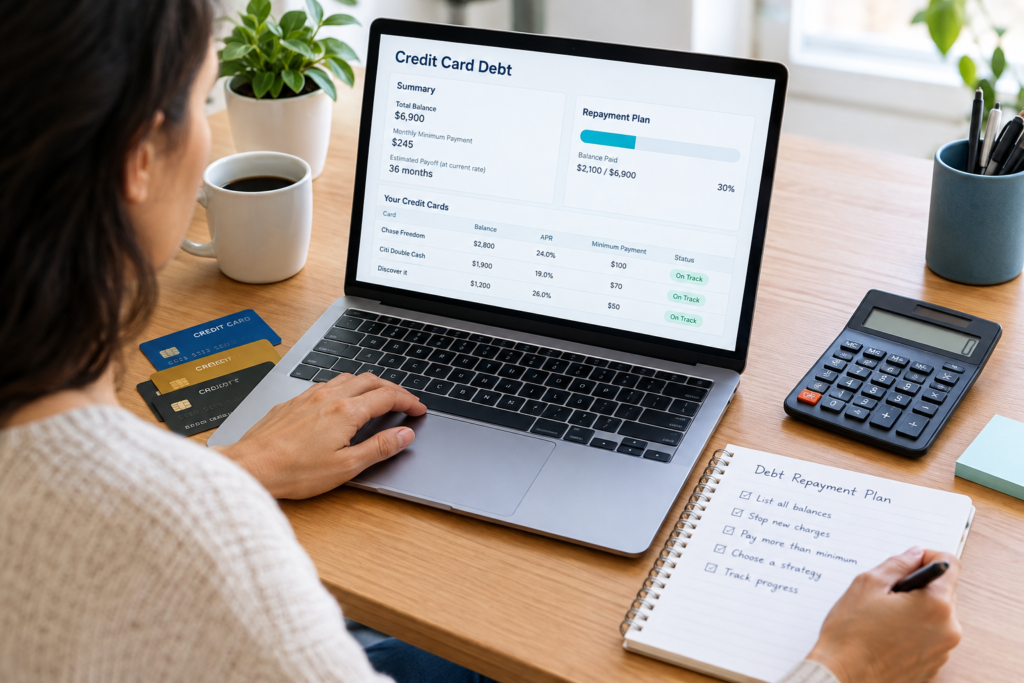
A credit card balance can feel manageable when you look only at the minimum payment. The problem becomes clearer when interest keeps adding to the balance each month.
Paying off credit card debt faster requires more than simply sending a larger payment when you have extra money. You need a clear repayment strategy, control over new spending, and a plan that fits your monthly budget.
The good news is that you can take several practical steps to reduce your balance faster. You can prioritize high interest debt, pay more than the minimum, review your interest rates, and look for ways to reduce unnecessary expenses.
This guide explains how to pay off credit card debt faster while keeping your repayment plan realistic.
Why Credit Card Debt Can Take So Long to Pay Off
Credit card interest can make debt repayment difficult because interest may continue to accrue while you carry a balance.
Many credit card companies calculate interest using an average daily balance. This means the timing and amount of your payments can affect the interest you pay.
Your credit card statement also shows important information about repayment. Federal rules require card issuers to provide information about how long repayment could take if you make only minimum payments. Statements also provide an estimate of the payment needed to repay the current balance within 36 months under specified assumptions.
Making only the minimum payment can therefore keep you in debt for a long time.
Paying more than the minimum reduces the balance more quickly and can reduce the amount of interest paid over time.
Step 1 List Every Credit Card Balance
Start by creating a complete list of your credit card debt.
For each card, record
- Current balance
- Annual percentage rate
- Minimum payment
- Payment due date
- Promotional interest rate and expiration date
- Any special balance or financing terms
Do not rely on memory.
Check your latest statements and account information. Some cards can have different interest rates for purchases, cash advances, and other types of balances.
Once you have the information in one place, you can see exactly what you owe.
Create a Simple Debt List
You can use a spreadsheet or notebook to organize your accounts.
For example
| Credit Card | Balance | APR | Minimum Payment |
|---|---|---|---|
| Card A | $3,200 | 24% | $95 |
| Card B | $1,800 | 19% | $55 |
| Card C | $900 | 29% | $35 |
These figures are only an example. Your actual balances and rates will determine the best repayment approach for your situation.
Step 2 Stop Adding New Credit Card Debt
Paying down debt becomes much harder when new purchases continue to increase the balance.
Review your recent statements and identify expenses that you can temporarily pay with cash or a debit account instead.
This does not mean you must stop using every credit card permanently. The goal is to prevent new charges from working against your repayment plan.
Consider removing saved credit card information from shopping websites. You can also avoid using a card for discretionary purchases while you focus on reducing the balance.
A smaller flow of new charges makes every extra payment more effective.
Step 3 Pay at Least the Minimum on Every Card
Never ignore the minimum payment while focusing on another card.
Your minimum payment is the amount required by the card agreement. Missing it can result in fees and other consequences. Late payments can also affect your credit history.
A basic repayment structure looks like this
- Pay the minimum required on every card.
- Choose one card for your extra payment.
- Put as much additional money as your budget allows toward that card.
- Continue until that balance reaches zero.
- Move the money you were paying toward the next debt.
This approach keeps every account current while concentrating your available money.
Step 4 Choose a Debt Payoff Strategy
Two common approaches are the debt avalanche and the debt snowball.
Both can help you organize repayment. The main difference is which balance receives your extra payment.
Debt Avalanche Method
The debt avalanche method focuses on the card with the highest interest rate.
You continue making minimum payments on all other cards. Then you put your extra payment toward the card with the highest APR.
Once that card is paid off, you move to the next highest rate.
The main advantage is that you focus your extra payments on the debt that carries the highest interest cost. The Consumer Financial Protection Bureau describes this as the highest interest rate method.
This approach can make sense if your main goal is to reduce interest costs.
Debt Snowball Method
The debt snowball method starts with your smallest balance.
You continue making minimum payments on the other cards. Any extra money goes toward the card with the smallest balance.
After paying it off, you apply that payment to the next smallest balance.
The advantage is that you can see an account reach zero sooner. The CFPB notes that this approach can provide faster visible progress, although it may result in more interest paid if higher cost debt remains outstanding.
Which Method Should You Use?
There is no single repayment method that fits every financial situation.
The avalanche method focuses on interest rates. The snowball method focuses on smaller balances and visible progress.
The most important part is choosing a method you can follow consistently.
Step 5 Pay More Than the Minimum
If your budget allows it, increase the payment on your target card.
Even a fixed additional amount can change how quickly you reduce the principal balance.
Suppose your required minimum payment is $75 and you can afford $175.
Instead of paying only $75, you could direct the additional $100 toward your target debt.
The exact interest savings will depend on your balance, APR, payment timing, and card terms.
Your credit card statement can help you understand the difference. Issuers provide repayment information based on minimum payments and a three year repayment scenario under specified assumptions.
Step 6 Make Extra Payments When You Have Additional Money
Extra income can help accelerate your repayment plan.
Possible sources include
- Tax refunds
- Work bonuses
- Overtime income
- Freelance earnings
- Selling unwanted items
- Cash gifts
- Temporary spending reductions
You do not need to commit every dollar of unexpected income to debt.
Instead, decide in advance how you will divide additional money between debt repayment, savings, and necessary expenses.
The key is to avoid treating unexpected money as automatic spending money.
Step 7 Look for Ways to Reduce Your Interest Rate
A lower interest rate can make repayment easier because less of your payment may go toward interest.
Start by contacting your credit card company. Ask whether there are options that could reduce your interest rate or make repayment more manageable.
If you are experiencing financial difficulty, the CFPB recommends contacting your card company promptly. Some companies may work with customers to adjust payments or provide other assistance.
Do not assume that a lower rate is guaranteed.
Ask about the exact terms, how long the rate lasts, and whether fees apply.
Step 8 Consider a Balance Transfer Carefully
A balance transfer allows you to move debt from one credit card to another.
Some cards offer promotional low interest rates for balance transfers. However, these offers can include a balance transfer fee, and the promotional rate usually lasts for a limited period. The rate can increase after the promotional period ends.
Before using a balance transfer, calculate
- Transfer fees
- Promotional period
- Interest rate after the promotion
- Required monthly payment
- Whether you can repay the balance before the promotional rate expires
A balance transfer does not eliminate debt.
It simply changes where the debt is held and may change its cost.
Step 9 Protect Your Emergency Savings
It can be tempting to put every available dollar toward credit card debt.
However, completely eliminating your cash reserves can leave you vulnerable to an unexpected expense.
A car repair, medical bill, home repair, or temporary income reduction could force you to use a credit card again.
Consider maintaining an emergency cushion that fits your financial circumstances while you work on your debt.
The right balance depends on your income, expenses, existing savings, and financial stability.
Step 10 Build a Monthly Debt Budget
Your debt repayment plan should fit inside your actual budget.
Start with your monthly take home income.
Then subtract essential expenses such as
- Housing
- Utilities
- Food
- Transportation
- Insurance
- Minimum debt payments
- Other necessary bills
The remaining amount shows how much flexibility you have.
You can then decide how much additional money to send toward your target credit card.
A realistic payment that you can make every month is generally more useful than an aggressive payment that causes you to fall behind later.
A Simple Example of Faster Debt Repayment
Consider someone with three credit cards
- Card A has a $3,200 balance at 24% APR.
- Card B has a $1,800 balance at 19% APR.
- Card C has a $900 balance at 29% APR.
The borrower has enough income to cover all three minimum payments plus an additional $200 each month.
Using the avalanche method, the extra $200 would go toward Card C because it has the highest APR.
The borrower would continue making the required payments on Cards A and B.
Once Card C reaches zero, the payment previously directed toward Card C could be added to the next target.
The actual payoff timeline depends on the card terms, interest calculations, payment dates, and whether new charges are made.
The example demonstrates the structure of the strategy rather than promising a specific savings amount.
Common Credit Card Debt Mistakes to Avoid
Paying Only the Minimum
Minimum payments can keep your account current, but they may not reduce the balance quickly.
If your budget allows, pay more than the required minimum.
Using the Paid Off Card Again
Paying off one card is a major step.
But immediately rebuilding the balance can undo your progress.
Try to understand what caused the original debt before increasing your credit card spending again.
Ignoring Interest Rates
Two cards with identical balances can have very different repayment costs if their APRs differ.
Check the interest rate on each account before deciding where your extra payment should go.
Closing Every Card Immediately
Paying off debt and closing credit card accounts are separate decisions.
Before closing an account, consider its fees, terms, age, credit limit, and how the change could affect your overall credit profile.
There is no universal rule that says every paid off card should be closed.
Taking New Debt to Cover Old Debt Without a Plan
Debt consolidation can simplify payments in some circumstances.
But moving debt does not solve the underlying spending problem.
The CFPB recommends reviewing your budget and understanding why the debt accumulated before taking out a consolidation loan.
What If You Cannot Afford Your Minimum Payments?
If your income is not enough to cover your minimum payments, act quickly.
Contact your credit card companies and explain your situation.
The CFPB recommends adding up your income and expenses, determining what you can afford, and contacting the card company directly. Some creditors may offer payment adjustments or other options.
You can also consider nonprofit credit counseling.
A reputable credit counselor can review your finances and explain possible options. The FTC recommends checking fees, services, counselor credentials, and contract terms before signing up.
Be cautious about companies that promise to make your debt disappear quickly.
The FTC warns consumers about debt relief scams and says consumers should be suspicious of guarantees and demands for upfront payment before services are provided.
What About Debt Management Plans?
A debt management plan is different from simply moving debt to another credit card.
A credit counseling organization may work with you to create a payment schedule. The organization may then distribute your payments to participating creditors.
Depending on the circumstances, creditors may agree to changes such as lower interest rates or waived fees.
These plans are not right for everyone.
Before enrolling, understand the fees, payment schedule, participating creditors, and restrictions on using additional credit.
Be Careful With Deferred Interest Offers
Some store cards and other credit products advertise no interest if you pay a purchase within a specified period.
These offers can work differently from a standard promotional APR.
The CFPB explains that deferred interest arrangements can result in previously accrued interest becoming due if the required balance is not paid within the promotional period.
If you have one of these balances, check the promotional end date carefully.
Do not assume that making the minimum payment will be enough to clear the balance before the deadline.
How to Stay Motivated During Debt Repayment
Credit card debt can take time to eliminate.
A simple tracking system can make your progress easier to see.
Create a monthly record showing
- Starting balance
- Payments made
- Interest charged
- New purchases
- Ending balance
You can also track the number of accounts with outstanding balances.
As one balance reaches zero, redirect that payment toward the next account.
The goal is to turn each completed payoff into additional payment power.
Frequently Asked Questions
What is the fastest way to pay off credit card debt?
The fastest approach depends on your balances, interest rates, available income, and spending. A common strategy is to make all minimum payments on time while directing extra money toward one target balance. The avalanche method targets the highest interest rate first.
Should I pay off the highest interest credit card first?
The highest interest rate method focuses extra payments on the debt with the highest APR. This can reduce attention to the debt with the greatest interest cost while minimum payments continue on other accounts.
Is it better to pay off the smallest credit card first?
The snowball method targets the smallest balance first. It can provide quicker visible progress because you may eliminate an account sooner. However, it may result in more interest costs than focusing on the highest interest rate debt.
Should I stop using my credit cards while paying off debt?
If new purchases are increasing your balance, reducing or stopping credit card use can make repayment easier. The right approach depends on your budget and financial circumstances.
Can a balance transfer help pay off credit card debt?
A balance transfer can potentially reduce interest costs during a promotional period. However, fees and the post promotional interest rate matter. Review the complete terms before transferring a balance.
What should I do if I cannot make my minimum payment?
Contact your credit card company as soon as possible. Explain your financial situation and ask what payment options may be available. You can also consider speaking with a reputable credit counseling organization.
Final Thoughts
Learning how to pay off credit card debt faster starts with knowing exactly what you owe.
List your balances, interest rates, minimum payments, and due dates. Then choose a repayment strategy that fits your financial situation.
Paying more than the minimum can help reduce your balance faster. Targeting high interest debt can focus your extra payments where interest costs are higher. The snowball method can provide visible progress by eliminating smaller balances first.
The most important part is consistency.
Avoid adding unnecessary debt, monitor your spending, and review your progress each month. If your debt has become difficult to manage, contact your creditors or seek help from a reputable credit counseling organization.
This article provides general educational information and is not personalized financial advice. Your credit card terms, income, expenses, and financial circumstances can affect which repayment strategy is appropriate for you.