Pakistan has reported its fifth polio case of 2026, with the latest infection detected in Bannu district in Khyber Pakhtunkhwa.
The case involves a 17 month old girl from Khandar Khankhel union council in Domel tehsil. Four of Pakistan’s five reported cases this year have been detected in Bannu Division, including three in Bannu district.
The development comes shortly after a nationwide vaccination campaign that reached more than 28.2 million children across 112 districts. The latest case therefore highlights both the progress made against polio and the difficulty of reaching every child in areas where access and security remain challenging.
What happened in the latest polio case
The Regional Reference Laboratory for Polio Eradication at Pakistan’s National Institute of Health confirmed the latest case on September 29.
According to reporting from dawn, awnthe affected child is a 17 month old girl from Bannu district. The case was reported from the Khandar Khankhel union council in Domel tehsil.
The case takes Pakistan’s reported total for 2026 to five.
Four of those five cases have been detected in Bannu Division. Three have come specifically from Bannu district.
This concentration matters because polio does not remain limited to the location where a case is identified. Continued circulation can create a risk for children in surrounding communities when vaccination coverage is incomplete.
Why Bannu is receiving attention
Bannu has emerged as an important area in Pakistan’s polio eradication efforts this year.
Health officials and reporting have repeatedly identified security and access problems as challenges for vaccination teams operating in parts of southern Khyber Pakhtunkhwa.
Earlier in September, officials in Khyber Pakhtunkhwa said the province’s reported polio cases had originated from areas where reaching children was difficult because of security concerns. The provincial government also described additional campaigns in Bannu and parts of the former tribal districts as an effort to reach children who may have been missed.
Security is not the only challenge.
Population movement can also make vaccination more difficult. Families may move between districts or cross borders, making it harder for health teams to maintain continuous vaccination coverage.
Punjab officials recently highlighted population movement as one reason transit vaccination teams remain important. These teams can vaccinate children who are traveling and may not be present during household visits.
Pakistan has made progress in 2026
The fifth case should be viewed alongside the broader polio situation.
Pakistan recorded 31 polio cases in 2025 and 74 cases in 2024, according to recent reporting by Dawn. The number reported during 2026 has remained substantially lower so far.
The World Health Organization has also continued to monitor poliovirus transmission in Pakistan as part of its international polio surveillance work.
In its August 2026 emergency committee statement, WHO reported ongoing WPV1 transmission in Pakistan and Afghanistan. It also noted that cross border transmission between the two countries had been documented during the first quarter of 2026.
This means a lower number of reported cases does not automatically mean that transmission has ended.
Environmental surveillance remains an important part of the response because poliovirus can be detected in wastewater even when no child with paralysis has been identified in an area.
Why vaccination remains important
Polio is a highly infectious disease that can cause permanent paralysis.
There is no cure for paralysis caused by polio. Vaccination is therefore the central tool used to prevent infection and transmission.
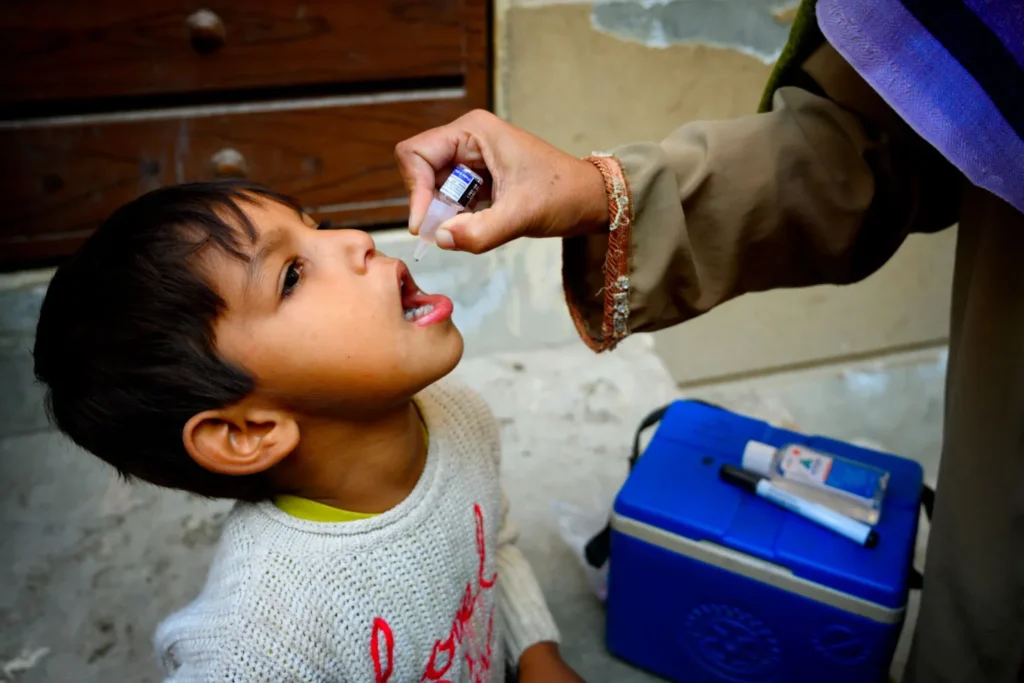
Pakistan’s National Emergency Operations Centre has continued to urge parents to ensure that children under five receive polio drops during vaccination campaigns.
Repeated doses can be necessary during campaigns because vaccination programs aim to protect children across communities and interrupt virus transmission.
For families, the practical message is straightforward.
If vaccination workers visit a home during an official campaign, parents should follow guidance from local health authorities and make sure eligible children receive the recommended vaccine.
Pakistan’s latest vaccination campaign
The latest case was reported just after Pakistan completed a week long anti polio campaign.
The campaign ran from September 21 through September 27 in 112 selected districts.
More than 28.2 million children received polio drops during the campaign, according to the National Emergency Operations Centre. More than 273,000 workers participated in the effort.
The campaign also ran alongside vaccination activities in neighboring Afghanistan.
The scale of the campaign shows how large the operational challenge remains. Health workers must reach millions of children while dealing with population movement, difficult terrain, security restrictions and areas where families may be difficult to reach.
Khyber Pakhtunkhwa remains a key focus
Khyber Pakhtunkhwa has received particular attention during the 2026 polio response.
The provincial government launched a September campaign targeting 7.3 million children. About 35,000 polio teams were involved across the province, alongside security personnel and other agencies.
Officials have also emphasized special campaigns in areas where children were difficult to reach during previous vaccination rounds.
These efforts are important because vaccination coverage depends on more than the number of doses distributed.
Health workers must identify children who were missed, return to households when necessary and maintain surveillance for signs of continued virus circulation.
What environmental surveillance tells health officials
Polio surveillance does not depend only on identifying children with paralysis.
Health authorities also test environmental samples, including sewage and wastewater, for poliovirus.
A positive environmental sample can indicate that the virus is circulating in a community even when no clinical case has been reported.
Earlier reporting from Dawn noted that Bannu had environmental samples showing poliovirus circulation between October 2025 and March 2026.
This type of monitoring helps health authorities identify areas where vaccination efforts may need additional attention.
It also explains why officials continue vaccination campaigns even when the number of confirmed cases remains relatively low.
What the latest case means for families
For parents in Pakistan, the most practical takeaway is the importance of following official vaccination campaigns.
A child may appear healthy while living in an area where poliovirus is circulating.
Vaccination protects individual children while also helping reduce the opportunity for the virus to spread to other children.
Parents should pay attention to announcements from their local health departments and vaccination teams.
Families who travel should also understand that vaccination efforts include transit points and mobile teams. This approach helps reach children who may not be at home during door to door visits.
Why the issue matters beyond Pakistan
Polio eradication is an international public health effort.
Pakistan and Afghanistan remain the two countries where wild poliovirus type 1 continues to circulate endemically. WHO has continued to monitor transmission across both countries and has highlighted the importance of synchronized vaccination campaigns.
The geographic connection between Pakistan and Afghanistan also matters because people regularly move across the region.
When poliovirus continues circulating in one area, it can pose a transmission risk to communities in another area if vaccination coverage is incomplete.
This is one reason international health organizations continue to support surveillance, vaccination and cross border coordination.
Common misconceptions about polio vaccination
A child who received one dose is fully protected
Polio vaccination programs may require multiple doses to provide strong protection across populations.
Parents should follow the schedule and instructions provided by health authorities rather than assuming one dose is enough.
No reported case means there is no virus
This is another important misconception.
Environmental surveillance can detect poliovirus even when no child with paralysis has been identified.
That is why health authorities continue testing wastewater and conducting vaccination campaigns.
Older children do not matter
Polio campaigns often focus on children under five because they are especially important to eradication efforts.
Parents should follow the eligibility guidance given during each official campaign because campaign targets can vary according to local health conditions.
Challenges facing Pakistan’s polio program
Pakistan’s progress in reducing reported cases is significant, but several challenges remain.
Security
Security problems can prevent vaccination teams from reaching some communities.
Officials in Khyber Pakhtunkhwa have identified difficult access in parts of the province as an important obstacle.
Population movement
Families moving between cities, districts and border areas can make follow up more difficult.
Transit teams are therefore an important part of vaccination programs.
Uneven vaccination coverage
A vaccination campaign can reach millions of children while some children remain missed.
Health authorities need detailed local information to identify those gaps and conduct follow up activities.
Continued virus circulation
The presence of poliovirus in environmental samples shows why surveillance remains important even when reported cases decline.
WHO has continued to identify Pakistan as a country requiring ongoing measures because of WPV1 transmission.
What happens next
The latest case will likely increase attention on Bannu and surrounding areas.
Health authorities will continue surveillance and vaccination activities while working to identify children who may have been missed during previous campaigns.
The immediate priority is preventing additional transmission.
That requires cooperation between health departments, vaccination workers, security agencies, community leaders and families.
The recent vaccination campaign shows the scale of the national response. More than 28.2 million children were reached during the latest week long campaign, but the detection of another case demonstrates why eradication efforts must continue.
The bigger picture for Pakistan
Pakistan’s fifth polio case of 2026 is an important public health development, particularly because of the concentration of cases in Bannu Division.
At the same time, the national picture includes a substantial reduction in reported cases compared with recent years.
That combination makes the latest development important to understand carefully.
The lower case count suggests progress, while the continued detection of poliovirus shows that transmission has not been eliminated.
For families, the most useful response is to follow official vaccination guidance and cooperate with health workers during campaigns.
For health authorities, the challenge is reaching children in every community, especially in areas affected by security concerns, difficult access and population movement.
The latest case serves as a reminder that reducing polio cases and eliminating poliovirus are different stages of the same long term effort.
Pakistan’s continued vaccination and surveillance work will remain central to that effort.