Can AI Agents Really Work Without Human Supervision?
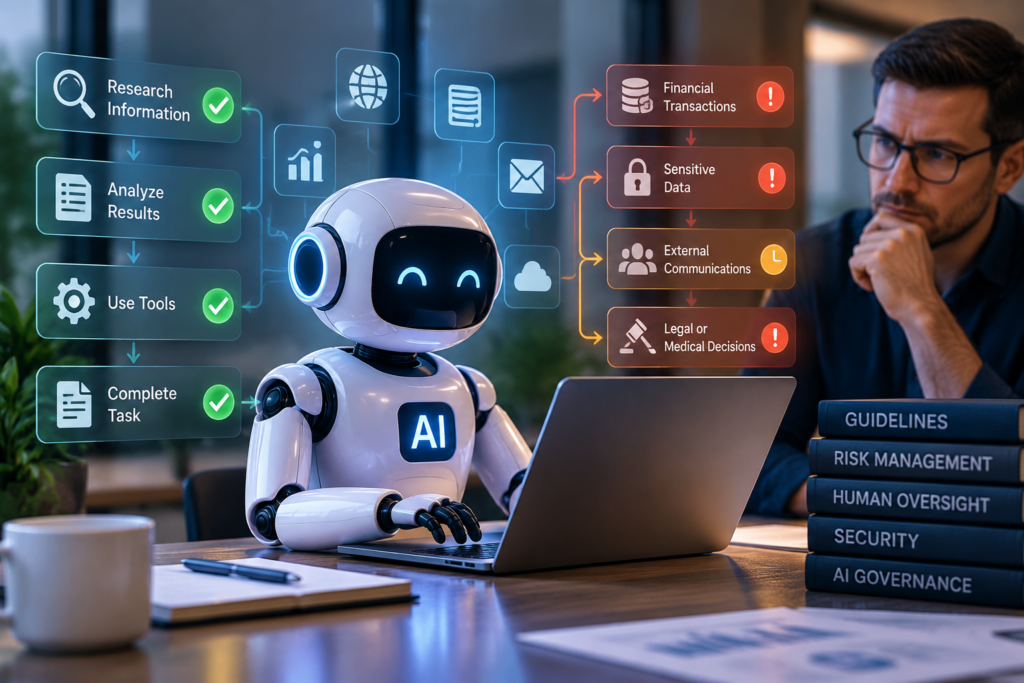
Imagine giving an AI system a goal instead of a simple question. Instead of asking it to write an email or summarize a document, you tell it to research a topic, analyze the results, choose the next step, use different software tools, and finish the task on its own.
That is the idea behind AI agents.
Unlike traditional chatbots, AI agents can be designed to reason through multi-step tasks, use tools, adapt to changing information, and take actions with limited human involvement. NIST describes AI agent systems as capable of autonomous decision-making and action with limited human supervision.
But there is an important difference between being able to work independently and being safe to leave completely unsupervised.
So, can AI agents really work without human supervision?
Yes, for some low-risk and well-defined tasks. But completely removing human oversight is not appropriate for every AI-agent workflow. The amount of supervision needed depends on what the agent can access, what decisions it can make, and what happens if it makes a mistake.
What makes an AI agent different from a chatbot?
A conventional chatbot generally responds to a user’s prompt. You ask a question, it generates an answer, and the interaction usually stops there.
An AI agent can be given a broader objective.
For example, instead of asking:
“Write a report about electric vehicles.”
You could give an agent a task such as:
“Research the latest electric vehicle market developments, collect relevant information, organize the findings, create a report, and save it to the company workspace.”
Completing that task could involve several steps. The agent might need to search for information, evaluate what it finds, use software tools, organize data, generate a document, and potentially take another action based on the results.
NIST’s cybersecurity guidance describes AI agents as systems that can understand context, reason, plan, adapt, and execute tasks. Multi-agent systems can also coordinate several agents working together toward a complex goal.
This ability to move from generating information to taking actions is what makes autonomous agents useful and what makes supervision more important.
Can AI agents operate without a person watching every step?
In some situations, yes.
An agent doesn’t necessarily need someone sitting in front of a computer approving every small action. For example, a company could use an agent to perform repetitive, low-risk tasks such as organizing information, preparing drafts, categorizing files, or monitoring a workflow.
NIST specifically notes that human-AI configurations can range from fully autonomous to fully manual. Some AI systems may not require human oversight for certain applications, while others may require it.
The key question is therefore not simply:
“Does this AI agent need a human?”
A better question is:
“Which decisions can the agent make independently, and which decisions should require human approval?”
That distinction allows companies to automate routine work without giving an AI system unlimited authority.
Where unsupervised AI agents can make sense
The safest applications for autonomous AI agents generally involve tasks where mistakes are easy to detect, reverse, or contain.
1. Organizing information
An AI agent can sort documents, categorize incoming information, summarize reports, or identify relevant files.
If it puts one document into the wrong folder, a person can usually correct the mistake without major consequences.
2. Preparing drafts
Agents can prepare first drafts of emails, reports, product descriptions, meeting notes, or internal documents.
A human may still review the final version, but the agent can handle much of the repetitive preparation work.
3. Monitoring routine workflows
An agent can watch for predefined events and take a limited action when a condition occurs.
For example, an organization could configure an agent to monitor a project-management system and flag tasks that are approaching a deadline.
4. Software development assistance
AI coding agents can perform increasingly complex technical tasks. OpenAI says coding agents can autonomously review repositories, run commands, and interact with development tools. The company also describes controls for deciding what agents can access, when approval is required, and what activity can be audited.
This is a useful example of a middle ground: an agent can perform substantial work independently while still operating inside technical boundaries.
Why completely unsupervised AI can be risky
The biggest problem is not necessarily that an AI agent will stop working.
The bigger problem is that it may continue working while making the wrong decisions.
An autonomous agent can potentially access websites, files, applications, databases, APIs, or other tools. If its instructions are incomplete or it encounters unexpected information, the consequences can extend beyond an incorrect chatbot response.
NIST recommends clearly defining human roles and responsibilities around AI systems and their oversight. Its guidance also emphasizes that AI systems can operate across different levels of autonomy and that organizations should determine appropriate human involvement based on the context.
There is also a cybersecurity concern.
For example, an AI agent may encounter malicious instructions hidden inside a webpage, document, email, or other piece of untrusted content. OpenAI’s current agent safety guidance identifies prompt injection as a significant risk because malicious content can attempt to override an agent’s instructions, expose private information, or cause unintended actions through connected tools.
That means an agent should not automatically be trusted simply because it successfully completed previous tasks.
The difference between low-risk and high-risk tasks
One practical way to determine the appropriate level of supervision is to classify tasks according to their potential consequences.
| Task type | Example | Suggested oversight |
|---|---|---|
| Low risk | Sorting files | Minimal |
| Low risk | Creating summaries | Periodic review |
| Moderate risk | Sending business emails | Approval before sending |
| Moderate risk | Editing production code | Human review |
| High risk | Financial transactions | Human authorization |
| High risk | Legal or medical decisions | Qualified human oversight |
This is not a universal rule for every organization. The appropriate controls depend on the system, the environment, the data involved, and the potential impact of an error.
The important principle is simple: the greater the potential consequence, the stronger the case for human control.
Human supervision does not have to mean approving everything
There is a common misconception that human oversight means a person must approve every action an AI agent takes.
That approach can defeat much of the purpose of automation.
A better system can divide actions into different permission levels.
For example:
Level 1: Automatic
The agent can perform routine, reversible actions without approval.
Level 2: Review
The agent prepares an action, but a human checks it before execution.
Level 3: Authorization
The agent can prepare the transaction or decision, but a human must explicitly approve it.
Level 4: Restricted
The agent is not permitted to perform the action at all.
This model gives an AI agent room to work independently without giving it unlimited authority.
What happens when an AI agent makes a mistake?
AI agents can make mistakes for several reasons.
The original instruction may be unclear. The information available to the agent may be incomplete. A connected tool may return unexpected information. The agent may misunderstand the user’s objective.
There can also be a more subtle problem: an agent may take a technically reasonable action that produces an unwanted result.
For example, suppose an agent is told to clean up an organization’s cloud storage.
It might correctly identify files that appear unnecessary and remove them. But if the agent does not understand a company’s retention policy, it could delete information that employees still need.
The problem is not necessarily that the agent failed to follow instructions. The problem may be that the instructions did not capture the full context.
NIST highlights this broader challenge in its AI risk-management guidance. It notes that converting complex human situations into data and models can remove context that may matter when evaluating impacts.
How to use AI agents more safely
Organizations do not have to choose between two extremes: manually performing every task or allowing an agent to do everything independently.
A safer approach is to build boundaries around the agent.
Start with a clearly defined task
Avoid vague objectives such as:
“Manage our customer operations.”
Instead, define exactly what the agent is responsible for.
For example:
“Review incoming support tickets, classify them by category, draft responses, and send only responses that match approved templates.”
Clear boundaries make it easier to test whether the agent is behaving as intended.
Limit access
An agent should not automatically receive access to every system or file available to an employee.
Give it only the permissions it needs.
If an agent creates reports, it may need access to specific datasets. It may not need permission to delete records, transfer money, or modify unrelated systems.
Require approval for sensitive actions
Actions involving money, confidential information, external communications, production systems, or important business decisions may deserve an approval step.
OpenAI’s guidance for coding agents, for example, describes using technical boundaries and explicit approval for higher-risk actions.
Keep an activity record
Organizations should be able to determine what an agent did and why.
Logs can help answer questions such as:
- What instructions did the agent receive?
- Which tools did it use?
- What information did it access?
- What actions did it take?
- Where did a human intervene?
- What happened after the action?
This becomes particularly important when an agent operates for long periods without someone watching every step.
Test before expanding autonomy
A company should not start with maximum permissions.
A better process is to test the agent in a controlled environment, examine its failures, adjust its instructions and permissions, and gradually expand what it can do.
NIST’s AI Risk Management Framework emphasizes continuous risk management across the AI lifecycle rather than treating risk assessment as a one-time activity.
A practical example of supervised autonomy
Consider an online retailer using an AI agent to handle customer-support requests.
The agent could independently:
- Read incoming support tickets.
- Identify the topic.
- Find the relevant order information.
- Draft a response.
- Check the response against approved policies.
But the system could require human approval when:
- A customer requests a refund above a specified threshold.
- A legal complaint is received.
- Sensitive personal information is involved.
- The customer disputes a major charge.
- The agent wants to make an exception to company policy.
This setup allows automation to handle routine work while keeping people involved when the consequences become more significant.
Common mistakes companies should avoid
Giving agents too many permissions
More access does not necessarily make an agent more useful.
Excessive permissions increase the potential impact of a mistake or security problem.
Assuming a successful test means the system is always reliable
An agent may perform perfectly during controlled testing and behave differently when it encounters unexpected information.
Real-world environments are rarely as predictable as test cases.
Treating human oversight as a checkbox
Having a human “in the loop” does not automatically make a system safe.
The person must have enough information, authority, time, and expertise to intervene when necessary. NIST specifically discusses the importance of clearly defining human roles and responsibilities in AI systems.
Letting agents make irreversible decisions too easily
If an action cannot easily be undone, it deserves more careful controls.
A useful design principle is to allow autonomous systems to handle reversible actions while requiring stronger authorization for irreversible ones.
So, can AI agents really work without human supervision?
AI agents can operate with limited human supervision, and some low-risk tasks can reasonably be automated. But completely removing human oversight is not suitable for every application.
The right level of supervision depends on the agent’s capabilities, permissions, environment, and the consequences of failure.
For a simple information-management task, an agent may be able to operate independently for long periods.
For a system that can access confidential data, change production systems, communicate externally, or make consequential decisions, stronger controls are much more important.
The future of autonomous AI is therefore unlikely to be simply about choosing between humans and machines. A more practical approach is to determine where machines can act independently, where humans should review decisions, and where human authorization must remain mandatory.
As AI agents become capable of handling longer and more complicated workflows, those boundaries will become just as important as the technology itself.