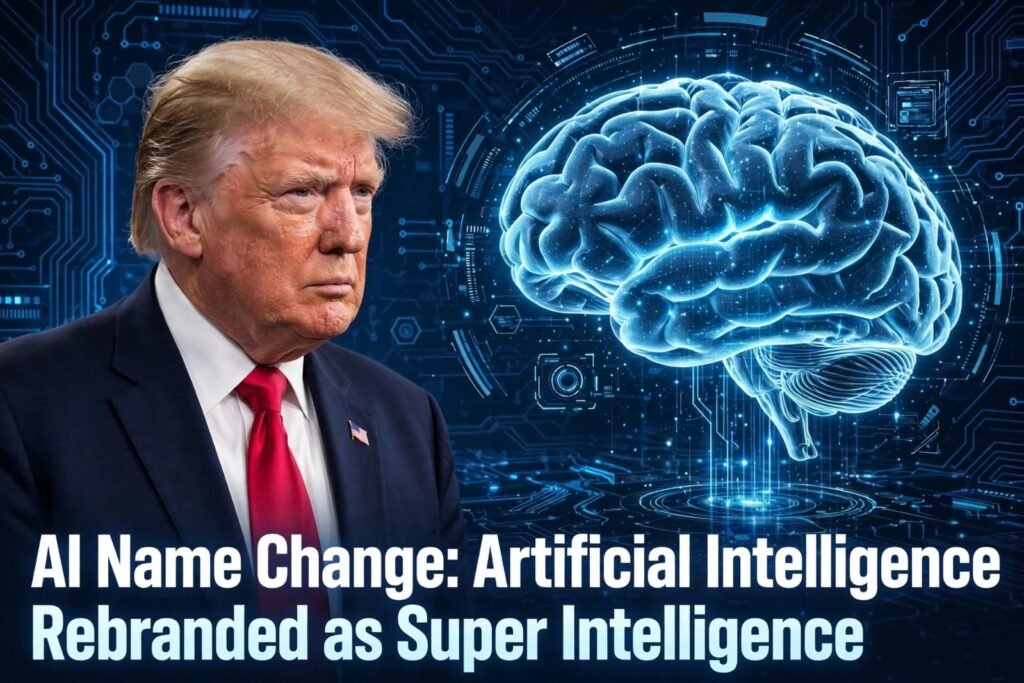
Trump AI Name Change: Artificial Intelligence Rebranded as Super Intelligence
President Donald Trump has introduced a major Trump AI name change, directing the U.S. executive branch to replace the terms “Artificial Intelligence” and “AI” with “Super Intelligence” and “SI” in official communications. The change was announced through an executive order signed on September 29, 2026, and has quickly become a major technology and political news story.
The Trump AI name change does not mean that the technology has legally received a new name everywhere in the world. Instead, the executive order instructs U.S. federal departments and agencies to use “Super Intelligence” and “SI” in official correspondence, public communications, websites, reports, policy documents and other non-statutory material, where permitted by law.
Why Did Trump Change the Name of AI?
The Trump AI name change is based on the administration’s view that modern AI systems have developed beyond what the original term “Artificial Intelligence” was intended to describe.
The White House says today’s frontier systems can do more than simply imitate or automate certain aspects of human intelligence. According to the executive order, these systems increasingly amplify human creativity and capabilities across areas including science, medicine and other fields.
Trump has also publicly argued that the word “artificial” can make intelligence sound fake. During his September 2026 United Nations General Assembly address, he said U.S. government documents would use “Super Intelligence” instead of “Artificial Intelligence.”
The administration now uses “SI” as the abbreviation for Super Intelligence.
What Does the Executive Order Actually Change?
The Trump AI name change primarily affects terminology used by the U.S. executive branch.
Under the September 29 executive order, federal agencies are directed to use “Super Intelligence” and “SI” instead of “Artificial Intelligence” and “AI” in:
– Official correspondence
– Public communications
– Government websites
– Reports
– Policy documents
– Other non-statutory documents
The order also states that previously issued regulations, contracts, grants, presidential actions and historical documents do not have to be changed.
This means the change is not simply a worldwide renaming of the technology. Existing legal references to artificial intelligence remain relevant, and the order itself says implementation must be consistent with applicable law.
Is AI Now Officially Called Super Intelligence Everywhere?
No. The Trump AI name change applies to the federal executive branch rather than automatically changing the terminology used by every government, company, researcher or country.
The executive order defines “Super Intelligence” and “SI,” for its purposes, using the existing statutory definition of artificial intelligence unless that definition is later changed through further presidential action or legislation.
The order also gives the Assistant to the President for Science and Technology 60 days to propose legislative language concerning a possible federal definition of “Super Intelligence” and SI.
Therefore, the terminology could continue to develop as the U.S. government considers how the new wording fits existing laws and policies.
Trump Had Already Started Using the New Term
The Trump AI name change did not appear suddenly with the executive order.
Trump had already announced the terminology change during his September 22 speech at the United Nations General Assembly. Following that speech, the State Department instructed diplomats in its international organizations bureau to replace references to “Artificial Intelligence” with “Super Intelligence” in their communications and positions.
The executive order on September 29 then formalized the terminology change across the executive branch.
Major Technology Executives Also Met Trump
The Trump AI name change came on the same day as a White House meeting involving major technology executives.
Executives from several leading technology companies joined Trump for discussions about the future of advanced AI systems and safety. The group also signed a voluntary agreement concerning controls and safety practices around what the administration calls Super Intelligence.
The meeting brought together leaders from companies including OpenAI, Google, Meta, Nvidia and Anthropic, among others.
The agreement was voluntary rather than a new federal law, making the White House terminology change and the industry agreement two related but separate developments.
California Takes a Different Approach
The Trump AI name change has also produced a notable response from California.
California Governor Gavin Newsom signed an executive order on September 30 directing California state agencies to continue using “Artificial Intelligence” and “AI.” California’s announcement came shortly after Trump’s federal executive order.
This means federal and California government communications can use different terminology for the same underlying technology.
California has also announced additional measures dealing with AI and workplace issues, including requirements involving human review of certain employment decisions and transparency when AI contributes to mass layoffs.
What Does Super Intelligence Mean?
The term “super intelligence” can have a broader meaning in technology discussions than simply being another name for AI.
In general discussions about AI research, superintelligence can refer to a hypothetical or advanced form of machine intelligence that exceeds human intellectual abilities across many areas.
However, Trump’s executive order uses “Super Intelligence” differently for its federal terminology. The order states that, for purposes of the order, the term covers technologies and systems encompassed by the existing statutory definition of artificial intelligence.
This distinction is important because the executive order’s use of the term does not automatically mean every existing AI system has suddenly become a scientifically defined superintelligent system.
Will Companies Stop Calling It AI?
The Trump AI name change does not automatically require private companies around the world to stop using the term AI.
The executive order specifically addresses the U.S. executive branch and official government materials. Private technology companies can continue using “AI” unless another applicable rule or agreement requires different terminology.
Some major technology executives participated in the White House meeting and signed the voluntary Super Intelligence agreement, but that is separate from a universal legal requirement for companies to rename their products and services.
What Happens Next?
The next stage of the Trump AI name change will involve the federal government’s work on a potential definition of “Super Intelligence” and SI.
The executive order gives the Assistant to the President for Science and Technology 60 days to prepare proposed legislative language and recommendations concerning how the terminology could interact with existing federal law.
This could lead to further discussions about how government agencies, laws and technology policies refer to advanced AI systems.
For now, “Artificial Intelligence” and “AI” remain widely used terms outside the specific federal terminology change.
Why This News Matters
The Trump AI name change is significant because AI terminology is closely connected to government policy, technology regulation and public communication.
The move also highlights different approaches within the United States. While the federal executive branch has been directed to use “Super Intelligence,” California has instructed its own agencies to continue using “Artificial Intelligence.”
As governments and technology companies continue developing policies for increasingly advanced AI systems, the terminology used to describe the technology may become an important part of the wider policy debate.
Frequently Asked Questions
1. What is Trump’s AI name change?
Trump signed an executive order directing the U.S. executive branch to use “Super Intelligence” and “SI” instead of “Artificial Intelligence” and “AI” in specified official communications.
2. When did Trump sign the AI name-change order?
President Trump signed the executive order on September 29, 2026.
3. Is AI now called Super Intelligence worldwide?
No. The order applies to the U.S. executive branch. It does not automatically change the terminology used worldwide.
4. What does SI stand for?
SI stands for “Super Intelligence” under Trump’s new federal terminology.
5. Will old government documents be renamed?
No. The executive order says previously issued regulations, contracts, grants, presidential actions and historical documents do not need to be altered.
6. Why did Trump choose the name Super Intelligence?
Trump has argued that the word “artificial” makes intelligence sound fake, while the White House says modern systems have capabilities beyond what the original term described.
7. Is California using the new name?
California has taken a different approach. Governor Gavin Newsom directed state agencies to continue using “Artificial Intelligence” and “AI.”
8. Will private companies have to rename AI?
The executive order does not automatically require private companies worldwide to rename their AI products or services.
Final Takeaway
The Trump AI name change is primarily a change in terminology for the U.S. federal executive branch. Trump’s September 29 executive order directs agencies to use “Super Intelligence” and “SI” in place of “Artificial Intelligence” and “AI” in specified official materials.
The development has also prompted different responses from U.S. state governments, while major technology companies continue to discuss how increasingly advanced AI systems should be developed and managed. The coming months will show whether “Super Intelligence” becomes more widely adopted in U.S. government policy or remains primarily a federal terminology change.
Stay Updated https://corefoxes.com/
Stay informed with the latest news and global developments. Visit our website for breaking stories, technology updates, in-depth coverage, and timely news from around the world.