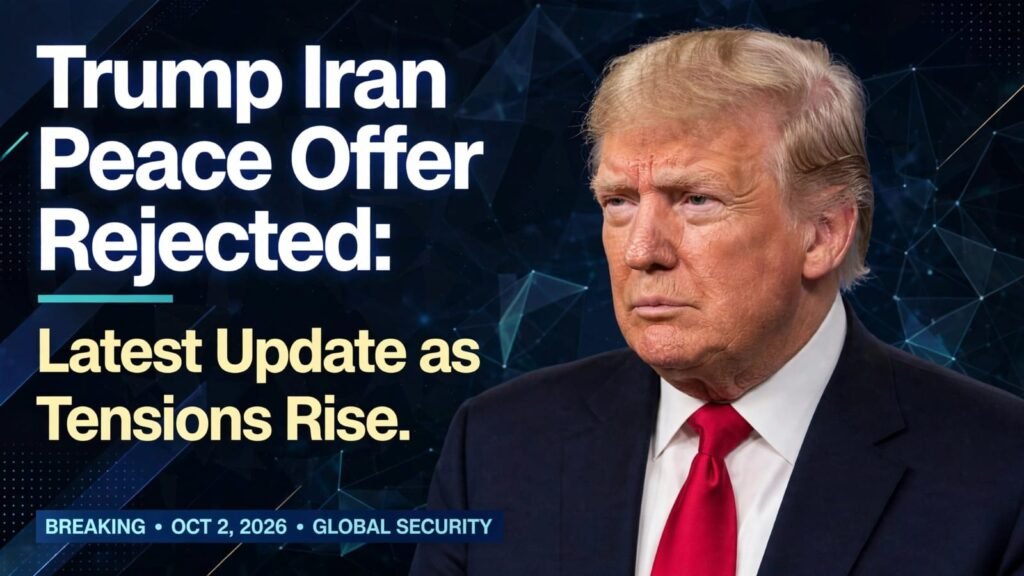
Trump Iran Peace Offer Rejected: Latest Update as Tensions Rise
The Trump Iran peace offer dispute has become a major new development in the ongoing conflict between the United States and Iran, after President Donald Trump said Iran’s latest proposal was not acceptable. Trump also said it was possible that the United States could resume or increase bombing of Iran after the November 3 midterm elections.
The latest Trump Iran peace offer development comes after weeks of diplomatic efforts involving regional mediators. Iran has proposed steps aimed at reopening the Strait of Hormuz and reducing restrictions, while the United States has continued to demand progress on nuclear issues and other security concerns.
What Happened With the Trump Iran Peace Offer?
The Trump Iran peace offer story developed after Tehran presented a proposal intended to help end the fighting and reopen the Strait of Hormuz.
According to reports, Iran’s proposal included reopening the strategically important waterway within a short period if the United States agreed to conditions including lifting its blockade of Iranian ports, releasing frozen Iranian assets and easing sanctions affecting Iranian oil sales.
Trump rejected the proposal and said Iran’s offer did not go far enough.
The latest development means that diplomatic efforts remain active, but there has not been a final agreement between Washington and Tehran.
Why Is the Strait of Hormuz Important?
The Trump Iran peace offer is closely connected to the Strait of Hormuz because the waterway is one of the world’s most important routes for energy shipments.
The strait connects the Persian Gulf with the Gulf of Oman and the wider Arabian Sea. Disruptions there can affect oil transportation and energy markets around the world.
Reuters reported that oil prices moved higher after Trump rejected Iran’s proposal, reflecting concerns about continued supply disruptions. Brent crude had settled at $105.28 per barrel in the September 27 report, while U.S. West Texas Intermediate crude settled at $92.60.
The situation therefore has implications beyond the United States and Iran, particularly for countries that depend on Middle Eastern energy supplies.
Iran’s Proposal and the Diplomatic Effort
The Trump Iran peace offer controversy follows indirect negotiations involving regional countries.
Mediators from countries including Qatar and Pakistan have been involved in efforts to keep diplomatic channels open. AP reported that discussions were aimed at finding a deal that could reopen the Strait of Hormuz and end the fighting.
Iranian Foreign Minister Abbas Araghchi has also been involved in diplomatic discussions surrounding the proposal.
Iran’s position has included demands related to sanctions, the blockade of its ports and access to frozen assets. The United States, meanwhile, has indicated that nuclear issues would need to be addressed as part of any wider agreement.
Trump Says the Offer Was Not Enough
The Trump Iran peace offer was publicly rejected by Trump, who said the proposal was insufficient.
In an interview reported on October 1, Trump also said it was possible that the United States could increase bombing of Iran after the November 3 midterm elections. His comments added uncertainty to the diplomatic process.
Trump has continued to say that he wants an agreement, but the conditions demanded by Washington and Tehran remain different.
This leaves diplomacy and military pressure operating at the same time.
Iran Receives a U.S. Response
Another important development came on September 30, when Iranian officials said Tehran had received an official U.S. response to its latest proposal.
Iranian Foreign Minister Abbas Araghchi reportedly presented the response to President Masoud Pezeshkian and the Iranian Cabinet. Iranian officials did not immediately disclose the full contents of the U.S. response.
The development showed that diplomatic communication between the two sides was continuing despite Trump’s public rejection of Iran’s conditions.
Qatar and Pakistan have also continued efforts to support negotiations.
U.S. Military Presence in the Middle East
The Trump Iran peace offer story is also unfolding alongside a significant U.S. military presence in the region.
AP reported on October 1 that the United States was sending roughly 9,000 troops aboard a group of ships toward the Middle East. A third U.S. aircraft carrier was also expected to be in the region, representing a substantial naval presence.
The military movements are taking place while diplomatic efforts continue.
The combination of negotiations, sanctions and military deployments has created uncertainty about the next stage of the conflict.
Iran Prepares for Possible Further Attacks
Iran has also indicated that it is preparing for a possible escalation.
Reuters reported on October 1 that Iranian commanders were preparing broader retaliation plans if the United States or its allies launched additional attacks. At the same time, Tehran was continuing diplomatic efforts despite describing the chances of success as limited.
The report said Iran had proposed a regional de-escalation plan through Qatari mediators.
This means both diplomatic and military preparations are continuing simultaneously.
New Sanctions Add More Pressure
The Trump Iran peace offer negotiations are also taking place while Washington continues economic pressure on Tehran.
The Trump administration announced additional sanctions targeting people and entities accused of supporting Iran’s military supply network. AP reported that the measures were part of the administration’s wider campaign to restrict financial and military support connected to Iran.
Sanctions remain one of the major issues surrounding U.S.-Iran negotiations.
Iran has argued for sanctions relief as part of a potential agreement, while the United States has continued to link relief to specific conditions.
What Could Happen Next?
The future of the Trump Iran peace offer remains uncertain.
Diplomatic channels have not completely closed, and regional mediators continue trying to bring the sides closer together. At the same time, Trump’s statements about potentially resuming bombing and the continued U.S. military presence indicate that the possibility of further military action remains part of the situation.
Any agreement would likely require both sides to resolve major disagreements over sanctions, nuclear issues, the Strait of Hormuz and security arrangements.
For now, there is no confirmed final peace agreement.
Why the Trump Iran News Matters Globally
The Trump Iran peace offer developments could affect more than the countries directly involved.
Any major disruption around the Strait of Hormuz could influence global oil supplies and energy prices. Higher energy costs can also affect transportation, manufacturing and household expenses in countries far from the Middle East.
Financial markets are therefore closely watching developments between Washington and Tehran.
Reuters reported that oil prices reacted to Trump’s rejection of Iran’s proposal, highlighting how diplomatic decisions can quickly influence energy markets.
Frequently Asked Questions
1. What is the Trump Iran peace offer?
The term refers to the latest diplomatic proposal from Iran aimed at helping end the conflict and reopening the Strait of Hormuz, along with conditions involving sanctions and Iranian assets.
2. Did Trump accept Iran’s latest peace proposal?
No. Trump said Iran’s latest proposal was not good enough and rejected its conditions.
3. What did Iran offer?
Iran proposed steps involving the reopening of the Strait of Hormuz and sought measures including changes to the U.S. blockade, sanctions and frozen Iranian assets.
4. Is the United States still negotiating with Iran?
Diplomatic communication and mediation efforts are continuing despite Trump’s rejection of the latest proposal. Qatar and Pakistan have been involved in efforts to facilitate discussions.
5. Why is the Strait of Hormuz important?
The Strait of Hormuz is a major international energy shipping route. Disruption there can affect oil supplies, shipping and global energy prices.
6. Could the United States launch more attacks?
Trump said it was possible that the United States could increase bombing of Iran after the November 3 midterm elections. This was a statement about a possible future action, not a confirmation that an attack will occur.
7. Is there a final peace agreement?
No final peace agreement has been confirmed. Negotiations and mediation efforts remain ongoing.
8. How could this affect oil prices?
Continued uncertainty around the Strait of Hormuz and regional fighting can put upward pressure on oil prices because of concerns about supply disruptions.
Final Update
The Trump Iran peace offer remains at the center of the latest U.S.-Iran diplomatic developments. Trump has rejected Iran’s latest proposal as insufficient, while mediators continue efforts to find a possible agreement. At the same time, military deployments, sanctions and statements from both sides indicate that tensions remain high.
For now, the situation remains fluid, with diplomacy continuing alongside preparations for possible further military action
Stay Updated
Don’t miss the latest headlines! Visit our website https://corefoxes.com/ now for breaking news, developing stories, and the latest global updates as they happen. Stay informed and check back regularly for the newest updates.