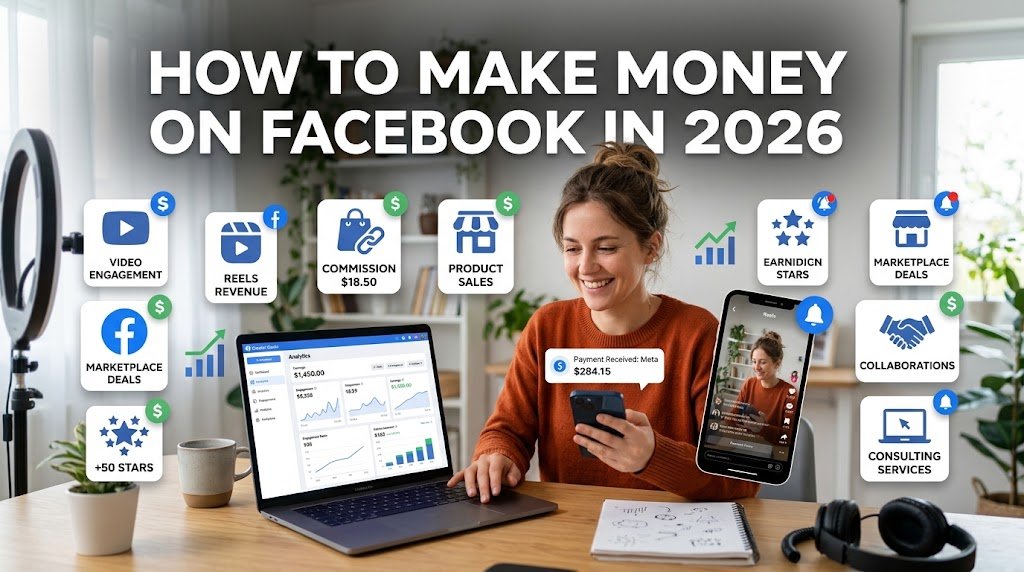
You can make money on Facebook in 2026 by creating original content, joining Facebook Content Monetization when eligible, earning through Stars, promoting products with affiliate links, selling products on Marketplace, working with brands, or using Facebook to promote your own services. You don’t need to use every method at once. The right option depends on whether you already have an audience, a product, a skill, or useful knowledge to share.
Facebook has also become more than a place for traditional video monetization. Meta says Facebook paid content creators nearly $3 billion in 2025, with 60% of those payouts going to Reels and the rest coming from Stories, photos, and text posts. That gives creators several ways to build an income from the platform.
1. Join Facebook Content Monetization
Facebook Content Monetization is one of the main ways eligible creators can earn directly from their content. The program can generate earnings from eligible Reels, longer videos, Stories, photos, and text posts.
In 2026, Meta says Content Monetization remains invite-only. Creators can express interest through the Professional Dashboard by opening the Monetization section and selecting Content Monetization.
Your earnings aren’t simply based on a fixed amount for every view. Facebook uses performance-related metrics, including Qualified Views and Earnings Rate, to help creators understand how their content is performing and generating revenue.
Because eligibility and monetization rules can change, check your Professional Dashboard regularly rather than relying on old followers or view requirements found on other websites.
2. Make Money With Facebook Reels
Facebook Reels are one of the most accessible ways to build an audience if you’re starting as a creator. You can make tutorials, product demonstrations, educational videos, reviews, recipes, commentary, entertainment clips, or other original content around a clear topic.
The important word here is original. Meta has said that content simply copied from another creator, or content changed only slightly, can be treated as unoriginal. This may affect its distribution and monetization eligibility.
If you already create short videos, you don’t have to limit that content to Facebook. The same basic idea can be adapted for other platforms. For example, creators interested in Instagram Income can repurpose suitable original content for Instagram while adjusting the presentation to fit that platform.
TikTok is another option for short-form creators. Learning about TikTok Income can help you understand how the same content skills may be used across another platform instead of relying entirely on Facebook.
3. Earn Money Through Facebook Stars
Facebook Stars allow eligible fans to support creators financially. Where the feature is available, viewers can send Stars during eligible creator content, giving creators another potential income source.
Stars can be especially useful for creators who have an active community. You don’t necessarily need millions of followers if the people who follow you regularly watch your content, join livestreams, comment, and support your work.
If Stars are available for your account, you can check the Professional Dashboard for eligibility and setup information.
4. Sell Products on Facebook Marketplace
You don’t need to become a content creator to make money on Facebook. Marketplace gives individuals and small businesses a way to sell physical products directly to potential buyers.
You could sell used furniture, electronics, clothing, collectibles, home items, handmade products, or other goods that have demand in your local market.
A simple way to start is by selling things you already own but no longer need. Once you understand how pricing, listings, photos, and buyer communication work, you can consider buying products specifically for resale.
Be careful with payment requests, fake buyer messages, and requests to move transactions outside trusted payment or communication channels.
5. Use Affiliate Marketing on Facebook
Affiliate marketing lets you earn a commission when someone purchases a product through your affiliate link. You don’t need to manufacture, store, or ship the product yourself.
A Facebook Page, Group, or creator profile can be used to share product comparisons, tutorials, reviews, or recommendations. For example, someone running a home cooking page could create useful content about kitchen equipment and recommend products that genuinely fit the audience.
The key is relevance. Don’t recommend products simply because they offer a commission. Explain what the product does, who it’s suitable for, and any limitations readers should know about.
You should also disclose affiliate relationships clearly and follow Facebook’s rules and the advertising requirements that apply in your country.
6. Work With Brands
Established Facebook creators can also earn through brand partnerships. A business may pay you to feature its product or service in a post, video, review, livestream, or other agreed content.
Follower count isn’t the only factor that matters. A smaller page with an audience interested in a specific subject may be useful to a brand because the audience is closely connected to its products.
For example, a gardening page may attract gardening-tool companies, while a cooking page may appeal to kitchenware brands.
If you publish sponsored content, make the commercial relationship clear and follow Facebook’s branded-content requirements.
7. Sell Your Own Products or Services
Facebook can also help you find customers for something you already know how to do or sell. This could include writing, graphic design, photography, tutoring, consulting, handmade products, templates, courses, or other services.
Facebook Groups can be useful when your service solves a specific problem. Instead of filling your posts with sales messages, share useful information that demonstrates your knowledge.
If you already understand Facebook content, scheduling, audience engagement, and page management, you can also consider Social Media Management as a service. Businesses may pay freelancers to create posts, schedule content, respond to comments, monitor performance, and manage their social media presence.
This can be a useful route for people who want to earn from Facebook-related skills without waiting for a creator account to qualify for direct monetization.
8. Build a Facebook Group Around a Specific Topic
A focused Facebook Group can become a source of income when it brings together people who share an interest, profession, or problem.
The group itself doesn’t automatically pay you. Instead, the community can support other income sources such as your products, services, affiliate recommendations, events, or relevant brand partnerships.
A specific topic usually gives people a clearer reason to join. For example, a group for beginner freelance writers has a more defined purpose than a general group about making money online.
Avoid turning the group into a constant stream of promotions. Useful discussions, practical resources, and active moderation give members a reason to keep participating.
9. Use Facebook to Send Traffic to Your Website or Store
Facebook can also make money indirectly by sending visitors to your website, online store, blog, newsletter, or service business.
For example, you could publish a useful Facebook post that answers a common question and direct interested readers to a detailed article on your website. Your website could then earn through advertising, affiliate marketing, product sales, or services.
You can also build income across several social platforms instead of depending on one source. If video is your main content format, for example, you can explore YouTube Income by turning your knowledge into longer tutorials, reviews, educational videos, or other useful content.
This approach gives you more than one place to build an audience and can reduce your dependence on changes to a single platform’s monetization rules.
What Do You Need to Start Making Money on Facebook?
You don’t need every monetization method at the beginning. Start with the option that matches what you already have: an audience, a product, a useful skill, or knowledge that people want.
If you’re starting from zero, choose one topic and one main content format. Reels can help you reach new people, while Groups and longer posts can help you build stronger relationships with an existing audience.
Before expecting income, make sure your account and content follow Facebook’s current policies. Meta has said that spammy behavior, fake engagement, copied content, and attempts to manipulate distribution can affect reach and monetization.
A focused audience is generally more useful than posting random content simply to collect views. Decide what you want people to know you for, then create content around that subject consistently.
How Much Money Can You Make on Facebook?
There isn’t one fixed Facebook earning rate. Income can depend on the monetization method, eligible views, audience location, content type, engagement, advertiser demand, product sales, affiliate commissions, and other factors.
For Facebook Content Monetization, Meta says earnings are connected to content performance and has introduced metrics such as Qualified Views and Earnings Rate to provide creators with more information about their results.
This means claims such as “$1 for every 1,000 views” shouldn’t be treated as a universal Facebook payment rate. Two creators can have similar view counts but receive different results.
If you’re selling products or services, your income may also have little connection to your Facebook view count. A post with 5,000 highly relevant views could potentially produce more business than a post with hundreds of thousands of unrelated views.
How to Start Making Money on Facebook in 2026
The easiest way to get started is to avoid trying every monetization method at the same time. Pick one audience, one topic, and one main income source, then build from there.
A practical starting plan is:
- Choose a specific topic you know well.
- Switch to Professional Mode if it fits your creator strategy.
- Publish original Reels, posts, or other useful content.
- Check the Professional Dashboard for monetization eligibility.
- Add another income source such as affiliate marketing or a service.
- Track views, engagement, clicks, qualified views, and actual revenue.
Meta’s current focus on original content also makes copied viral videos a poor long-term approach. The company has reported stronger performance for original Reels compared with earlier periods.
The goal isn’t simply to get views. You want to create content that attracts the right audience and gives you a realistic path toward income.
Common Mistakes That Can Stop Facebook Earnings
Many beginners focus only on follower numbers. But a large following doesn’t guarantee income, and copied or spammy content can create monetization problems even when it receives views.
Using unrelated captions, excessive hashtags, fake engagement, copied videos, or repetitive posts can work against your account. Meta has said that certain spam tactics can limit content distribution and affect monetization eligibility.
Another common mistake is relying on only one source of income. If all your earnings come from Facebook’s creator program, changes to eligibility, policies, or content performance could affect your revenue.
A stronger approach is to build an audience on Facebook while developing another income source, such as affiliate marketing, products, services, brand partnerships, or traffic to your own website.
FAQs About Making Money on Facebook
Can I make money on Facebook without followers?
Yes. You can sell products through Marketplace, offer services, use affiliate marketing, or build an audience through original content. Some direct creator monetization features, however, have specific eligibility requirements.
How many followers do you need to make money on Facebook?
There isn’t one follower requirement that applies to every Facebook earning method. Requirements vary depending on the monetization feature, account, location, content, and current Meta policies.
Does Facebook pay for Reels in 2026?
Eligible creators can earn from Reels through Facebook Content Monetization. However, there isn’t one universal payment amount for every view. Earnings depend on eligible content performance and other factors.
What is the easiest way to start making money on Facebook?
For someone without an existing business, creating original content around one specific topic is a practical starting point. As the audience grows, you can explore Content Monetization, Stars, affiliate marketing, brand partnerships, products, or services.