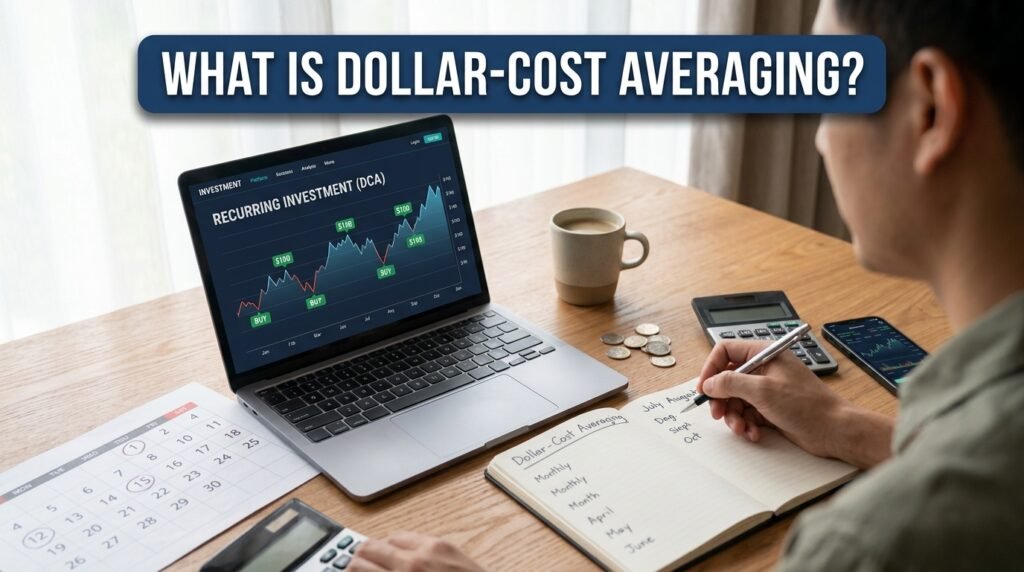
Investing can feel difficult when markets are constantly moving. Prices rise, fall, and sometimes change dramatically within a short period. This can make investors wonder whether they should invest now, wait for a better opportunity, or keep their money in cash until markets become more predictable.
Dollar-cost averaging is one strategy that can make investing more systematic. Instead of investing a large amount of money all at once, an investor puts a fixed amount into an investment at regular intervals.
This approach does not guarantee profits or eliminate investment risk. However, it can help investors maintain consistency and reduce the pressure of trying to predict the perfect time to enter the market.
What Is Dollar-Cost Averaging?
Dollar-cost averaging, often called DCA, is an investment strategy in which you invest a predetermined amount of money at regular intervals regardless of whether the market is rising or falling.
For example, suppose you decide to invest $300 every month in a diversified investment fund.
You invest $300 in January, another $300 in February, another $300 in March, and continue the process throughout the year.
When prices are high, your $300 buys fewer shares. When prices are lower, the same $300 buys more shares.
Over multiple purchases, this creates an average purchase price for your investments.
The key idea is consistency rather than trying to predict short-term market movements.
How Does Dollar-Cost Averaging Work?
Dollar-cost averaging works by maintaining a regular investment schedule.
Imagine an investor contributes $500 every month to the same investment.
If the investment’s price is $50 per share, the $500 contribution buys 10 shares.
If the price later falls to $25, the same $500 buys 20 shares.
If the price then rises to $40, the contribution buys 12.5 shares.
The investor is purchasing more shares when prices are lower and fewer shares when prices are higher.
This does not mean the investor automatically makes money. The investment can continue falling, and there is always the possibility of losing money.
The benefit is that the investor does not need to make a separate decision about whether the market is at its “perfect” entry point every month.
Why Do Investors Use Dollar-Cost Averaging?
One major reason investors use DCA is to create a consistent investing habit.
Market timing can be extremely difficult. An investor waiting for the “right” time may continue waiting because there is no way to know with certainty when a market has reached its lowest or highest point.
Dollar-cost averaging removes some of that decision-making.
Instead of asking, “Is this the best time to invest?” the investor follows a predetermined schedule.
This can make the investment process easier to maintain over long periods.
Dollar-Cost Averaging and Market Volatility
Market volatility can make investing emotionally difficult.
When prices rise quickly, investors may feel pressure to buy because they are afraid of missing out. When prices fall sharply, the same investors may become nervous and want to sell.
A regular investment strategy can help reduce some of these emotional reactions.
For example, an investor who contributes $250 every month continues investing during both rising and falling markets, assuming the strategy and investment remain appropriate for their goals.
The investor is not trying to predict every market movement.
This can be particularly useful for people who receive regular income and want to invest part of each paycheck.
A Simple Dollar-Cost Averaging Example
Consider an investor who invests $1,000 per month for four months.
Suppose the investment prices are:
- Month 1: $50
- Month 2: $40
- Month 3: $25
- Month 4: $40
The investor buys fewer shares during the first month because the price is higher.
When the price falls to $25, the same $1,000 contribution purchases significantly more shares.
When the price rises again, the investor buys fewer shares.
After four months, the investor owns shares purchased at different prices rather than making one large purchase at a single price.
The average purchase price depends on the total amount invested and the number of shares purchased.
The example is simplified, but it demonstrates the basic mechanics of DCA.
Does Dollar-Cost Averaging Guarantee Better Returns?
No.
Dollar-cost averaging does not guarantee better investment returns.
If an investment rises steadily over time, investing a large amount earlier could potentially produce better results than spreading the investment across many months because more money would have been exposed to the rising market for a longer period.
This is an important limitation of DCA.
The strategy is primarily about managing the timing of purchases and creating consistency. It should not be presented as a way to outperform the market automatically.
Investors should understand the difference between reducing timing decisions and reducing investment risk.
DCA can help with the first, but it does not eliminate the second.
Dollar-Cost Averaging vs. Investing a Lump Sum
There are two common approaches when someone has a large amount of money available to invest.
The first is lump-sum investing, where the money is invested at once.
The second is dollar-cost averaging, where the money is divided into multiple investments over time.
Suppose you have $12,000 available.
With lump-sum investing, you might invest the entire $12,000 immediately.
With DCA, you might invest $1,000 per month for 12 months.
If markets rise throughout the year, the lump-sum investor may benefit because more money was invested earlier.
If markets decline shortly after the initial investment, the DCA investor may benefit from having additional money available to invest at lower prices.
Neither outcome can be predicted with certainty.
The better approach depends on the investor’s financial circumstances, risk tolerance, time horizon, and ability to remain committed to the strategy.
Dollar-Cost Averaging for Beginners
DCA can be particularly easy to understand for beginners because it focuses on a simple routine.
An investor can choose:
- How much to invest
- How frequently to invest
- Which investment to purchase
- How long to continue
For example, someone could invest $200 every two weeks after receiving a paycheck.
Over time, these regular contributions can become part of the investor’s financial routine.
However, beginners should not assume that a regular contribution automatically makes an investment suitable.
The underlying investment still matters.
You should understand what you are buying, the level of risk involved, the fees charged, and whether the investment matches your financial goals.
The Role of Automation
Automation can make dollar-cost averaging easier to maintain.
Many investment platforms allow investors to schedule recurring contributions. Money can then be transferred from a bank account and invested according to the selected schedule.
Automation reduces the need to remember each investment date.
It can also help prevent emotional decisions from disrupting the strategy.
However, automated investing should still be reviewed periodically. Your income, expenses, investment goals, and risk tolerance can change.
A strategy that was appropriate several years ago may need to be adjusted as your circumstances change.
Dollar-Cost Averaging and Long-Term Investing

DCA generally works best as part of a long-term investment approach.
The strategy is not designed for predicting whether a stock will rise tomorrow or fall next week.
Instead, the focus is on making regular investments over an extended period.
Time can be an important factor in investing because returns can compound when gains remain invested.
Our guide on Start Investing Early: Why Time Beats Bigger Deposits explains how giving investments more time to compound can affect long-term wealth building.
The important lesson is that consistency and time can matter significantly, although investment returns are never guaranteed.
Dollar-Cost Averaging and Diversification
DCA controls how you invest money over time, but it does not automatically diversify your portfolio.
For example, investing $500 every month into one highly concentrated stock is still concentrated investing.
Diversification depends on what you own, not simply how frequently you buy it.
An investor using DCA might choose a diversified index fund, mutual fund, or exchange-traded fund depending on their goals and available investment options.
The underlying investment should be evaluated separately from the contribution strategy.
Can Dollar-Cost Averaging Reduce Risk?
DCA can reduce the risk of investing a large amount at an unfavorable short-term price, but it does not remove market risk.
If the overall investment declines significantly, the investor can still lose money.
For example, buying an investment gradually does not protect you if the investment continues falling for an extended period.
DCA should therefore be viewed as a method for managing investment timing and maintaining discipline, not as an insurance policy against losses.
Dollar-Cost Averaging for Retirement Investing
DCA can naturally fit into retirement investing because many workers receive income regularly and contribute to retirement accounts through payroll deductions.
For example, an employee may contribute a fixed percentage of each paycheck to a retirement plan.
Those contributions can purchase investments during different market conditions throughout the year.
Some retirement investors also use target-date funds as part of their long-term strategy. A target-date fund can automatically adjust its asset allocation as the investor approaches a selected retirement year.
Our guide on What Is a Target-Date Fund and How Does It Work? explains how these funds manage their investment mix over time.
DCA and target-date funds are not competing concepts. DCA describes how money is invested over time, while a target-date fund describes a type of investment designed around a future date.
Common Mistakes to Avoid
One mistake is assuming DCA guarantees profits.
Another is using DCA as an excuse to avoid investing indefinitely. If you continually wait for the “perfect” market condition, you may never establish a consistent investment strategy.
Investors should also avoid changing their contribution schedule every time the market moves.
If the strategy is based on regular contributions, constantly stopping and restarting because of market headlines can undermine the discipline that makes the approach useful.
Finally, do not ignore fees. Investment costs can reduce long-term returns, especially when money remains invested for many years.
When Might Dollar-Cost Averaging Make Sense?
DCA may make sense for investors who receive regular income and want to invest consistently.
It can also appeal to people who are uncomfortable investing a large amount of money at one time.
For example, someone receiving a paycheck every two weeks may prefer to invest a portion of each paycheck rather than trying to determine when to make a large investment.
The strategy can also help investors create a repeatable financial habit.
However, individual circumstances matter. Someone with a large cash balance may need to consider the trade-offs between investing immediately and spreading contributions over time.
Final Thoughts
Dollar-cost averaging is a simple investment strategy based on making regular investments regardless of short-term market conditions.
It can help investors develop consistency, reduce the pressure of market timing, and purchase more shares when prices are lower and fewer shares when prices are higher.
However, DCA does not guarantee profits or eliminate investment risk. In a steadily rising market, investing a lump sum earlier may produce better results because more money is invested sooner.
The most important point is to understand what DCA actually does. It is a disciplined approach to investing over time, not a guaranteed method for beating the market.
When combined with appropriate investments, diversification, reasonable costs, and a long-term financial plan, regular investing can become a practical part of building wealth.
For investors planning their long-term goals, understanding how much money they may need for financial independence is also useful. Our guide on How Much Money Do You Actually Need to Retire? explains how spending, withdrawal rates, and retirement goals can influence the amount you may need to invest over time.
This article is for educational purposes only and does not constitute personalized financial, investment, or tax advice. Investment returns are not guaranteed, and you can lose money by investing.