When investors compare mutual funds, they often look at returns, fees, investment strategy, and risk. However, another important number can provide insight into how actively a fund manages its portfolio: the mutual fund turnover ratio.
The turnover ratio shows how frequently a mutual fund buys and sells investments within its portfolio during a specific period, usually one year. A higher turnover ratio generally means the fund manager is trading investments more frequently, while a lower ratio suggests a more stable, buy-and-hold approach.
Understanding the mutual fund turnover ratio can help investors evaluate trading activity, potential costs, taxes, and whether a fund’s investment strategy matches their long-term goals.
What Is a Mutual Fund Turnover Ratio?
A mutual fund turnover ratio measures how much of a fund’s portfolio is replaced during a year.
For example, suppose a mutual fund has a turnover ratio of 20%. This generally means the fund replaced an amount of investments equivalent to about 20% of its portfolio during the year.
A fund with a 100% turnover ratio has experienced much more portfolio activity. This does not necessarily mean the entire portfolio was sold and replaced, but it indicates a significantly higher level of buying and selling.
The turnover ratio is usually provided in a mutual fund’s annual report, prospectus, or other fund documents.
How Is Mutual Fund Turnover Ratio Calculated?
The exact calculation can vary depending on the reporting methodology, but a commonly used approach compares the value of securities bought or sold with the fund’s average assets.
A simplified example can make the concept easier to understand.
Imagine a mutual fund has average assets of $100 million during the year. If the fund’s portfolio turnover calculation results in $40 million of annual turnover, its turnover ratio would be approximately 40%.
This does not tell investors whether the fund performed well or badly. Instead, it provides information about how actively the portfolio was managed.
A turnover ratio should therefore be considered alongside other factors rather than used as a standalone measure.
What Does a High Turnover Ratio Mean?
A high turnover ratio means the fund is buying and selling investments relatively frequently.
This may happen because the fund follows an active investment strategy. A manager may sell companies that no longer fit the strategy, take profits from certain holdings, respond to changing economic conditions, or identify new investment opportunities.
For example, an actively managed equity fund may have a higher turnover ratio than a passive fund that attempts to track a broad market index.
High turnover is not automatically bad. An active manager may generate strong returns despite frequent trading. However, investors should understand that higher trading activity can create additional costs and tax consequences.
What Does a Low Turnover Ratio Mean?
A low turnover ratio generally indicates that the fund holds investments for longer periods.
This approach is common among funds that follow a long-term investment strategy. Instead of frequently reacting to short-term market movements, the manager may focus on companies or securities that are expected to perform well over many years.
Lower turnover can also be associated with lower trading activity.
For investors building a long-term portfolio, time can be an important advantage. Investors interested in this concept can learn more about starting to invest early and how compounding can affect long-term investment growth.
How Does Turnover Affect Fund Costs?
One of the biggest reasons turnover matters is trading costs.
When a mutual fund buys and sells securities, transactions can involve brokerage costs, bid-ask spreads, market impact, and other expenses. These costs can reduce the fund’s overall return.
Consider two funds that generate similar gross investment performance. If one fund trades much more frequently, its trading-related costs could be higher.
Not all trading costs are necessarily shown as a simple expense in the fund’s expense ratio. This is why investors should not assume that comparing expense ratios alone tells the complete story.
Turnover provides another piece of information about how the fund operates.
How Can Turnover Affect Taxes?
Turnover can also matter for investors who hold mutual funds in taxable investment accounts.
When a fund sells investments for a gain, it may distribute capital gains to shareholders. Investors may then have tax consequences even if they did not personally sell any shares of the mutual fund.
A fund with significant portfolio turnover may have more opportunities to realize capital gains, although the actual tax impact depends on many factors.
For example, the fund may sell securities at losses that offset some gains, or it may hold investments long enough to receive different tax treatment.
Because tax rules vary by country and individual circumstances, investors should review the fund’s distribution history and consider their own tax situation.
High Turnover Does Not Always Mean Higher Returns
One common mistake is assuming that a fund with more trading activity must be better managed.
That is not necessarily true.
A fund manager can make many trades and still underperform the market. Another manager can make relatively few trades and produce strong long-term results.
Turnover measures portfolio activity, not investment skill.
Investors should therefore examine turnover together with historical performance, investment strategy, risk, fees, portfolio holdings, and the fund manager’s approach.
Past performance also does not guarantee future results.
Mutual Fund Turnover vs. Passive Investing
Turnover can be especially useful when comparing actively managed mutual funds with more passive investment options.
A passive fund generally attempts to follow an index or predefined investment strategy. Because it does not need to constantly identify new investments, its turnover may be relatively low.
An actively managed fund has greater flexibility to change its holdings. Its turnover can therefore be substantially higher.
However, investors should not assume that low turnover automatically makes a fund better. The right choice depends on the investor’s goals, risk tolerance, time horizon, costs, and preferred investment approach.
Investors should also understand how different types of professionally managed funds work. For example, a target-date fund automatically adjusts its investment mix as the target date approaches, although its strategy and risk level can differ from other mutual funds.
What Is a Good Mutual Fund Turnover Ratio?
There is no single turnover ratio that is considered good for every mutual fund.
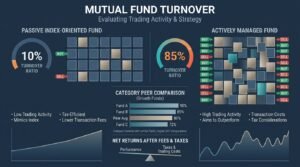
A 10% turnover ratio might be normal for one investment strategy but unusual for another. An actively managed fund may naturally have higher turnover than a passive index-oriented fund.
Instead of asking whether the number is simply high or low, investors should ask whether the turnover makes sense for the fund’s strategy.
Compare the fund’s turnover with similar funds in the same category. Also examine whether higher trading activity appears to contribute to better results after fees and taxes.
The goal is not necessarily to find the fund with the lowest turnover. The goal is to understand whether the fund’s trading activity is reasonable for its investment strategy.
What Should Investors Check Besides Turnover?
Turnover is only one part of mutual fund analysis.
Investors should also review:
- Expense ratio
- Historical performance
- Investment strategy
- Portfolio holdings
- Risk level
- Fund manager experience
- Asset allocation
- Minimum investment requirements
- Capital gains distributions
- Fund size and liquidity
Diversification is also important. Investors should understand what assets they already own before adding another fund to their portfolio.
For example, someone already holding several stock funds may want to understand whether another mutual fund meaningfully improves diversification or simply creates additional overlap.
Investors may also consider other assets as part of a broader portfolio. For example, gold investment in Pakistan can provide exposure to a different type of asset, although gold also carries its own risks, price fluctuations, and costs.
Should Long-Term Investors Care About Turnover?
Yes, especially when comparing similar mutual funds.
A turnover ratio can help investors understand how actively a fund is managed and whether its strategy involves frequent trading.
For a long-term investor, lower turnover may sometimes be beneficial because it can reduce unnecessary trading activity and potentially limit certain tax and transaction costs.
However, turnover should never be viewed in isolation.
A higher-turnover fund could still be appropriate if its investment strategy, risk level, costs, and long-term results fit the investor’s objectives.
The important point is to understand what you are paying for and how the fund’s management approach affects your investment.
Final Thoughts
The mutual fund turnover ratio is a useful measure of how frequently a fund changes its portfolio. A high ratio generally indicates more buying and selling, while a low ratio usually indicates a longer-term, less active approach.
Higher turnover can increase trading activity and may create additional tax considerations, particularly in taxable accounts. Lower turnover may support a more stable investment approach, but it does not automatically mean better performance.
Before investing, compare turnover with the fund’s expense ratio, strategy, risk, holdings, performance, and tax implications.
Most importantly, choose a mutual fund based on how well it fits your overall financial goals rather than focusing on one number. A turnover ratio can provide valuable information, but it is only one part of making an informed investment decision.