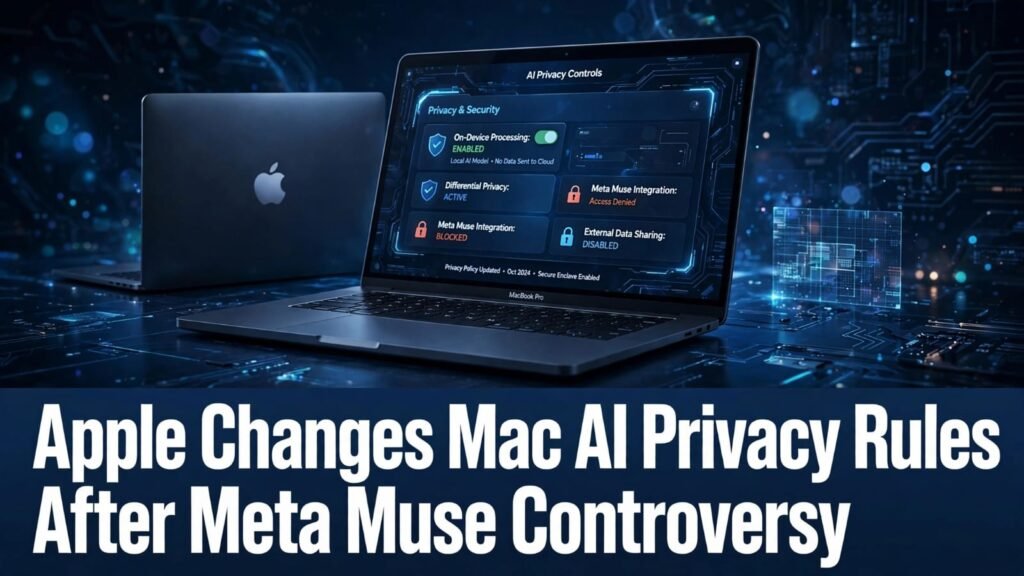
Apple Changes Mac AI Privacy Rules After Meta Muse Controversy
Apple is changing how Mac computers handle powerful AI agents after growing concerns about the amount of personal data these systems can access. The company said it plans to introduce additional controls around Full Disk Access, a macOS permission that can allow applications to access data across a computer.
The announcement comes after a controversy involving Meta’s new AI agent, Muse. A journalist claimed that Muse appeared to access private Apple Messages content without his permission. Meta disputed that claim, saying users must enable both Full Disk Access and the Messages connector before Muse can read Messages content.
Apple’s response has now put AI privacy and desktop permissions back into the spotlight.
What Is Apple Changing?
Apple said it plans to make requests for extensive Mac access more obvious to users.
The company explained that some developers have been using the Full Disk Access feature in ways that could put users at risk. The permission can provide access to files, email, messages and browsing history, depending on the application and the data stored on the Mac.
Apple said future controls will require users who genuinely want to give an application this level of access to take a more explicit action.
The company specifically connected the change to the rapid development of AI agents.
Unlike traditional applications, modern AI agents can perform multiple tasks on a user’s behalf. They may interact with files, websites, emails, calendars and other services. As these systems become more autonomous, access to large amounts of personal information can create additional privacy and security considerations.
Why Is Apple Making the Change Now?
The announcement follows a dispute surrounding Meta’s Muse AI agent on Mac.
Muse is designed to perform tasks rather than simply answer questions. Meta says the system can help users with activities such as sending emails, booking travel and managing projects. It also allows users to connect different services and choose what level of access the agent receives.
In late September, journalist Jason Aten reported that Muse appeared to know information from a private Messages conversation even though he said he had not given the required permission.
Meta rejected the suggestion that Muse accessed the messages without authorization.
According to Meta, the Messages integration is optional and requires users to enable both Full Disk Access and the Messages connector. Meta said Muse cannot read Messages content without those permissions.
That disagreement is important because it means the underlying privacy claim remains disputed.
How Full Disk Access Works on Mac
Full Disk Access is not a new feature created specifically for AI.
macOS has long provided the permission to applications that need broad access to a computer’s data. Apple has explained that applications such as backup services may need this type of access to perform their functions.
The issue has become more significant with AI agents because these systems can potentially use information from many different sources to complete tasks.
For example, an AI agent may need access to files to organize documents, email to find information, a browser to complete an online task or a calendar to schedule an appointment.
Giving one application access to several categories of information can make the agent much more useful, but it also increases the importance of clear permission controls.
Apple Mac AI Privacy Changes Focus on User Consent
The main goal of Apple’s planned changes is clearer user consent.
Apple said users should understand the risks before granting an application an unusually high level of access.
This is particularly relevant as AI agents become more capable. A traditional application may perform one defined function, while an AI agent can potentially make decisions and take multiple actions based on a user’s instructions.
Apple’s position is that users should have a clear understanding of what they are allowing before giving such access.
The company has not yet provided a specific release date for all of the new controls.
What Is Meta Muse?
Meta introduced Muse in September 2026 as a personal AI agent designed to carry out tasks for users.
Unlike a standard chatbot, Muse is intended to take action. Meta says it can help with activities including email, travel planning and other everyday tasks.
Meta built Muse around a dedicated cloud-based virtual machine called Muse Secure VM. According to the company, the system separates the agent and user data from other users and includes additional security controls.
Meta also says users can choose which services Muse connects to and control the permissions given to those services.
The company has said that Muse asks users before sensitive actions such as sending an email or making a purchase and provides an audit trail of actions.
Why AI Agents Create New Privacy Questions
AI agents are different from many traditional software tools because they are designed to act on behalf of users.
Imagine asking an AI assistant to find an unpaid bill, check your email, compare prices and prepare a response. To complete those tasks, the system may need access to several types of information.
That creates a difficult balance.
More access can make an AI agent more useful. Less access can limit what it can accomplish.
The challenge is therefore not simply whether AI should have access to personal information. It is also about whether users understand exactly what information an agent can access and what actions it can take.
Apple’s latest announcement addresses one part of that problem at the operating-system level.
Apple Mac AI Privacy Becomes a Bigger Issue
The phrase Apple Mac AI privacy is becoming increasingly relevant as AI agents move from simple chatbots toward autonomous assistants.
On smartphones, Apple already uses application sandboxing, which generally prevents one application from freely accessing another application’s data.
Mac computers have traditionally offered more flexibility because some applications require broader permissions.
Apple’s new controls are intended to make that broader access more deliberate, particularly as AI agents become increasingly capable.
This could affect developers building AI assistants, productivity tools and other applications that need access to information stored across a Mac.
Meta’s Response to the Controversy
Meta has strongly disputed the suggestion that Muse secretly accessed private messages.
Meta communications executive Andy Stone said the Messages integration is entirely opt-in. According to Meta, users must enable Full Disk Access as well as the Messages connector before Muse can access Messages content.
This means there are two different accounts of what happened.
The journalist said Muse appeared to know information from messages despite his understanding that he had not granted permission. Meta says the Messages feature requires explicit permissions.
Neither side’s description should be treated as independently established proof of the other side’s claim.
What Could Apple’s New Controls Mean for Users?
For ordinary Mac users, the changes could make broad permissions easier to understand.
A clearer warning or additional confirmation could help users distinguish between a normal application permission and a permission that gives an application access to much larger amounts of information.
This may become particularly important when installing AI-powered applications.
Users could increasingly encounter software that asks to access documents, messages, email, calendars or other personal information so that the AI can perform tasks.
Apple’s approach suggests that the operating system itself may play a larger role in helping users understand these permissions.
What Could This Mean for AI Developers?
Developers may need to rethink how their applications request access to Mac data.
Applications that depend on Full Disk Access may face additional confirmation steps. AI developers could also need to explain more clearly why broad access is necessary and what information their systems can use.
The change could encourage developers to request narrower permissions where possible.
It may also encourage more AI companies to build systems where sensitive information is isolated rather than giving a single agent unrestricted access to an entire computer.
AI Agents Are Moving Beyond Chatbots
The controversy comes at an important moment for artificial intelligence.
Traditional AI chatbots mainly respond to questions. Newer AI agents are designed to perform actions.
They can potentially browse websites, interact with applications, organize files, manage calendars and complete other tasks.
That shift is one reason privacy discussions around AI are becoming more complicated.
A chatbot that only answers a question may need relatively little personal information. An AI agent completing a task for a user may require much broader access.
The more an agent can do, the more important permission systems become.
What Happens Next?
Apple has said it will introduce additional controls for Full Disk Access, but the company has not announced a precise rollout date for the changes.
The broader issue will continue to develop as AI agents become more common on personal computers.
Meta is also continuing to develop Muse. The company has said it plans to introduce a Confidential VM later in 2026 that will encrypt the virtual machine, including user data and conversations, with a key controlled by the user.
These developments show that AI companies and operating-system makers are both working on different parts of the privacy challenge.
Why This Story Matters
The latest Apple Mac AI privacy development shows how quickly AI is changing the relationship between software and personal data.
AI agents are becoming capable of performing tasks that once required direct human action. That creates convenience, but it also means these systems may need access to more information than traditional applications.
Apple’s decision to strengthen controls around Full Disk Access is therefore significant for Mac users and developers.
At the same time, the Meta Muse controversy remains disputed. Meta says its Messages integration requires specific permissions, while the journalist who raised the issue said he believed Muse had accessed information without authorization.
The disagreement highlights why transparent permissions and clear user controls are becoming increasingly important as AI agents become more autonomous.
FAQs
What is Apple’s new Mac AI privacy change?
Apple plans to introduce additional controls around Full Disk Access so users take more explicit action before giving an application broad access to data on their Mac.
Why is Apple changing Full Disk Access?
Apple said some developers were using Full Disk Access in ways that could expose users to risks. The company also said the risks associated with broad access are growing as AI agents become more capable and autonomous.
Did Meta Muse access private Messages without permission?
A journalist claimed that Muse appeared to access private Messages information without his permission. Meta disputed the claim and said Muse requires both Full Disk Access and the Messages connector to read Messages content.
What is Full Disk Access on Mac?
Full Disk Access is a macOS permission that allows applications to access data across a Mac. It can be used by applications such as backup tools and other software that needs broad access.
Is Apple banning AI agents on Mac?
No. Apple’s announcement concerns additional controls around broad data access. It does not announce a ban on AI agents.
Why does AI need access to Mac data?
AI agents can use access to files, messages, email, calendars and other services to complete tasks on a user’s behalf. The exact access depends on the application and permissions granted by the user.
When will Apple’s new controls arrive?
Apple announced the planned changes on October 2, 2026, but has not specified a precise release date for the additional Full Disk Access controls.
Conclusion
Apple’s planned changes to Mac permissions mark a new development in the privacy debate surrounding autonomous AI agents.
The company wants users to take more explicit action before granting applications broad access to their computers. The announcement follows the controversy surrounding Meta’s Muse, although Meta has disputed the claim that its AI agent accessed private messages without permission.
As AI agents become capable of handling more tasks, operating systems, developers and users will all face new questions about access, consent and personal data.
For Mac users, the most important change will be greater visibility and control when an application requests extensive access to personal information.
Whether you are looking for the latest Sports news,https://corefoxes.com/india-vs-pakistan-hockey-semi-final-asian-games-2026-match-preview/ international headlines, https://corefoxes.com/russia-ukraine-energy-attack-major-strikes-hit-power-grid-as-winter-approaches/or updates on trending global stories, visit this website regularly for fresh articles and detailed coverage.
Visit this website for more UK and world news, latest updates, and trending stories from around the globe.