
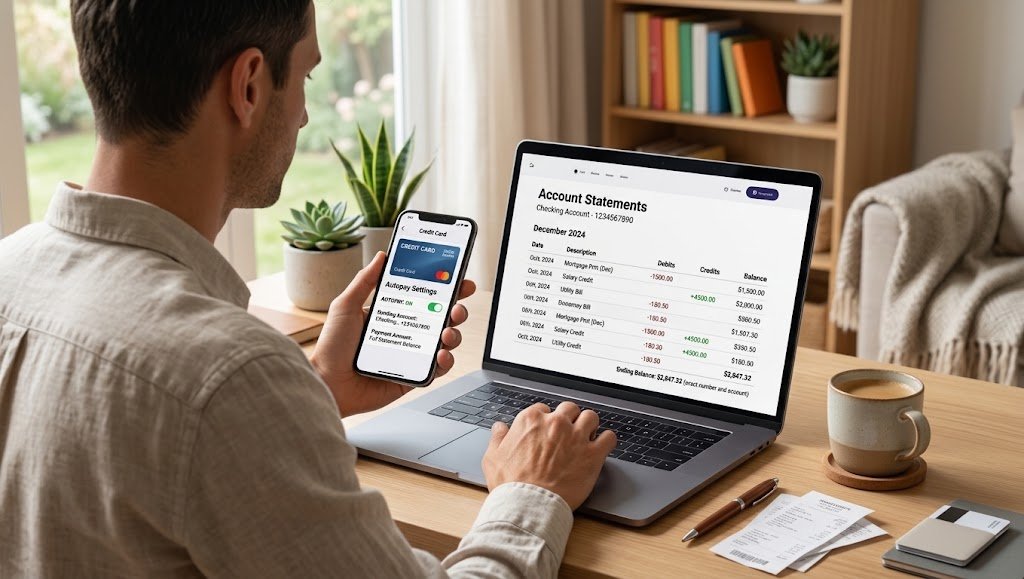
Credit card autopay is one of the most recommended financial habits out there — set it and forget it, never miss a due date again. For most people, it genuinely delivers on that promise. But there’s a lesser-known downside: depending on how it’s configured, autopay can quietly work against the very credit score it’s supposed to protect.
This isn’t an argument against using autopay. It’s a look at the specific ways the “convenient” version of it can go wrong, and how to set it up so it actually does what it’s meant to do.
What Credit Card Autopay Actually Does
At its core, credit card autopay authorizes your bank to automatically send a payment to your card issuer on or around the due date, pulling from a linked checking account. Most issuers offer three common settings: pay the minimum due, pay the statement balance, or pay the full current balance.
The appeal is obvious. According to the Consumer Financial Protection Bureau, automatic payments are one of the most effective tools for avoiding the single biggest driver of credit score damage: a late or missed payment. Payment history alone accounts for roughly 35% of a FICO score, based on FICO’s own breakdown of how scores are calculated.
Where Credit Card Autopay Can Backfire
The problem isn’t autopay itself — it’s the gap between what people assume autopay is doing and what it’s actually configured to do.
Autopay set to “minimum due” can quietly grow your balance. If it’s set to pay only the minimum, credit card autopay technically prevents a late payment, but it does nothing to stop interest from compounding or utilization from creeping upward. Many people set this up once, assume the card is “handled,” and stop checking the balance altogether.
A declined autopay payment still counts as missed. If the linked checking account doesn’t have enough funds on the day autopay runs, the payment fails — and unlike a manual payment you’d notice failing, autopay failures can go unnoticed for weeks. The card issuer still reports it as a missed payment to the bureaus.
Autopay can mask rising utilization. Because the bill gets handled automatically, it’s easy to stop looking at the statement closely. Someone can be running utilization up toward 60% or 70% of their limit — which Experian notes is one of the fastest ways to drag a score down — without ever noticing, because the “danger signal” of a scary bill never actually reaches them.
Multiple autopay accounts increase the odds of a silent failure. The more cards and bills running on autopay, the more likely it is that one linked account runs dry at the wrong moment, especially around irregular expenses.
How to Set Up Credit Card Autopay the Right Way
Getting the benefit of autopay without the hidden risk comes down to a few adjustments most people never make.
- Set it to pay the full statement balance, not the minimum. This is the single biggest fix — it protects your score from late payments while also avoiding interest and utilization creep.
- Keep a buffer in the linked checking account. Credit card autopay only works if the funds are actually there on the day it runs.
- Still check the statement monthly, even with autopay running, so unexpected charges or errors don’t go unnoticed for a full billing cycle.
- Turn on separate low-balance and payment-confirmation alerts from your bank, so a failed autopay attempt doesn’t sit invisible for weeks.
- Review autopay settings after any account change — a new checking account, a closed account, or a change in due date can all silently break the automation.
This kind of periodic check-in fits naturally alongside broader efforts at automating your finances — automation is meant to remove willpower from the equation, not remove attention entirely.
Why This Pattern Is Easy to Miss
Autopay problems tend to hide well because they don’t feel like mistakes in the moment. Nothing dramatic happens — no red flag, no bounced check notice most people would catch immediately. The bill “gets paid,” just not in the way that actually protects the score.
This is part of a broader pattern where financial habits marketed as “responsible” or “safe” — like credit card autopay — get set up once and never revisited, even as circumstances change. For some people, this passive relationship with money traces back to deeper money scripts around avoidance — a preference for not looking too closely at the numbers, even when the system in place is quietly working against them.
Final Thoughts
Credit card autopay is still, on balance, a good habit — it eliminates the single most damaging mistake most people make with credit: the late payment. But “set it and forget it” only works if it’s set up correctly in the first place, and revisited occasionally rather than truly forgotten.
The fix isn’t turning autopay off. It’s pairing it with the full-balance setting, a funded account, and a few minutes of attention each month — enough to make sure the convenience isn’t quietly costing you.