Germany Scholarships for International Students: A Complete 2026 Guide
Germany’s public universities already charge zero tuition, which changes what a scholarship there is actually for. Instead of funding a degree that would otherwise be unaffordable, most German scholarships exist to cover living costs, rent, food, and health insurance, so a student can focus fully on their studies rather than working multiple part-time jobs to survive. In this blog, we will walk through the major funding sources available to international students, what each one actually pays, and which ones see far less competition than most applicants assume.
Why Scholarships in Germany Work Differently
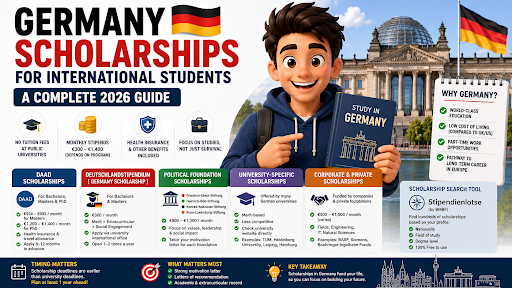
In countries like the UK or the US, a scholarship is often the difference between affording a degree and not. In Germany, the degree itself is largely free at public universities, so scholarship funding shifts toward something closer to a living stipend. Most programs pay somewhere between €300 and roughly €1,400 a month, depending on the source and study level. Combined with even modest part-time work, that’s generally enough to live comfortably without financial strain, which is the real goal behind most of these programs rather than covering tuition that barely exists in the first place.
DAAD: Germany’s Largest Scholarship Provider
The German Academic Exchange Service, known as DAAD, is by far the largest and most well-known scholarship provider for international students in Germany, covering bachelor’s, master’s, and PhD applicants from virtually every country.
Current DAAD stipends generally run around €934 to €992 a month for master’s students and between €1,200 and €1,400 a month for PhD candidates, alongside health insurance coverage and travel allowances. Tuition itself typically isn’t a factor to cover, since most DAAD-eligible programs are already at public universities.
The DAAD’s own scholarship database lets applicants filter by nationality, study level, and field, which narrows an overwhelming list down to a manageable shortlist fairly quickly. One consistent mistake applicants make is submitting the same generic motivation letter across every program. DAAD selection panels are looking for specificity: why Germany, what impact the applicant intends to create, and how the proposed study connects to a clear goal, not a broad statement that could apply to any country. Most DAAD programs open applications 8 to 12 months before the intended start date, so late planning is the single biggest reason strong candidates miss out.
Deutschlandstipendium: The Underrated Option
The Deutschlandstipendium, or Germany Scholarship, pays a flat €300 a month, funded half by the federal government and half by private sponsors. It’s a smaller amount than DAAD funding, but it’s stable, and unlike DAAD, it isn’t purely grade-driven.
Selection also weighs community involvement, volunteering, leadership experience, and personal motivation alongside academics. Applicants who’ve done meaningful work outside the classroom, whether that’s organizing something, mentoring others, or leading a project, tend to be well positioned for this one specifically.
The application process differs from DAAD in one important way: it’s submitted directly through the target university’s international office, not through a centralized platform. Many universities open Deutschlandstipendium applications only once or twice a year, so checking a specific university’s page directly is necessary rather than assuming a fixed national calendar.
Political Foundation Scholarships
Germany’s political and cultural foundations run some of the more generous scholarship programs available, typically in the €900 to €1,300 monthly range, and they tend to weigh personal values and mission alignment more heavily than raw GPA. The major ones include:
Friedrich-Ebert-Stiftung, focused on social justice and democratic engagement; Heinrich-Böll-Stiftung, strong for sustainability and human rights advocacy; Konrad-Adenauer-Stiftung, oriented toward leadership in politics, economics, and social initiatives; Rosa-Luxemburg-Stiftung, focused on equality, feminism, and progressive social causes
The single most important rule with these foundations: never send the same motivation letter to more than one. Each foundation has a distinct identity and mission, and the letter needs to demonstrate genuine alignment with that specific mission rather than simply expressing financial need. Choosing one or two foundations that authentically match personal values and writing a genuinely tailored letter outperforms a scattershot approach across all of them.
University-Specific and Corporate Scholarships
Two funding sources get overlooked constantly, largely because they’re buried inside individual institution pages rather than aggregated anywhere.
Many universities run their own merit-based scholarships for non-German students, often with far less competition simply because most applicants never look past the major national programs. The Technical University of Munich runs scholarships specifically for international applicants, and universities in Heidelberg, Hamburg, and Leipzig maintain similar smaller-scale programs worth checking directly through each institution’s international office.
Corporate scholarships are the second overlooked source. Major German engineering and industrial firms, including companies like BASF and Siemens, fund students in engineering, IT, and STEM fields as a direct talent pipeline, and some of these lead straight into internships or graduate job offers. Smaller foundations exist too; the Boehringer Ingelheim Fonds, for instance, funds natural sciences students in the roughly €500 to €1,500 monthly range. Most corporate scholarship listings are published in German, so searching with German-language terms rather than English ones surfaces considerably more results.
Stipendienlotse: Germany’s Scholarship Search Engine
The Stipendienlotse, run by Germany’s Federal Ministry of Education and Research (BMBF), is a scholarship database most applicants never discover. Entering nationality, field of study, and degree level filters an enormous list, several hundred programs total, down to genuinely eligible options, including smaller programs that rarely surface in a general web search. It’s free to use and worth bookmarking early in the search process rather than relying purely on DAAD or Deutschlandstipendium.
Getting the Timing Right
Scholarship deadlines consistently land earlier than university application deadlines, and that gap catches a lot of applicants off guard. For anyone targeting a winter semester intake, some scholarship windows for that cycle may already be closing by the time university applications are even finalized. Starting the scholarship search a full year ahead, rather than treating it as a parallel step to university applications, is the realistic approach.
It’s also worth remembering that funding doesn’t disappear after a first unsuccessful attempt. Scholarships remain open to students already studying in Germany, not just incoming applicants, so a missed cycle isn’t the end of the option; it’s a reason to reapply the following year with a stronger, more specific application.