
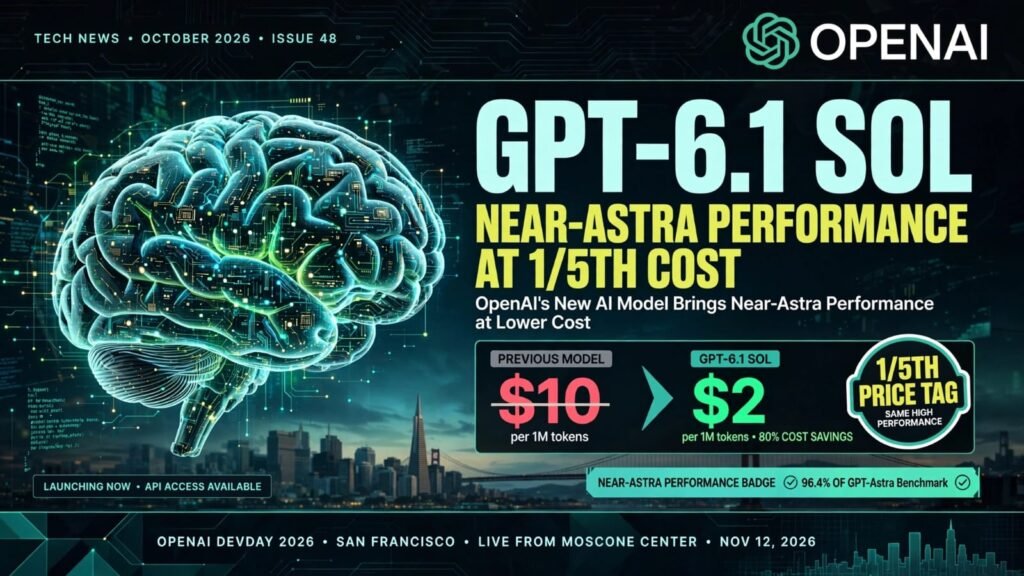
GPT-6.1 Sol: OpenAI’s New AI Model Brings Near-Astra Performance at Lower Cost
OpenAI has introduced GPT-6.1 Sol, a new artificial intelligence model designed to deliver strong performance on coding, computer use, and professional tasks while costing significantly less than GPT-6 Astra. The GPT-6.1 Sol launch was announced on September 29, 2026, during OpenAI’s latest developer event.
The new model arrives only about a week after GPT-6 Sol, making the rapid update one of the latest developments in the competitive AI industry. OpenAI says GPT-6.1 Sol offers performance close to GPT-6 Astra for several demanding workloads while using a much lower price point.
What Is GPT-6.1 Sol?
GPT-6.1 Sol is an upgraded model in OpenAI’s GPT-6 family. It is aimed particularly at users and developers who need capable AI for complex coding, computer-use tasks, document work, and professional workflows.
According to OpenAI, the model provides near-Astra performance at a lower cost. Its official API documentation lists GPT-6.1 Sol for complex coding, computer use, and professional work, with a context window of more than one million tokens.
The model supports several advanced capabilities, including web search, file search, image generation, code interpretation, computer use, hosted shell, and other tools through supported API workflows.
Why Is GPT-6.1 Sol Getting Attention?
One of the biggest reasons GPT-6.1 Sol is attracting attention is its price-performance balance.
OpenAI says GPT-6.1 Sol can approach GPT-6 Astra on several demanding evaluations while costing around one-fifth of Astra’s standard input and output token prices. This could make advanced AI more practical for developers who need to run large numbers of tasks.
For companies building AI-powered applications, lower model costs can be important because an application may generate thousands or even millions of AI interactions. A model that offers strong performance at a lower price can therefore reduce the cost of running those services.
GPT-6.1 Sol for Coding
Coding is one of the main areas where GPT-6.1 Sol is being positioned.
OpenAI says the model is designed for agentic coding, meaning it can work through multi-step programming tasks rather than simply answering a single coding question. It can help developers debug problems, work through complex codebases, and complete longer workflows.
GPT-6.1 Sol is also being made available through GitHub Copilot, where it can be used for agentic coding and terminal workflows. GitHub says the model is rolling out to eligible Copilot users across several supported products.
GPT-6.1 Sol and Computer Use
Another major focus is computer use.
The GPT-6.1 Sol model can be used for workflows that require AI to interact with computer environments and complete multiple steps. This is important because the AI industry is increasingly moving from simple chatbots toward systems that can perform tasks using software and digital tools.
OpenAI’s documentation lists computer use among the supported capabilities of GPT-6.1 Sol through its Responses API.
This could make the model useful for tasks such as navigating digital interfaces, handling information across applications, and supporting professional workflows.
Where Can GPT-6.1 Sol Be Used?
GPT-6.1 Sol is being rolled out across several developer and professional platforms.
OpenAI says the model is available through its API, while other reports and official platform announcements confirm availability in supported ChatGPT Work and Codex environments.
Amazon Web Services also announced general availability of GPT-6.1 Sol on Amazon Bedrock on September 29, allowing developers to use the model through AWS infrastructure.
GitHub has also announced GPT-6.1 Sol availability in GitHub Copilot, including coding agents and terminal-based workflows.
GPT-6.1 Sol vs GPT-6 Astra
GPT-6 Astra remains positioned by OpenAI as its more powerful flagship model, while GPT-6.1 Sol focuses on providing strong performance with lower costs.
OpenAI’s current documentation describes GPT-6.1 Sol as offering near-Astra performance for complex work at a lower cost. The official API pricing lists $2 per million input tokens and $10 per million output tokens under standard pricing, while cached input is priced lower.
This means the two models are aimed at somewhat different priorities. Users working on the most demanding tasks may need Astra, while developers running frequent workloads may be interested in the lower cost of Sol.
Safety and GPT-6.1 Sol
The rapid development of AI models has also increased attention on safety.
OpenAI published a safety addendum for GPT-6.1 Sol on September 29. The company says the model uses the same safeguards stack as GPT-6 Astra and has been evaluated under its Preparedness Framework.
OpenAI’s safety documentation classifies GPT-6.1 Sol as Critical for cybersecurity capability and High for biological and chemical capability under that framework. These classifications describe the level of capability being evaluated and the safeguards applied; they are not claims that the model will necessarily cause harm.
What Comes Next for GPT-6.1 Sol?
The release of GPT-6.1 Sol shows how quickly the AI market is evolving. The model follows GPT-6 Sol by only around one week, while companies are increasingly competing on reasoning, coding, autonomous agents, speed, and operating costs.
For developers, the biggest question will be how well GPT-6.1 Sol performs in real-world projects compared with more expensive models. Lower pricing could encourage businesses to experiment with more AI-powered applications and automated workflows.
As availability expands across developer platforms, more users will be able to test the model for coding, computer use, document processing, and professional tasks.
Final Thoughts
Check this website regularly for fresh updates about global markets .https://corefoxes.com/
GPT-6.1 Sol is one of OpenAI’s latest steps toward making advanced AI more accessible for frequent professional and development workloads. OpenAI says it approaches GPT-6 Astra performance in several areas while offering substantially lower standard token costs.
Its availability through the API, Amazon Bedrock, and GitHub Copilot also gives developers multiple ways to experiment with the new model. As more real-world testing takes place, its practical performance and cost advantages will become clearer.
Frequently Asked Questions
What is GPT-6.1 Sol?
GPT-6.1 Sol is a new OpenAI AI model designed for complex coding, computer use, and professional workloads.
When was GPT-6.1 Sol released?
OpenAI introduced GPT-6.1 Sol on September 29, 2026.
Is GPT-6.1 Sol cheaper than GPT-6 Astra?
Yes. OpenAI says GPT-6.1 Sol is designed to provide near-Astra performance at a substantially lower cost.
What can GPT-6.1 Sol do?
GPT-6.1 Sol supports tasks including coding, computer use, document work, web search, file search, and other supported AI workflows.
Is GPT-6.1 Sol available for developers?
Yes. GPT-6.1 Sol is available through the OpenAI API and has also been announced on platforms such as Amazon Bedrock and GitHub Copilot.
Is GPT-6.1 Sol available in ChatGPT?
Availability depends on the ChatGPT product and plan. OpenAI says GPT-6.1 Sol is rolling out in ChatGPT Work and Codex, rather than being generally available in the main ChatGPT chat at the time of the launch.