
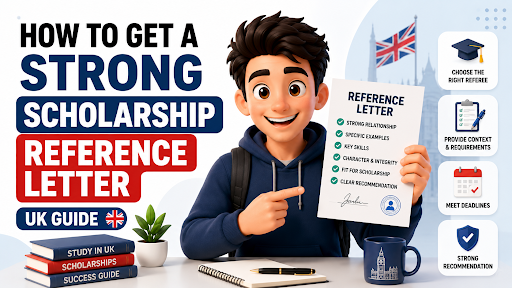
How to Get a Strong Scholarship Reference Letter (UK Guide)
A strong application can still fall short if the reference attached to it is generic. Scholarship panels read references specifically to hear from someone other than the applicant, and a vague or rushed letter undercuts everything else in the file. In this blog, we will cover who should actually write your reference, what a strong one needs to include, and how to manage the process so nothing gets missed.
Why References Carry So Much Weight
A scholarship application is, by design, the applicant’s own account of their strengths. A reference exists to confirm that account from someone else’s perspective, ideally someone who has seen the applicant’s work firsthand rather than just heard about it. That’s why panels weigh references heavily; a reference that simply restates the personal statement in different words adds very little, while one built on specific, observed detail adds real credibility.
Choosing the Right Type of Referee
Not every strong relationship makes for a strong reference. The right referee depends on what the scholarship is actually evaluating.
Academic References
For most graduate scholarships, an academic reference carries the most weight. This should come from someone who has directly supervised coursework, research, or a dissertation, not simply a professor whose class was attended. Someone who supervised a research project or thesis is in the strongest position here, because they can speak to research ability and academic rigor with real detail, not general impressions.
Employer or Supervisor References
An employer or direct supervisor reference works well for scholarships that weigh professional experience alongside academics. This referee is better positioned to speak on leadership, work ethic, and how the applicant performs under real deadlines and team dynamics, areas an academic referee usually can’t speak to directly.
Personal References
Most scholarship bodies explicitly rule out family members for personal references. The strongest personal references tend to come from mentors or coaches, people who’ve observed the applicant’s growth over time in a non-academic, non-professional setting. This referee can speak to initiative, discipline, and character in a way that feels distinct from the academic and professional references.
Volunteer Coordinator References
When an applicant’s most relevant experience comes from volunteering rather than paid work, a reference from whoever coordinated that experience can fill the gap effectively, particularly for scholarships that value community involvement or leadership outside formal employment.
What a Strong Reference Letter Actually Includes
A reference that stands out follows a fairly consistent structure, even though the content changes based on who’s writing it.
Establishing the Relationship First
The opening paragraph should state clearly how the referee knows the applicant, in what capacity, and for how long. A letter that opens with generic praise before establishing this context reads as less credible, since the panel has no way to judge how much weight the referee’s opinion should carry.
For example, an academic reference might open with something like, “I supervised [Applicant]’s final-year research project [topic name] over the [academic year], in my role as Senior Lecturer in the Department of [Department name].” That single sentence does more credible work than several lines of general praise, because it tells the reader exactly why this person is qualified to speak on the applicant’s abilities.
Highlighting Relevant Skills With Specifics
Once the relationship is established, the letter should move into concrete skills, and the specific skills highlighted should match the type of referee. An academic reference should focus on research ability, analytical thinking, and writing quality. An employer reference should focus on leadership, reliability, and collaboration. Vague praise like “hardworking and talented” carries far less weight than a specific example: a project delivered ahead of schedule, a dataset independently corrected, or a team conflict resolved without escalation.
Addressing Character, Not Just Competence
Scholarship panels are also assessing whether an applicant will represent the program well, so character and personal qualities matter alongside technical ability. A referee describing consistency, discipline, or how someone handles setbacks adds a dimension that grades and a CV can’t show on their own.
Connecting the Applicant’s Strengths to the Scholarship Itself
This is the step most reference letters skip, and it’s often the difference between a good letter and a genuinely strong one. If the scholarship has published eligibility criteria or specific attributes it’s looking for, sharing that information with the referee ahead of time allows the letter to speak directly to it, rather than offering general praise that could apply to any scholarship application.
Closing With a Clear Recommendation
A strong closing paragraph states the recommendation plainly, without hedging, and offers to answer any follow-up questions from the panel. The letter should always end with the referee’s full name and a signature; an unsigned reference raises immediate questions about whether the applicant wrote it themselves.
Managing the Logistics
Referees are busy, and the process breaks down more often from poor coordination than from a weak letter itself.
Give referees advance notice before any request email arrives from the university or scholarship body, so it isn’t mistaken for spam or missed entirely Confirm the submission deadline directly with the referee rather than assuming they’ll track it themselves Clarify the submission method early; some scholarships email the referee directly, others require the applicant to collect and forward the letter Share the scholarship’s specific criteria or listing so the reference can address them directly instead of writing something generic
Reference Letter vs. Reference Form
Some scholarships request a full letter, written entirely by the referee in their own words. Others use a structured form with short-answer or rating-scale questions instead. Forms are faster for the referee to complete but generally carry less individual detail, so if given a choice, a full letter is usually the stronger option when the applicant has a referee capable of writing one well.
Common Mistakes to Avoid
- Asking someone who barely knows the applicant, since generic praise is easy to spot and undermines the whole letter
- Leaving the referee with no context about the scholarship’s specific criteria Failing to confirm the referee actually received and understood the deadline
- Submitting an unsigned letter, which raises immediate authenticity concerns
- Choosing a referee based on their title or seniority alone rather than how well they actually know the applicant’s work