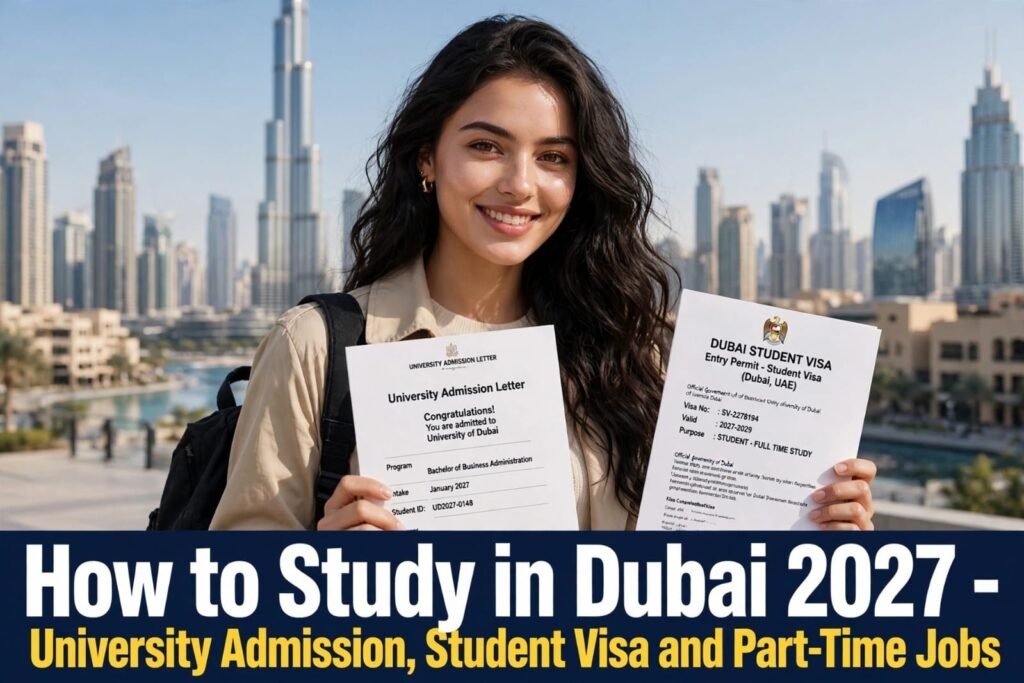
How to Study in Dubai 2027: University Admission, Student Visa and Part-Time Jobs
Study in Dubai 2027 can be an attractive option for international students who want to earn a university degree in a modern and internationally connected city. Dubai has universities and higher-education institutions offering programmes in business, finance, engineering, information technology, healthcare, media, design, tourism, and other fields.
For international students, the process normally involves choosing a suitable university, checking admission requirements, submitting academic documents, receiving an admission decision, and arranging the appropriate student visa. Some students may also be interested in working while studying, but employment is subject to UAE rules and the appropriate work authorization.
The UAE government provides official information about higher education, student admission, qualification recognition and student visas.
Why Study in Dubai?
Dubai attracts students from many countries because of its international environment, large business sector, modern infrastructure, and wide range of educational institutions.
Students can choose programmes at different levels, including:
– Bachelor’s degrees
– Master’s degrees
– Doctoral programmes
– Professional and specialized programmes
– Foundation and pathway programmes
The right option depends on your previous education, career goals, budget, and the admission requirements of the institution.
Dubai can also provide exposure to an international business environment. Students interested in business, technology, finance, hospitality, engineering, and other growing sectors may find the city’s economy particularly relevant to their future careers.
How to Apply to a Dubai University
The first step in the Study in Dubai 2027 process is selecting a university and programme.
Before applying, check:
1. Whether the university is officially licensed or recognized.
2. The degree and programme you want to study.
3. Academic entry requirements.
4. English-language requirements.
5. Whether an entrance examination is required.
6. Tuition fees and other charges.
7. Available scholarships or discounts.
8. Student visa arrangements.
9. Application deadlines.
The UAE government provides information about higher education institutions and student admission, making it important to verify an institution before paying application or tuition fees.
What Documents Are Required?
The exact requirements depend on the university and programme. International applicants may commonly be asked for:
– Valid passport
– Recent passport-size photographs
– Secondary school certificate for undergraduate admission
– Academic transcripts
– Bachelor’s degree and transcripts for postgraduate admission
– English-language test results when required
– Curriculum vitae for certain postgraduate programmes
– Personal statement or statement of purpose when required
– Recommendation letters for some programmes
– Application form
– Other documents requested by the university
Some academic documents may need authentication, attestation, equivalency, or verification depending on the applicant’s education system and the university’s requirements.
Applicants should not assume that the same documents are required by every Dubai university.
Is IELTS Required to Study in Dubai?
IELTS is not automatically compulsory for every student or every university.
Many institutions use English-language requirements for programmes taught in English, but accepted tests and minimum scores can differ.
Some universities may accept alternatives or assess applicants through their own procedures.
Therefore, students should check the English-language requirement for their specific programme before booking a test.
Is SAT Required for Dubai Universities?
SAT requirements can also vary.
Some universities or programmes may consider SAT or other standardized tests, while others may use different admission criteria.
Students should therefore avoid assuming that SAT is mandatory for every Dubai university.
The UAE’s official higher-education information shows that admission requirements can differ between institutions and programmes.
How Much Does It Cost to Study in Dubai?
The cost of studying in Dubai depends heavily on the university, degree, programme, and lifestyle.
Students may need to budget for:
– Tuition fees
– Application fees
– Student visa expenses
– Accommodation
– Food
– Transportation
– Health insurance or other required coverage
– Books and study materials
– Personal expenses
Some universities offer scholarships, merit-based discounts, or other financial assistance. However, students should check the exact conditions directly with the university.
A low-cost programme is not necessarily the best option if it does not match your academic and career goals.
Dubai Student Visa for International Students
International students normally need an appropriate visa or residence arrangement to live in the UAE for study.
According to the UAE government, an international student can stay in the country for study under the sponsorship of a UAE-resident parent or through the accredited university or college where the student is studying.
Students should confirm the current visa requirements, documents, fees, medical requirements, and application procedure before travelling.
The UAE government also provides official information about student visas and other visa categories.
How Does the Dubai Student Visa Process Work?
Although procedures can vary, the general process may involve:
Step 1: Choose a University
Select an accredited institution and programme that matches your academic background.
Step 2: Apply for Admission
Submit the university application and required academic documents.
Step 3: Receive Admission
If accepted, the university provides the relevant admission documentation.
Step 4: Complete Visa Procedures
If the university is sponsoring the student’s visa, follow its instructions for the student residence process.
Step 5: Complete Required Formalities
Depending on the applicable rules, students may need to complete medical, identification, insurance, or other residence formalities.
Step 6: Begin Your Studies
After completing the required procedures, the student can begin the programme according to the university’s schedule.
Always check the latest official requirements because visa and residence rules can change.
Can International Students Work While Studying in Dubai?
This is one of the most important questions for international students.
Students should not assume that a student visa by itself gives unrestricted permission to work.
UAE employment regulations include specific permits for students and part-time employment. The official regulations include a student training and employment permit for students already in the UAE, subject to applicable conditions. They also recognize part-time work permits.
Therefore, students should confirm that their proposed job and employment arrangement are legally permitted before starting work.
What Part-Time Jobs Can Students Find?
Depending on qualifications, availability, employer requirements, and legal authorization, students may look for opportunities such as:
– Retail assistant
– Customer service
– Administrative assistant
– Social media assistant
– Sales assistant
– Hospitality roles
– Events support
– Tutoring
– Internships
– Digital marketing roles
– Entry-level technology roles
The availability of a particular job depends on the student’s skills and the current employment market.
Students should also make sure that working does not violate university rules or interfere with their academic responsibilities.
Can Students Work as Tutors?
The UAE has introduced a Private Tuition Work Permit that includes university students among the categories that may qualify, subject to the applicable requirements.
This means eligible students interested in private tutoring should check the official permit requirements instead of providing paid tuition without authorization.
Can You Get a Full-Time Job After Graduation?
Yes, graduates may seek employment in the UAE, but graduating from a university does not automatically provide unrestricted permission to work.
Once a student receives a job offer, the appropriate employment and residence arrangements must be followed.
The UAE government recognizes standard work visas for employees in government and private-sector organizations, while other visa categories exist for specific circumstances.
Graduates should therefore discuss the employment visa process with their prospective employer and check the current government requirements.
How to Find a Job After Studying in Dubai
Students can begin preparing for employment before graduation.
Useful steps include:
– Build a professional CV.
– Create a strong LinkedIn profile.
– Complete internships where legally permitted.
– Develop industry-specific skills.
– Attend university career events.
– Apply through company career pages.
– Network with professionals.
– Prepare for interviews.
– Keep academic documents organized.
Students should avoid paying unofficial individuals who promise guaranteed employment or a guaranteed work visa.
The UAE government provides official information about job searches, employment processes, contracts, and workplace regulations.
Can Pakistani Students Study in Dubai?
Yes, Pakistani students can apply to eligible Dubai universities if they meet the admission requirements of their selected institution.
A Pakistani applicant should generally prepare academic certificates, transcripts, passport documents, and any additional documents required by the university.
However, admission is not automatic. Each institution decides whether an applicant meets its academic and programme-specific requirements.
Pakistani students should also verify whether their academic documents require attestation, equivalency, or additional verification.
Important Mistakes to Avoid
Students planning to Study in Dubai 2027 should avoid several common mistakes.
Do Not Assume SAT Is Always Required
SAT requirements differ between institutions and programmes.
Do Not Assume IELTS Is Always Required
English-language requirements vary, and some universities may accept alternative evidence.
Do Not Pay an Unverified Agent
Always verify the university and its official application process before making payments.
Do Not Work Without Checking Authorization
A student should confirm whether the proposed employment requires a work permit or other approval.
Do Not Ignore Total Costs
Tuition is only one part of the budget. Accommodation, food, transportation, visa expenses, and personal costs should also be considered.
Do Not Use Fake Documents
False academic or personal documents can create serious problems with admission and immigration procedures.
Study in Dubai 2027 can offer international students access to a diverse higher-education environment and potential career exposure in one of the world’s major business destinations.
The safest approach is to start with an accredited university, carefully check the programme requirements, prepare genuine academic documents, and follow the official admission and student visa procedures.
Students who want to work during their studies should also understand that employment is regulated. Appropriate work authorization may be required, and students should verify the rules before accepting a job.
For Pakistani and other international students, careful planning can make the admission process much easier. Compare universities, check the exact requirements, calculate the complete cost, and use official sources before submitting documents or making payments.
FAQs
1. Can international students study in Dubai?
Yes. International students can apply to eligible universities and higher-education institutions in Dubai if they meet the institution’s admission requirements.
2. Is IELTS compulsory for studying in Dubai?
Not necessarily. IELTS requirements depend on the university, programme, and applicant’s educational background.
3. Is SAT compulsory for Dubai universities?
No, SAT is not universally compulsory. Requirements vary by university and programme.
4. Can Pakistani students study in Dubai?
Yes. Pakistani students can apply to Dubai universities if they meet the relevant academic, language, documentation, and visa requirements.
5. Can international students work part-time in Dubai?
Students may be able to work under applicable UAE rules and permits. They should confirm the required authorization before starting employment.
6. Can students work as tutors in the UAE?
Eligible university students may be able to provide private tuition under the UAE’s Private Tuition Work Permit system, subject to the applicable requirements.
7. Can I get a job in Dubai after graduation?
Graduates can apply for jobs, but they must have the appropriate employment and residence authorization to work legally in the UAE.
8. Who sponsors a Dubai student visa?
Depending on the circumstances, a student may be sponsored by a UAE-resident parent or by an accredited university or college.
9. What documents are needed for Dubai university admission?
Requirements vary, but applicants may need a passport, academic certificates, transcripts, photographs, English-language evidence, and additional programme-specific documents.
10. How can I avoid Dubai university admission scams?
Apply through the university’s official website, verify the institution, check the official payment details, and avoid agents promising guaranteed admission or employment.
Turkey Work Visa Process 2027 for Pakistanis: How to Get a Job in Turkey from Pakistan