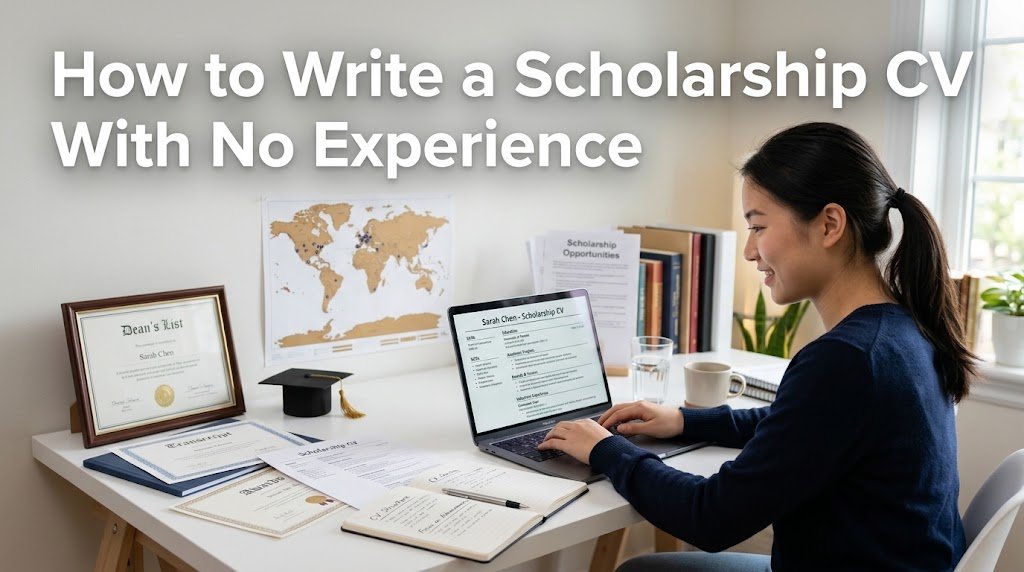
You can write a strong scholarship CV even if you have never had a formal job. Instead of focusing on employment, use your education, academic projects, research, leadership, volunteering, awards, certifications, extracurricular activities, and relevant skills to show what you can contribute. Scholarship committees understand that students may have limited professional experience, so the goal is to present your existing achievements clearly and honestly.
A scholarship CV isn’t simply a job CV with the word “scholarship” added to it. It should help the committee understand your academic background, interests, achievements, potential, and connection to the programme you want to study. If you’re still at the beginning of the application process, it’s also worth learning How to Apply for Scholarships to Study Abroad so your CV fits the requirements of the scholarships you’re targeting.
What Should You Put on a Scholarship CV With No Experience?
When you don’t have work experience, put your strongest academic and extracurricular evidence near the top of your CV. Your education may become the most important section, especially if you’re applying for an undergraduate or postgraduate scholarship.
Think about everything you’ve done during school, college, or university. A final-year project, research assignment, student society position, volunteering activity, academic competition, online course, or presentation can all provide useful evidence.
A student CV can include:
- Contact information and a short profile
- Education and academic results
- Academic or personal projects
- Research experience, if applicable
- Leadership and student society roles
- Volunteer or community work
- Awards and academic achievements
- Relevant certifications and courses
- Skills and languages
You don’t need to use every section. Keep the sections that provide real evidence about your preparation for the scholarship.
Start With Your Education
For students without employment history, education should usually appear near the top of the scholarship CV. Include your degree or current programme, institution, dates, relevant grades, and academic achievements.
If your CGPA, percentage, class rank, academic distinction, or specific grades are strong and relevant, include them. You can also mention a thesis, dissertation, final-year project, or important coursework when it relates directly to the scholarship or intended field of study.
For example:
BS Computer Science
University of Lahore, Pakistan
2023–2027
CGPA: 3.72/4.00
Relevant Academic Work:
Developed a student attendance management system as a semester project using Python and MySQL.
You don’t need to list every subject you’ve studied. Select coursework only when it helps demonstrate preparation for your intended programme.
Write a Short Scholarship CV Profile
A short profile at the beginning of your CV can explain who you are and what you want to study. Keep it specific rather than filling it with generic claims such as “hardworking,” “passionate,” or “highly motivated.”
Mention your current academic level, field of study, key area of interest, and the type of scholarship or programme you’re pursuing.
For example:
Undergraduate Biology student with a strong academic record and research interest in environmental science. Completed university projects involving water-quality analysis and participated in campus science activities. Seeking postgraduate study opportunities focused on environmental research.
This gives the reader context before they reach the rest of your CV. Your profile should also support the story you tell elsewhere in the application, particularly in your How to Write a Scholarship Motivation Letter.
Use Academic Projects Instead of Work Experience
One of the best ways to write a scholarship CV with no experience is to turn relevant academic projects into evidence of your abilities.
A project can show research, analysis, communication, teamwork, technical knowledge, problem-solving, or subject knowledge. Don’t simply write the project title. Explain what you actually did.
Instead of:
Final-Year Project:
Solar Energy
Write:
Final-Year Project: Solar Energy Adoption in Rural Communities
- Reviewed research on household solar adoption.
- Collected responses from 80 local households.
- Analysed survey results and presented findings to the department.
This gives the scholarship committee something concrete to assess. Academic projects are particularly useful for master’s and PhD applications because they can demonstrate preparation for further study.
Include Research Experience Even If It Was Part of Your Degree
You don’t need to have worked as a professional research assistant to mention research-related experience. A dissertation, thesis, laboratory project, research paper, field study, or independent academic investigation may be relevant.
For each research activity, explain the topic, your role, methods, and outcome where possible.
For example:
Research Project: Social Media and Student Learning
- Reviewed 25 academic sources on online learning behaviour.
- Designed a questionnaire for university students.
- Analysed responses and presented the findings in a departmental seminar.
If you’re applying for a research-based master’s or PhD, place relevant research work higher on the CV. The same information can also help when preparing the supporting Documents Required for Scholarship Applications, particularly if the scholarship asks for evidence of academic or research work.
Add Leadership, Volunteering, and Student Activities
No job experience doesn’t mean you have no experience. Leadership roles, volunteering, student societies, community service, competitions, tutoring, and event organisation can show responsibility and initiative.
Don’t just list the activity. Explain your contribution and, where possible, the result.
For example:
Class Representative — Department of Business Studies
2025–2026
- Communicated student concerns to faculty members.
- Helped coordinate academic events for approximately 100 students.
- Assisted classmates with information about departmental activities.
Or:
Volunteer — Community Literacy Programme
2025
- Tutored secondary-school students in English twice a week.
- Helped prepare learning materials for weekly sessions.
These activities can be particularly useful when applying for scholarships that value leadership or community involvement.
List Skills That You Can Actually Prove
A scholarship CV shouldn’t contain a huge list of skills just to make the page look full. Choose skills that relate to your academic field or scholarship and support them with examples elsewhere in the CV.
For example, a computer science student might list:
- Python
- SQL
- Data analysis
- Microsoft Excel
- Research
- Presentation
A social sciences student might list:
- Academic research
- Qualitative analysis
- Report writing
- Public speaking
- Survey design
- Microsoft Office
The key is honesty. If you list a skill, you should be able to explain where you developed or used it if asked.
Include Awards, Certifications, and Languages
Awards can help your scholarship CV stand out when they demonstrate academic ability, leadership, competition results, or community involvement. Include the name of the award, organisation, and year.
Certifications can also be useful when they’re relevant to your intended programme. For example, a data-analysis course may be worth mentioning for a statistics programme, while a research methods certification may support a postgraduate application.
Languages can be included with an honest proficiency level, such as:
Languages:
English — Advanced
Urdu — Native
Arabic — Intermediate
Don’t add certificates simply because you have them. Relevance matters more than quantity.
Use the Right Scholarship CV Format
A clean format is usually better than a decorative one. The exact length depends on the scholarship or university instructions, so always check the application requirements first.
For a student with little or no experience, one page is often enough if it contains the most relevant information. A longer CV isn’t automatically stronger.
Use clear headings and consistent dates. Keep the design simple, readable, and easy for a scholarship committee to scan.
A practical order is:
Name and contact details → Profile → Education → Projects/Research → Leadership or Volunteering → Awards → Skills → Certifications/Languages
You can change this order according to your strongest evidence. A research-focused applicant, for example, may put research and academic projects immediately after education.
Scholarship CV Example With No Experience
Here is a simple example of how your information could look:
Ayesha Khan
Lahore, Pakistan | ayesha@email.com | +92 XXX XXXXXXX
Profile
Final-year BS Environmental Sciences student with a strong academic record and an interest in climate and water-resource research. Completed academic research projects involving water-quality assessment and environmental awareness. Seeking postgraduate scholarship opportunities in environmental science.
Education
BS Environmental Sciences
University of Punjab, Lahore
2023–2027
CGPA: 3.75/4.00
Academic Projects
Water Quality Assessment Project
- Collected and analysed water samples from three local sites.
- Compared results against recommended quality indicators.
- Presented findings during a departmental seminar.
Leadership & Volunteering
Volunteer, University Environmental Society
2025–Present
- Helped organise campus awareness sessions.
- Assisted with a tree-planting activity involving more than 50 students.
Awards
Dean’s List — 2025
University Academic Excellence Certificate — 2024
Skills
Research, Microsoft Excel, Academic Writing, Data Analysis, Presentation
Languages
English — Advanced
Urdu — Native
Notice that there is no empty “Work Experience” section. Every section provides evidence that supports the applicant’s academic profile.
Common Mistakes to Avoid
Students often make their scholarship CV weaker by trying to hide their lack of employment experience. Don’t invent internships, jobs, research positions, or achievements. A short, honest CV is much better than a document filled with claims you can’t support.
Before submitting, compare your CV with the scholarship’s eligibility criteria and document requirements. Make sure your grades, dates, institution names, project titles, and awards match your official records. It’s also useful to review Common Scholarship Application Mistakes to Avoid before you submit the complete application, because a strong CV can still be undermined by errors elsewhere in the application.
Avoid:
- Adding false work or research experience
- Listing every school activity you’ve ever completed
- Using vague claims without evidence
- Including irrelevant personal information
- Copying the same CV without checking the scholarship criteria
- Ignoring the requested file format or page limit
Your CV should also agree with your scholarship motivation letter and other application documents. If your statement says you want to study renewable energy, your relevant academic projects, courses, research, or activities should support that direction where applicable.
Final Checklist Before Sending Your Scholarship CV
Before uploading your CV, take a few minutes to check the details. Small errors in dates, grades, names, or formatting can make an otherwise good application look careless.
Make sure your document:
- Clearly shows your academic background
- Includes relevant projects and activities
- Uses accurate grades, dates, and achievements
- Contains only skills you genuinely have
- Follows the scholarship’s instructions
- Has consistent formatting and spelling
- Is saved in the requested file format
Most importantly, don’t treat having no job history as a weakness you need to disguise. For a student applicant, your academic record, projects, leadership, community involvement, research, and other meaningful activities can provide plenty of evidence for a scholarship CV.
FAQs
Can I apply for a scholarship without work experience?
Yes. Many students apply for scholarships before they have formal employment. Use your education, academic projects, research, leadership, volunteering, awards, and relevant skills to demonstrate your preparation.
How long should a scholarship CV be with no experience?
For a student with limited experience, one page is often sufficient. However, always follow the specific scholarship or university requirements if they provide a page limit.
What should I write in a CV if I have no experience?
Start with education and include academic projects, research, volunteering, leadership roles, awards, certifications, relevant skills, and extracurricular activities. Don’t create experience that you don’t have.
Should I include a photo on my scholarship CV?
Only include a photo if the scholarship or university specifically requests one. For many international academic applications, a photo isn’t necessary. Check the official application instructions before adding personal information.