
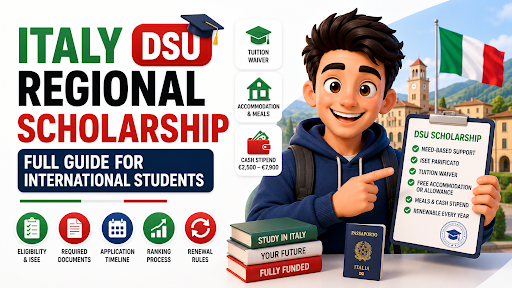
Italy DSU Regional Scholarship: Full Guide for International Students
Italy’s regional scholarship system remains one of the more overlooked ways to study in Europe on a fully funded basis, largely because it’s organized differently from most national scholarship programs. Instead of one central body, funding runs through 20 separate regional agencies, each with its own portal, deadline, and application quirks. In this blog, we will walk through how the system actually works, what determines eligibility, and how to avoid the documentation mistakes that cost students an entire year of funding.
What the DSU Scholarship Actually Covers
Formally known as Diritto allo Studio Universitario, or the right to university study, the DSU is Italy’s regional welfare program for students, funded partly by national government contributions and partly by each region’s own budget. It’s structured as need-based support rather than a merit award, meaning the first-year outcome depends almost entirely on family income and financial circumstances rather than grades.
A full award typically includes a complete tuition waiver, free or subsidized accommodation, and daily meal access through the university canteen. Students who don’t secure a dormitory spot receive a cash allowance instead, intended to cover private rent for the academic year. Depending on region and income tier, the annual cash stipend generally falls somewhere between roughly €2,500 and €7,900 for students living away from home, paid out in two installments across the year rather than as a single lump sum.
Because each region, Tuscany’s DSU, Lombardy’s ADISU, Lazio’s LazioDiSCo, and so on, runs its own agency, the specific benefit package and exact income cutoffs vary slightly by location. Which region applies depends entirely on where the university is located, not where the student is from.
How Eligibility Is Actually Determined
Eligibility runs through a financial indicator called the ISEE, Italy’s standardized measure of a household’s economic situation. For Italian families, this is calculated directly through domestic tax records. International applicants use a different version, the ISEE Parificato, calculated by an authorized CAF office using foreign income documentation instead.
The income threshold for qualifying for any level of DSU support generally sits between €25,000 and €30,000 per year, though this shifts slightly by region and year. Families with a significantly lower ISEE, typically under roughly €14,000, tend to qualify for the full support package: tuition waiver, accommodation, and the maximum stipend tier. Families closer to the upper threshold may still receive partial support, but the benefit shrinks the closer income sits to the regional cutoff.
One detail that catches many applicants off guard: the ISEE Parificato is calculated using a specific reference year of income, not the most recent one. For a given intake year, the relevant income year is usually two years prior, so preparing documentation early matters more than most students expect.
Documents You’ll Need
Document preparation is where most applications actually fall apart, not the eligibility criteria itself. The full document set typically includes:
- A confirmed university admission letter or pre-enrollment confirmation
- A family registration certificate showing household composition
- A family income certificate covering the required reference year
- A property certificate listing any land, housing, or assets owned by the family
- Proof of housing status if the family doesn’t own property
- A bank statement showing the sponsoring family member’s balance
For programs like medicine and surgery, where formal admission letters tend to arrive later than the scholarship deadline, a pre-enrollment summary can generally be submitted in place of the full admission letter.
Every document ultimately needs translation into Italian, followed by legalization, first through the relevant foreign ministry in the student’s home country, then through the Italian embassy or consulate handling that region. This step alone can take several weeks, which is why starting document preparation two to three months before the application window opens is the realistic timeline, not a cautious overestimate.
Application Timeline and Regional Portals
Most regional portals open sometime between June and September, though the exact window differs by region and occasionally shifts year to year. Checking the previous year’s official call, published on each region’s own site, is the most reliable way to estimate when the next cycle will open, since there’s no single centralized calendar across all 20 regions.
Applications are submitted entirely online during the initial window; only soft copies of documents are required at this stage, with legalized hard copies needed later once a scholarship is actually awarded.
How the Ranking Process Works
Once the application window closes, provisional rankings are published in stages, typically starting in late October or November, with a second and sometimes third ranking following as corrections are processed. If an applicant’s name doesn’t appear or a rejection is listed, the reason is usually a specific missing or incorrect document rather than a blanket ineligibility. Addressing that gap before the next ranking round is the standard path to appearing on a later list.
Once hard, legalized copies are submitted to the local CAF office after arrival in Italy, the office finalizes the ISEE, and the scholarship amount is deposited directly into the student’s Italian bank account.
Renewing the Scholarship in Later Years
The first year is awarded purely on financial need. From the second year onward, renewal shifts to a merit basis, generally requiring a set number of credits, commonly in the range of 30 to 35 ECTS, to be completed by a set date, usually in August. Falling short of that threshold results in losing the scholarship for the following year, regardless of financial need, which makes consistent academic progress just as important as the initial application.
Costs to Budget For, Even With a Full Award
A “full” DSU award doesn’t necessarily mean zero cost. Most students still owe Italy’s regional right-to-study tax, typically around €140, along with a small stamp duty fee, generally around €16. These amounts are minor compared to tuition and living costs, but worth budgeting for rather than assuming a fully funded scholarship removes every expense.
Common Mistakes That Cost a Year of Funding
- Submitting an incorrect or incomplete property certificate, which can result in outright disqualification
- Starting document legalization too close to the deadline, given how long embassy processing can take
- Assuming the most recent income year applies, when the ISEE Parificato typically uses an earlier reference year
- Missing the credit threshold in year two and losing the renewal despite strong financial need
- Not checking region-specific requirements, since some regions request two years of income documentation instead of one