
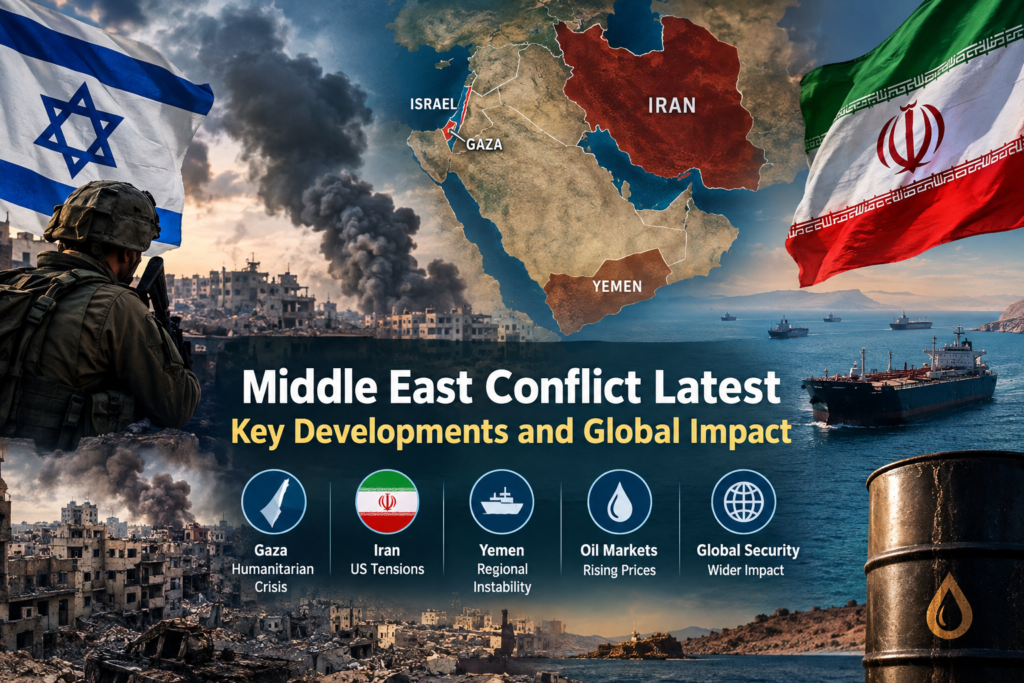
The Middle East conflict has moved far beyond a single front. Developments involving Iran, Israel, the United States, Gaza, Yemen, and major shipping routes are now affecting security and energy markets worldwide.
The latest situation is especially significant because the conflict is putting pressure on the Strait of Hormuz. The waterway is a major route for global energy shipments. Recent disruptions have also affected shipping activity and increased concerns about oil supplies.
At the same time, fighting and political tensions continue across several parts of the region. Gaza remains under severe humanitarian pressure, while Yemen has become another major source of regional instability.
Here is what to know about the Middle East conflict latest developments, the key players involved, and why the situation matters beyond the region.
What Is the Latest in the Middle East Conflict?
The current Middle East crisis involves several connected conflicts and political disputes rather than one isolated war.
The most significant developments include the continuing US Iran confrontation, instability in Yemen, ongoing violence in Gaza, and disruptions around important maritime routes.
Recent reports indicate that negotiations between Washington and Tehran remain uncertain. Iran has proposed a plan involving the reopening of the Strait of Hormuz, but US President Donald Trump rejected the proposal as unacceptable. Iranian officials have continued to discuss negotiations while waiting for an official US response.
The situation has also affected global energy markets.
The International Energy Agency says the regional war has created the largest supply disruption in the history of the global oil market. It also warns that continued restrictions on Gulf supplies could increase pressure on prices and global demand.
Why Is Iran Central to the Current Crisis?
Iran has become a central factor in the current regional confrontation.
The conflict involving Iran has affected the Gulf, maritime trade, energy infrastructure, and relations between Washington and several Middle Eastern governments.
The Strait of Hormuz is one of the most important parts of this equation. Iran has sought influence over access through the waterway while the United States has pushed to maintain freedom of navigation.
Recent reporting shows that shipping through Hormuz has fallen sharply. Reuters reported that only two commodity vessels crossed the strait on one Monday, compared with a pre conflict average of about 125 large commercial ships per day.
These figures require caution because ships can switch off their tracking systems. The IEA also warns that AIS data cannot provide a complete picture of maritime traffic during the conflict.
The uncertainty itself creates problems for shipping companies, insurers, energy traders, and governments.
What Is Happening in Gaza?
Gaza remains one of the most serious humanitarian issues within the broader Middle East conflict.
A ceasefire that took effect in October 2025 ended large scale hostilities, but the situation has not returned to normal. The UN reported in September 2026 that Israeli strikes, shelling, drone attacks, and ground operations were continuing.
The UN also reported that humanitarian access remains severely restricted across large parts of Gaza. Around two thirds of the territory was described as inaccessible or subject to severe access restrictions in a September report.
Humanitarian conditions remain another major concern.
Earlier in September, the UN reported that Israeli strikes had destroyed more than $770,000 in nutrition supplies and damaged critical water infrastructure. The World Health Organization also evacuated patients from Gaza, while many others remained in need of medical evacuation.
These developments have kept Gaza at the center of international diplomatic discussions.
Why Gaza Remains Important
The Gaza conflict affects more than the immediate humanitarian situation.
It influences relations between Israel and Arab countries, US foreign policy, Iranian regional strategy, and discussions at the United Nations.
It also affects efforts to establish a longer term political framework for Gaza.
The UN’s September report said that planned recovery arrangements had not yet reached the scale required. It also said that the disarmament of Hamas and other Palestinian armed groups had not been implemented under the existing framework.
This creates a difficult challenge.
Reconstruction requires security and political coordination. At the same time, long term stability is difficult to establish while humanitarian needs remain unresolved.
How Is Yemen Affecting the Middle East Conflict?
Yemen has become another important front.
The Houthi movement has expanded its military activity as regional tensions have increased. The group has links to Iran and has previously targeted commercial shipping in response to the Gaza conflict.
Recent fighting has also intensified between Houthi forces and Saudi backed Yemeni forces.
Reuters reported in September that Houthi fighters had advanced into parts of Yemen’s highlands and were seeking strategic positions that could affect access between Saudi backed forces and the Red Sea coast. The UN was cited as reporting nearly 700 deaths and more than 130,000 displaced people from the latest escalation.
The conflict has major international implications because Yemen sits near the Bab el Mandeb Strait.
The waterway connects the Red Sea with the Gulf of Aden. It is an important route for international shipping.
Disruption in this area can force ships to take longer routes. That increases transportation time, fuel use, insurance costs, and pressure on supply chains.
Why Is the Strait of Hormuz So Important?
The Strait of Hormuz is one of the most important energy chokepoints in the world.
It connects the Persian Gulf with the Gulf of Oman and the Arabian Sea. Large quantities of oil and other energy products normally pass through the area.
The current conflict has made the waterway a major security issue.
The IEA is monitoring changes in shipping through Hormuz, the Bab el Mandeb, and another regional maritime route. Its data shows how the conflict has disrupted normal shipping patterns.
The problem extends beyond oil.
Disruptions can affect natural gas, refined petroleum products, commercial shipping, and other commodities.
For the United States, the impact can appear through global energy prices rather than direct shortages at American ports.
That distinction matters.
The US does not depend on the Strait of Hormuz in the same way as some Asian economies do. However, oil is traded in a global market. A major supply disruption in one region can influence prices elsewhere.
How Is the Conflict Affecting Oil Prices?
Energy markets have reacted to continuing uncertainty.
The IEA reported in September that benchmark oil prices had resumed an upward trend after renewed hostilities disrupted regional exports. The agency warned that continued supply restrictions could create further pressure on prices.
Reuters reported on September 28 that Brent crude rose more than 1% after Trump rejected an Iranian proposal connected to reopening the Strait of Hormuz.
For American consumers, higher global oil prices can eventually affect several areas.
These can include:
- Gasoline prices
- Air travel costs
- Freight expenses
- Manufacturing costs
- Shipping rates
- Consumer goods prices
The effect does not happen equally or immediately across all markets.
Companies may have existing fuel contracts or inventories. Governments can also release emergency reserves or use alternative supply routes.
Still, prolonged disruption creates additional pressure across the global economy.
What Does the Conflict Mean for Global Shipping?
Shipping is one of the clearest ways the Middle East conflict can affect countries far from the battlefield.
Commercial vessels face increased security risks when operating near conflict zones.
Companies may respond by changing routes, delaying shipments, or increasing insurance coverage.
Longer routes can increase costs because vessels consume more fuel and spend more time at sea.
The Strait of Hormuz and Bab el Mandeb are particularly important because they connect major energy producing regions with global markets.
Russian President Vladimir Putin and Saudi Crown Prince Mohammed bin Salman recently discussed the importance of safe maritime passage through both Hormuz and Bab el Mandeb. Their September 22 discussion highlighted the international concern over regional shipping security.
What Is the US Role in the Middle East Conflict?
The United States remains one of the most important external actors in the crisis.
Washington is directly involved in the confrontation with Iran and is also closely connected to Israel and Gulf partners.
US policy is also important for maritime security.
The administration has faced pressure over how to respond to threats affecting Saudi Arabia and shipping routes. Reuters reported that US military action against the Houthis had been considered but was not resumed at the time of its September 21 report.
Diplomacy remains another part of the US strategy.
Recent developments suggest that Washington and Tehran have not reached a durable agreement. The disagreement over Hormuz has become one of the central issues in the latest diplomatic discussions.
The outcome could influence regional security, energy markets, and future negotiations.
How Are Other Countries Responding?
Countries across the Middle East and beyond are trying to limit the wider consequences of the conflict.
Saudi Arabia has focused heavily on protecting its territory and energy infrastructure.
Other Gulf states have also emphasized maritime security and diplomatic efforts.
At the United Nations General Assembly, foreign ministers from Qatar, Egypt, Jordan, the UAE, Indonesia, Pakistan, Türkiye, and Saudi Arabia expressed concern over the humanitarian situation in Gaza. They called for humanitarian assistance and implementation of commitments connected to Gaza’s recovery.
Turkey has also called for broader international action on the Palestinian issue.
The different positions show how difficult it is to build a unified regional response.
Countries may share concerns about civilian suffering and regional instability while holding different views about military action, Iran, Israel, and the future political structure of Gaza.
What Could Happen Next?
Several developments could shape the next stage of the Middle East conflict.
US Iran negotiations
Diplomatic talks remain one of the most important variables.
A successful agreement could reduce pressure around the Strait of Hormuz and lower some risks for energy markets.
A breakdown in negotiations could produce additional uncertainty.
Maritime security
The safety of commercial shipping will remain important.
Any sustained disruption around Hormuz or Bab el Mandeb could increase pressure on energy prices and global transportation networks.
Gaza recovery
Gaza’s humanitarian and reconstruction needs will remain a major international issue.
The UN says recovery requires stronger implementation of existing arrangements and greater access to humanitarian assistance.
Yemen
Further Houthi advances or attacks could expand the regional security problem.
The situation could also place greater pressure on Saudi Arabia and other countries involved in Yemen.
What Should US Readers Watch?
Readers in the United States can follow several indicators to understand how the conflict is developing.
Watch oil markets. Major changes in crude prices can signal concerns about supply disruptions.
Watch the Strait of Hormuz. Shipping activity provides an important indication of the level of maritime disruption.
Watch US Iran negotiations. Diplomatic progress could reduce some regional risks.
Watch Gaza humanitarian conditions. Aid access and civilian conditions remain central to international diplomacy.
Watch Yemen. Developments around the Red Sea can affect international shipping.
Watch US military policy. Changes in American deployments or operations could alter the regional security environment.
Common Misunderstandings About the Middle East Conflict
The conflict is often described as one war involving only Israel and Palestine.
That description does not capture the current regional picture.
Several interconnected conflicts and rivalries are operating at the same time.
Iran’s confrontation with the United States is one major component. Gaza is another. Yemen and the Red Sea represent another important front.
The same is true for energy markets.
A rise in oil prices does not automatically mean that US fuel supplies are running out. Global prices can rise because traders expect future supply risks.
Another common mistake is treating every claim from a military or political actor as independently verified.
During active conflicts, governments, militaries, armed groups, and other parties regularly make competing claims. Readers should check major claims against independent reporting and official sources before treating them as established facts.
Why the Middle East Conflict Matters Globally
The Middle East conflict matters because the region sits at the center of several global systems.
It is critical to international energy markets.
It contains major maritime trade routes.
It has direct connections to US national security policy.
It also influences relationships between major global powers and regional governments.
The conflict therefore has consequences far beyond the countries directly involved.
For American households, the most visible effects may appear through energy prices, transportation costs, travel disruptions, and broader economic uncertainty.
For businesses, shipping costs and supply chain risks can become more important.
For governments, the challenge is balancing security concerns with diplomatic efforts to prevent further escalation.
Final Thoughts
The Middle East conflict latest developments show a regional crisis with several interconnected fronts.
Gaza remains a major humanitarian and political issue. Iran and the United States remain locked in a serious confrontation. Yemen has become increasingly important because of its position near the Red Sea. Meanwhile, disruptions around the Strait of Hormuz have placed global energy markets under additional pressure.
The situation remains fluid.
Diplomatic negotiations, maritime security, oil supplies, and developments in Gaza and Yemen will all shape what happens next.
For US readers, following these areas together provides a clearer picture than focusing on any single battlefield or political statement. The regional conflict is affecting security, energy, shipping, and diplomacy at the same time.