Noah’s Ark Found in Turkey: Latest Discovery Explained
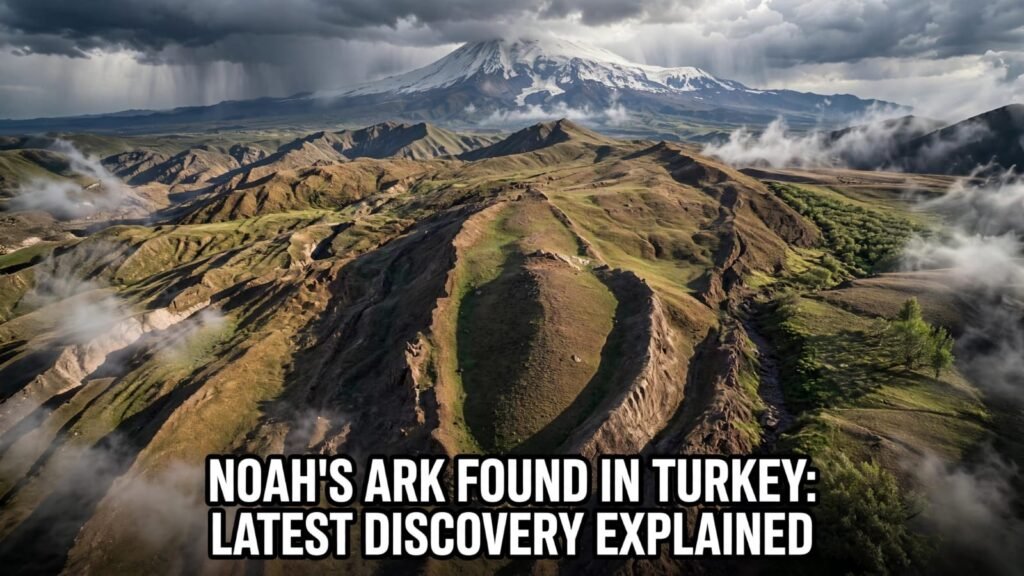
The Noah’s Ark found in Turkey claim has gained fresh attention in 2026 as researchers continue studying the boat-shaped Durupınar Formation near Mount Ararat. New radar scans, soil samples, pottery fragments, and core drilling have provided interesting clues. However, researchers have not yet confirmed that the site contains the biblical Noah’s Ark.
What Is the Durupınar Formation?
The Durupınar Formation is a large boat-shaped geological structure in eastern Turkey, near the town of Doğubayazıt. Its unusual appearance has attracted researchers and visitors for decades.
Some researchers believe the formation could be connected to the story of Noah’s Ark. Others argue that its shape is the result of natural geological processes.
Because of this disagreement, the Noah’s Ark found in Turkey story remains a subject of investigation rather than a confirmed archaeological discovery.
What Did Researchers Discover?
Researchers studying the formation have collected soil samples from different parts of the site and examined underground features using geophysical technology.
Recent investigations have reported unusual patterns beneath the surface. Some radar images appear to show lines and angles that researchers want to examine more closely.
These features have increased interest in the Noah’s Ark found in Turkey investigation, but radar results alone cannot establish that an ancient ship is buried underground.
More testing is needed to understand whether the structures are natural or connected to human activity.
New Soil Samples From the Site
Soil analysis is another important part of the investigation. Researchers have collected numerous samples from around the formation and are examining their chemical and organic characteristics.
Some reported results have attracted attention because researchers believe certain samples may contain material worth investigating further.
However, unusual organic material does not automatically mean that wooden remains from Noah’s Ark have been discovered. Researchers need laboratory testing to establish the material’s age and origin.
Pottery Fragments Add Interest
Pottery fragments have also been reported during recent fieldwork at the site.
Archaeologists are examining these pieces to determine whether they are genuinely ancient and, if so, what they can reveal about human activity in the area.
The pottery is an interesting archaeological clue, but it does not prove the Noah’s Ark found in Turkey claim. Establishing a connection with the biblical story would require much stronger evidence.
Core Drilling Begins
One of the biggest developments in the latest investigation is the use of core drilling.
Researchers are taking samples from deeper layers of the formation so they can study what lies beneath the surface. Deeper samples could provide useful information about the structure’s composition and geological history.
The team has also discussed using robotic technology to investigate difficult-to-reach underground areas.
This approach could provide researchers with physical evidence that can be tested in laboratories rather than relying only on photographs or radar images.
Has Noah’s Ark Been Confirmed?
Despite the headlines, the Noah’s Ark found in Turkey story should not be described as a confirmed discovery.
The latest research has produced clues that investigators consider worth studying, but there has been no universally accepted archaeological proof that the Durupınar Formation is Noah’s Ark.
A genuine confirmation would require reliable physical evidence, scientific dating, archaeological analysis, and independent verification.
Why Is the Discovery So Important?
The story attracts worldwide attention because Noah’s Ark is one of the best-known stories from the Bible and other ancient traditions.
For many years, researchers and explorers have searched for possible evidence of the Ark. The unusual shape of the Durupınar Formation has made it one of the most discussed locations connected with these searches.
Modern technology has now given researchers new ways to investigate the site. Radar scanning, soil analysis, drilling, and robotic exploration can provide information that was not available to earlier investigators.
What Happens Next?
The next stage will involve laboratory analysis of the samples collected from the formation.
Researchers will need to determine the age, composition, and origin of the material recovered during the investigation. Scientists will also need to compare the results with the geological history of the region.
If future testing identifies genuine ancient human-made material, it could make the site more interesting for archaeological research. If the evidence points to natural geological processes, it could help explain the formation’s unusual shape.
Noah’s Ark Found in Turkey: What We Know So Far
The Noah’s Ark found in Turkey claim is based on a combination of the formation’s unusual shape and new scientific investigations.
Researchers have reported radar anomalies, soil differences, pottery fragments, and results from deeper drilling. These findings are being examined, but they do not yet establish that Noah’s Ark has been found.
The most accurate description at this stage is that the Durupınar Formation is an archaeological and geological site under continuing investigation.
Final Thoughts
The Noah’s Ark found in Turkey story has become popular again because modern researchers are using new technology to investigate the Durupınar Formation.
The latest findings are interesting, but they should be separated from claims of a confirmed discovery. Until laboratory testing and independent scientific research establish the nature and age of the evidence, the identity of the formation remains unresolved.
For now, the search continues, and future research may provide a clearer answer about what lies beneath the unusual boat-shaped structure.
Frequently Asked Questions About Prophet Noah (Nuh AS)

1. Who was Noah?
Noah, known as Prophet Nuh (AS) in Islam, was a prophet and messenger of Allah. He was sent to guide his people toward worshipping Allah and away from idol worship.
2. How long did Prophet Nuh (AS) preach to his people?
The Quran states that Nuh (AS) remained among his people for 950 years. During this time, he repeatedly called them toward faith and obedience to Allah.
3. Why did Allah send Prophet Nuh (AS) to his people?
According to the Quranic account, Nuh (AS) was sent because his people had turned away from the worship of Allah and followed false gods. He warned them and called them to repentance.
4. Did the people of Nuh (AS) accept his message?
Most of his people rejected his message despite his long efforts to guide them. The Quran describes their rejection and opposition to his preaching.
5. Why did Prophet Nuh (AS) build the Ark?
Allah commanded Nuh (AS) to build the Ark after his people continued to reject his warning. The Ark became the means of protection for those who were saved from the Flood.
6. What happened during the Great Flood?
According to the Quran, the waters rose after Allah’s command, and those who rejected Nuh’s message were destroyed. Nuh (AS) and those who believed were saved in the Ark.
7. Did everyone in Prophet Nuh’s family enter the Ark?
No. The Quran describes one of Nuh’s sons refusing to board the Ark and choosing to seek safety on a mountain instead. He was ultimately among those who drowned.
8. Where did the Ark come to rest?
The Quran states that the Ark came to rest on Mount Judi. This differs from the biblical account, which refers to the mountains of Ararat.
9. Is Noah the same person as Prophet Nuh (AS)?
Yes. Noah is the English name, while Nuh (Nūḥ) is the Arabic name used in the Quran for the same prophet.
10. Where is the story of Nuh (AS) mentioned in the Quran?
The story appears in several parts of the Quran, including Surah Nuh, Surah Hud, Surah Al-Mu’minun, Surah Ash-Shu’ara, and Surah Al-Qamar.
11. What is the main lesson from the story of Nuh (AS)?
The story emphasizes patience, faith, obedience to Allah, and the importance of continuing to follow the truth even when others reject it.
More Updates