
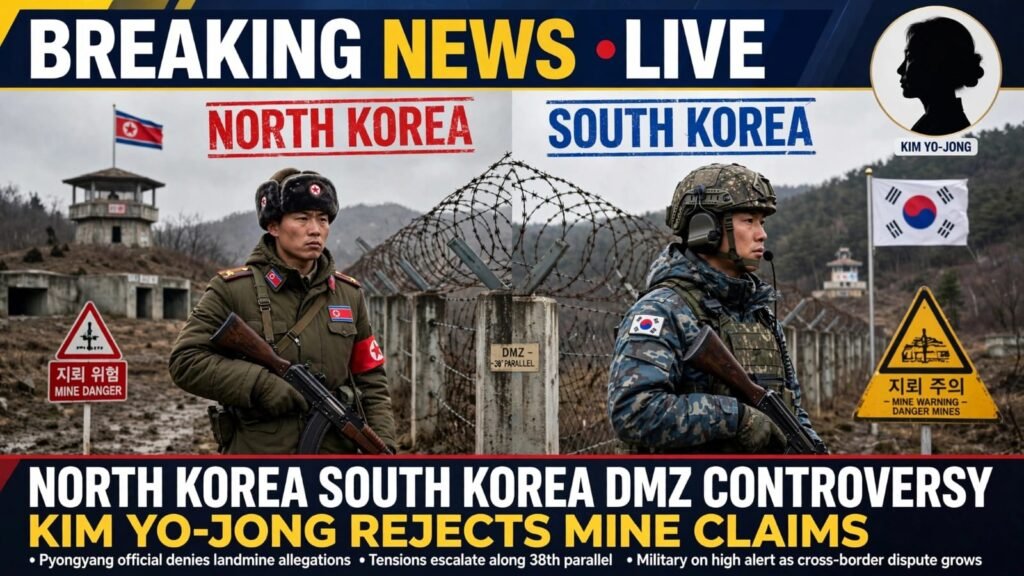
North Korea South Korea DMZ Controversy: Kim Yo-jong Rejects Mine Claims
The North Korea South Korea DMZ controversy has intensified after Kim Yo-jong rejected South Korea’s preliminary finding that North Korean land mines likely caused explosions that injured three South Korean soldiers on September 21, 2026. Kim accused Seoul of making false claims and warned of retaliation if South Korean forces fire at North Korean troops working near the border.
The latest development has drawn attention because the incident happened inside the Demilitarized Zone (DMZ), one of the most heavily fortified areas in the world. South Korean authorities and the U.S.-led United Nations Command have been investigating the explosions, while North Korea has rejected responsibility.
What Happened in the DMZ?
The North Korea South Korea DMZ controversy began after two explosions occurred on September 21 near the Military Demarcation Line in the western section of the DMZ.
Three South Korean soldiers were injured in the blasts. South Korean officials later announced that their preliminary investigation indicated North Korean mines were highly likely to have caused the explosions.
The investigation involved South Korean military officials and the United Nations Command. Investigators reported finding evidence that they said pointed toward North Korean mines at the site.
South Korea’s Defense Minister Kang Shin-chul said the suspected placement of mines south of the Military Demarcation Line could represent a violation of the armistice agreement that stopped active fighting in the Korean War.
Kim Yo-jong Rejects South Korean Findings
Kim Yo-jong, the sister of North Korean leader Kim Jong-un, rejected South Korea’s assessment.
According to North Korean state media, she accused Seoul of fabricating the findings and using the incident as a justification for political and military provocation. North Korea has not accepted responsibility for the explosions.
Kim also rejected South Korean claims about North Korean troops crossing the border during fortification work. She said North Korean soldiers had not crossed the Military Demarcation Line and described the border construction work as an exercise of sovereignty.
This denial is now at the center of the North Korea South Korea DMZ controversy, with both sides presenting different accounts of what happened.
North Korea Warns of Retaliation
The latest statement also included a warning directed at South Korean forces.
Kim Yo-jong said North Korean border units would respond if South Korean troops used live fire against North Korean soldiers involved in border work. She warned of immediate retaliation if North Korean personnel were fired upon.
North Korea also said it would strengthen tactical counterattack capabilities in the area facing South Korean forces.
The warning adds another layer to the already tense situation along the DMZ. However, there has been no report in the latest coverage of a new armed clash between the two sides following Kim’s statement.
What Does South Korea Say?
South Korean officials maintain that the evidence points toward North Korean involvement.
South Korea’s military said investigators found North Korean mines in the area and that the evidence made it highly likely that the mines caused the explosions. Officials also said there was no record indicating that South Korean or allied forces had placed mines at the location.
South Korea has said it could consider corresponding measures if a final investigation confirms North Korean responsibility.
The government has not publicly announced a specific military response based solely on the preliminary findings.
Why Is the DMZ So Sensitive?
The Korean Demilitarized Zone was created under the 1953 Korean Armistice Agreement. It separates North and South Korea and stretches for about 248 kilometers.
Despite its name, the DMZ is heavily fortified, with troops, fences, barriers and large numbers of land mines in and around the area.
Because the two Koreas have not signed a formal peace treaty ending the Korean War, incidents along the border can quickly become sensitive military and diplomatic issues.
The current North Korea South Korea DMZ controversy therefore involves not only the mine investigation but also questions about the armistice and military activities close to the Military Demarcation Line.
What Happens Next?
The investigation is not yet the final word on responsibility.
South Korea and the United Nations Command have continued examining evidence from the explosion site. South Korean officials have said further analysis will be used before the government decides on its next steps.
North Korea, meanwhile, has already rejected the South Korean assessment and warned against military action.
The immediate focus will therefore be on the final investigation findings and how both governments respond to them.
Could the Situation Escalate?
The latest statements show that tensions have increased, but the available reports do not establish that a wider military confrontation is underway.
Kim Yo-jong’s warning is significant because it specifically links possible retaliation to South Korean firing on North Korean troops. South Korea, for its part, has discussed corresponding measures but has not publicly detailed a specific response.
The situation could therefore develop depending on new evidence, military movements and official decisions from both sides.
keep checking this website for viral new articles.
https://corefoxes.com/world-championship-of-legends-2026-schedule-teams-and-latest-update/
The North Korea South Korea DMZ controversy remains unresolved as of September 30, 2026. South Korea says its preliminary investigation strongly points to North Korean mines, while Kim Yo-jong has rejected that conclusion and accused Seoul of creating a justification for confrontation.
For now, the key development is the sharp disagreement over responsibility for the September 21 explosions and North Korea’s warning of retaliation if its troops are fired upon. Further investigation and official responses will determine how the situation develops.
Frequently Asked Questions
What is the North Korea South Korea DMZ controversy?
It concerns explosions in the DMZ that injured three South Korean soldiers and a dispute over whether North Korean mines caused the blasts.
What did Kim Yo-jong say about the DMZ mines?
Kim Yo-jong rejected South Korea’s preliminary findings linking North Korean mines to the explosions and accused Seoul of making false claims.
When did the DMZ explosions happen?
The explosions occurred on September 21, 2026, near the Military Demarcation Line in the western DMZ.
How many South Korean soldiers were injured?
Three South Korean soldiers were injured in the two explosions, according to current reports.
Has North Korea accepted responsibility?
No. North Korea has denied responsibility and rejected South Korea’s preliminary assessment.
Could the DMZ controversy lead to more tensions?
The latest statements include warnings of retaliation, but current reports do not establish that a wider military confrontation has begun.