
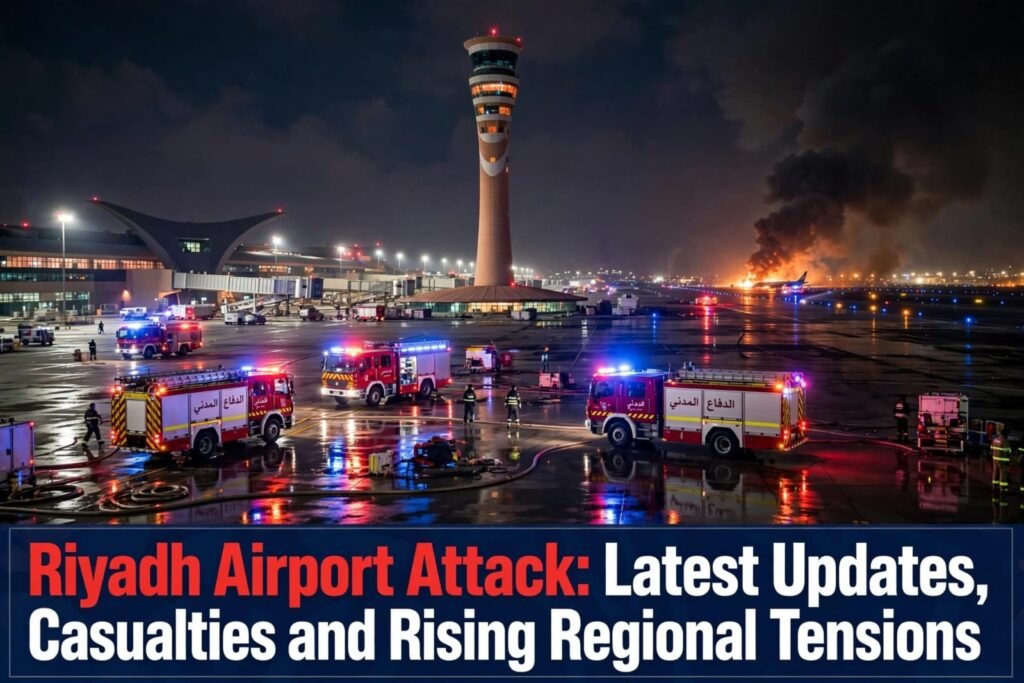
Riyadh Airport Attack: Latest Updates, Casualties and Rising Regional Tensions
The Riyadh Airport Attack has raised serious concerns about aviation safety and regional security after a deadly strike on King Khalid International Airport in Saudi Arabia. Saudi authorities reported that 12 people were killed and 309 others were injured in the attack on October 10, 2026. A further incident involving an unidentified projectile was reported at the airport on October 11, increasing concerns about the safety of passengers, airport workers and international travellers.
The developments have attracted international attention because Riyadh is an important destination for business travel, international conferences and commercial aviation. The situation also comes amid escalating hostilities involving Saudi Arabia and Yemen’s Houthi movement.
What Happened in the Riyadh Airport Attack?
King Khalid International Airport, located in the Saudi capital, Riyadh, has reportedly experienced multiple attacks within a short period.
According to Saudi aviation authorities, the October 10 attack killed 12 people and injured 309 others. The victims included Saudi citizens and foreign nationals. Several injured people were reported to be in critical condition.
The incident marked a serious escalation in the ongoing conflict affecting the region. Emergency responders transported injured people to hospitals, while authorities assessed the damage and addressed the security situation.
The Riyadh Airport Attack has also raised questions about the protection of civilian infrastructure during armed conflict. Airports serve ordinary passengers, international visitors, airline employees and essential commercial operations, making attacks on these facilities particularly concerning.
Source: Saudi authorities’ casualty figures reported by Reuters and Al Jazeera.
A Second Airport Incident Raises Fresh Concerns
On October 11, the Saudi-led coalition reported that an unidentified projectile struck Terminal 4 at Riyadh’s King Khalid International Airport, causing a fire. The coalition also reported intercepting a cruise missile near the airport.
Officials had not provided complete details about the second incident at the time of reporting. Responsibility for this latest incident was not immediately established.
The airport remained closed following the deadly attack on October 10, according to reports published on October 11.
The latest developments have made the security situation more difficult to assess. Authorities must determine the extent of the damage, investigate the incidents and establish when normal airport operations can safely resume.
Travellers should avoid relying on unverified social media posts for flight information. Airline announcements and official airport or aviation-authority updates are more reliable sources for checking cancellations, diversions and reopening information.
Source: Reuters, reporting published October 11, 2026.
Who Was Responsible for the Attack?
The Saudi-led coalition attributed the deadly October 10 strike to Yemen’s Houthi movement. Reports said the Houthis claimed responsibility for that attack as tensions intensified between the group and Saudi Arabia.
The Houthis are an armed political and military movement based in Yemen. They have been involved in a prolonged conflict with the internationally recognised Yemeni government and have also confronted Saudi Arabia.
However, it is important to distinguish the earlier attack from the subsequent incident reported on October 11. The identity of those responsible for the later projectile incident had not been confirmed in the available reporting.
Investigations, official statements and independently verified evidence are necessary to establish responsibility for individual incidents. Readers should be cautious about claims circulating online before authorities release supporting information.
The Riyadh Airport Attack has become part of a wider security crisis, but further developments will determine whether the latest incidents represent a broader escalation.
Casualties and Impact on Civilians
Saudi aviation authorities reported 12 deaths and 309 injuries following the October 10 attack. The victims came from several countries, demonstrating the international nature of passenger traffic and airport employment in Saudi Arabia.
According to published reports, those killed included four Saudi citizens, two Bangladeshi nationals and one national each from the United States, Jordan, Palestine, Syria, Sudan and Egypt.
The incident has had a devastating impact on affected families. It has also highlighted the risks faced by civilians when armed conflicts threaten transport hubs and other public facilities.
People injured in such incidents may require emergency treatment, surgery, rehabilitation and long-term support. Families can also face emotional distress, travel difficulties and unexpected expenses.
The full humanitarian impact may take time to understand, particularly while authorities continue to assess the consequences of the violence.
Why Is Riyadh Airport Important?
King Khalid International Airport is a major transport hub serving Riyadh, one of Saudi Arabia’s most important economic and administrative centres.
The airport connects the capital with domestic destinations and international cities. It supports tourism, business travel, religious journeys, employment and commercial activity.
Disruptions at a major airport can affect thousands of travellers. Flights may be cancelled, diverted or delayed, while airlines must adjust their schedules and passengers may need alternative accommodation or transportation.
The airport is also important to Saudi Arabia’s broader economic ambitions. The country has been investing in tourism, infrastructure, international business and efforts to diversify its economy beyond oil.
A prolonged interruption to airport operations could complicate travel plans and create challenges for companies, conference organisers and visitors.
The consequences will depend on the duration of the closure, the extent of the damage and the security measures introduced by the authorities.
Could the Attacks Affect International Flights?
The reported closure of Riyadh’s airport has raised concerns among travellers and airlines.
When an airport closes because of a security incident, airlines may suspend services, divert aircraft to other airports or offer passengers alternative arrangements. The exact response depends on official restrictions, the airline’s operational decisions and conditions in the surrounding airspace.
Travellers planning to visit Saudi Arabia should take several precautions:
– Check flight status directly with the airline before leaving for the airport.
– Monitor official airport and civil aviation announcements.
– Contact the airline about rebooking options if a flight is cancelled.
– Review travel insurance conditions and retain receipts for eligible expenses.
– Follow instructions from local authorities and the relevant embassy or consulate.
Passengers travelling through other Saudi airports should also verify the status of their specific flights rather than assuming that every airport is affected in the same way.
The Riyadh Airport Attack does not automatically mean that all flights across Saudi Arabia have been suspended. Flight restrictions and operational decisions can differ by airport, airline and route.
What Has the International Community Said?
The incident has drawn international attention because attacks affecting civilians and civilian infrastructure can have consequences beyond the immediate conflict zone.
The African Union Commission condemned the October 10 attack in a statement published on October 11, expressed condolences to the victims’ families and called for de-escalation.
International responses to such incidents generally focus on protecting civilians, preventing further violence and reducing the risk of a wider regional confrontation.
The situation also raises difficult diplomatic questions. Governments must consider how to respond to attacks while assessing the humanitarian consequences and the possibility that additional military action could intensify the conflict.
Statements from governments and international organisations may change as new evidence becomes available. Any assessment of the international response should therefore take account of the date and wording of the latest official announcements.
Could the Conflict Escalate Further?
The renewed violence has increased concerns about a wider confrontation involving Saudi Arabia, the Houthis and potentially other regional or international actors.
US President Donald Trump said Washington was considering whether to join Saudi strikes against the Houthis, according to reports published on October 11. This indicated that further US involvement was under consideration, not that a final decision had necessarily been made.
Any expansion of military operations could have consequences for regional security, civilian populations, shipping routes and energy markets.
However, it would be premature to predict exactly what will happen next. Governments may choose different diplomatic, military or security responses, and negotiations or other developments could change the situation.
The immediate priorities remain establishing the facts, protecting civilians, investigating the incidents and preventing further loss of life.
Will the Riyadh Airport Attack Affect Oil Prices?
Saudi Arabia is a major player in the global energy market, so security developments in the country can attract attention from oil traders and energy companies.
Investors may monitor regional violence for potential risks to oil production, export infrastructure and shipping routes. If a conflict threatens energy supplies or important maritime corridors, markets may react to concerns about possible disruptions.
Nevertheless, an attack on an airport does not automatically cause oil prices to rise. Market movements depend on several factors, including actual supply disruptions, global demand, production decisions, inventories and expectations about how long a crisis might last.
Readers should distinguish between confirmed changes in oil prices and forecasts based on geopolitical concerns. Claims that fuel prices will definitely increase because of the Riyadh Airport Attack would require additional evidence.
The economic consequences will become clearer as the security situation develops and more information becomes available.
What Should Travellers Do Now?
People who have booked flights to or through Riyadh should focus on practical, verified information rather than rumours.
First, contact the airline to confirm whether the flight is operating. A booking confirmation alone does not guarantee that a flight will depart as scheduled during an airport closure.
Second, check official travel advisories issued by the traveller’s government. These may provide information about security risks, airport access and emergency assistance.
Third, keep essential documents accessible, including passports, booking references, travel insurance details and contact information for family members.
Travellers already in Saudi Arabia should follow local emergency instructions and avoid restricted areas. Anyone who needs assistance should contact their airline, local authorities or their country’s diplomatic mission through verified channels.
People with family members travelling through Riyadh may wish to contact them directly when possible. They should avoid sharing unverified casualty lists or disturbing images, which can increase confusion and distress.
What Happens Next?
The next stage will depend on official investigations, security assessments and decisions about airport operations.
Authorities will need to assess the damage, investigate the projectiles and determine what additional precautions may be necessary. Airlines will also need reliable information before restoring affected services.
Diplomatic developments will be equally important. International governments may call for restraint, issue travel guidance or consider additional measures in response to the attacks.
Readers following the Riyadh Airport Attack should look for updates that clearly identify the publication date and distinguish confirmed information from claims that remain under investigation.
As of the reporting available on October 11, the deadly October 10 attack had caused 12 deaths and 309 injuries, while a further airport incident had been reported on October 11. The full consequences of the latest incident and the timing of a return to normal airport operations remained uncertain.
Frequently Asked Questions
1. What happened in the Riyadh Airport Attack?
Saudi authorities reported that an attack on King Khalid International Airport on October 10, 2026, killed 12 people and injured 309 others. A further incident involving an unidentified projectile was reported on October 11.
2. Where did the attack take place?
The deadly attack took place at King Khalid International Airport in Riyadh, the capital of Saudi Arabia.
3. How many people were killed?
Saudi aviation authorities reported 12 deaths following the October 10 attack. The figure refers to that incident and should not be confused with any later casualty updates.
4. Who was blamed for the attack?
The Saudi-led coalition attributed the October 10 attack to Yemen’s Houthi movement, which claimed responsibility according to published reports. Responsibility for the subsequent incident on October 11 had not been established in the reporting available at that time.
5. Is Riyadh airport open?
Reports published on October 11 said the airport remained closed after the deadly attack. Travellers should check the latest official airport announcements and their airline’s flight status for current information.
6. Will flights to Saudi Arabia be cancelled?
Some flights may be disrupted, diverted or cancelled depending on airport restrictions and airline decisions. Passengers should confirm their individual flight status before travelling.
7. Could the incident affect oil prices?
The incident could influence market sentiment if investors become concerned about wider regional instability or energy supply disruptions. However, an increase in oil prices is not guaranteed.
8. Where can readers find reliable updates?
Readers should follow official Saudi aviation announcements, airline notifications and established news organisations such as Reuters and the Associated Press. Reports should be checked for publication dates because the situation may change quickly.
Conclusion
The Riyadh Airport Attack has highlighted the serious risks that escalating regional conflicts pose to civilians, international travel and essential infrastructure. The October 10 incident caused substantial loss of life and hundreds of injuries, while the additional incident reported the following day raised further security concerns.
The situation remains developing, and important questions about airport operations, responsibility for subsequent incidents and the possibility of further escalation require verified updates. For travellers, businesses and families, the most useful approach is to rely on official announcements, follow safety instructions and avoid treating unconfirmed claims as established facts.