
You use your brain every second of the day. It helps you read this sentence, remember a name, recognize a face, and control your movements.
Yet many of the brain’s abilities remain surprisingly complex.
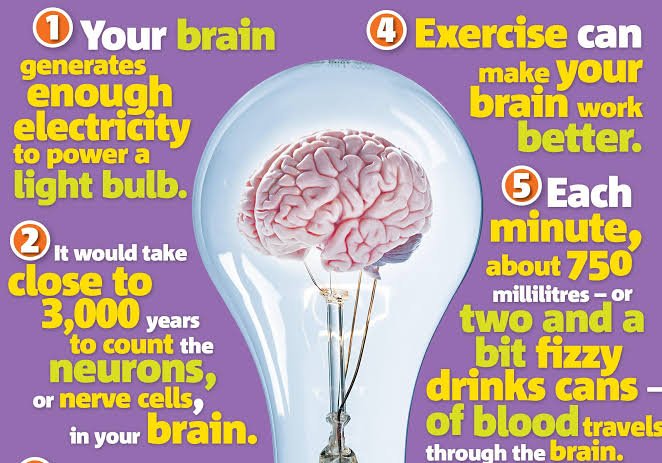
Scientists continue to study how the brain creates memories, processes information, controls emotions, and adapts to new experiences. The human brain contains billions of neurons and an enormous network of connections that allows different areas to communicate.
The National Institute of Neurological Disorders and Stroke describes the brain as the most complex part of the human body. It controls thinking, movement, behavior, senses, and many automatic body functions.
Here are 10 interesting facts about the human brain that show just how remarkable this organ is.
1. The Human Brain Contains More Than 80 Billion Neurons
Neurons are specialized cells that send and receive information throughout the nervous system.
The brain contains more than 80 billion neurons. These cells communicate through electrical and chemical signals. Their connections form networks that allow the brain to process information and control different functions.
A neuron has several important parts.
Dendrites receive signals from other cells. The cell body maintains the neuron. An axon carries signals toward other cells.
Neurons communicate across tiny junctions called synapses. Chemical messengers called neurotransmitters can carry information across these connections.
This process happens continuously.
When you recognize someone’s voice, move your hand, solve a problem, or recall a memory, networks of neurons are working together.
The brain also contains glial cells. These cells support neurons, protect them, provide insulation, and help maintain healthy brain function.
So the brain is not simply a collection of neurons. It is a highly organized network of different cell types working together.
2. Your Brain Uses a Lot of Energy
The brain is relatively small compared with the rest of the body.
However, it requires a large amount of energy to keep its cells functioning.
An NIH educational resource explains that the brain makes up about 2 percent of body weight while consuming roughly 20 percent of the body’s oxygen and energy.
That energy supports thousands of chemical reactions that happen throughout the brain.
Your brain needs energy even when you are sitting quietly.
Thinking, remembering, moving, processing sounds, maintaining body temperature, and controlling automatic functions all require ongoing brain activity.
This explains why the brain needs a steady supply of oxygen and nutrients.
Blood vessels deliver oxygen and glucose to brain tissue. The brain also has protective systems that help regulate what reaches its delicate environment.
One example is the blood brain barrier.
3. The Brain Has Its Own Protective Barrier
The brain needs protection from harmful substances circulating in the blood.
The blood brain barrier helps provide that protection.
It consists of tightly packed cells that control the movement of substances between the blood and the fluid surrounding brain neurons. It allows important substances such as oxygen and water to reach the brain while restricting many harmful substances.
This barrier is selective rather than completely closed.
Some medications can cross it, while others have difficulty reaching brain tissue.
The blood brain barrier is important because the brain requires a carefully controlled environment.
Even small changes in that environment can affect how nerve cells function.
Researchers continue to study the barrier because understanding it can help improve treatments for neurological conditions.
4. Your Brain Can Change With Experience
One of the most interesting facts about the human brain is its ability to change.
Scientists use the term neuroplasticity to describe the brain’s ability to adapt by changing neural connections and networks.
Learning something new can strengthen certain connections between neurons.
Practice can also change how efficiently brain networks perform a task.
Think about learning to play an instrument.
At first, reading music and coordinating your hands may require intense concentration. With practice, those tasks can become more familiar.
Similar processes occur when people learn languages, develop new skills, or practice complex movements.
The brain does not simply remain fixed after childhood.
Research also indicates that adult brains can generate new neurons in some areas. Changes in connections and new neuron formation may contribute to learning, memory, and brain repair.
This does not mean the brain can repair every type of damage.
However, it shows that the adult brain has more capacity for change than scientists once believed.
5. Sleep Helps Your Brain Process Memories
Going to sleep does not mean your brain completely shuts down.
Your brain remains active during sleep and performs important processes related to learning and memory.
Research reviewed by Harvard Health indicates that sleep helps consolidate memories. This means information that was recently learned can become more stable and easier to recall later.
For example, imagine studying vocabulary before an important test.
Reading the words is only one part of learning. Your brain also needs to process and organize that information.
Sleep can support this process.
Researchers have found that both factual information and learned skills can show better retention after periods that include sleep.
Sleep also involves changes in neural connections.
Research supported by the National Institute of Mental Health found evidence in animal studies that sleep may help streamline neural connections and restore the brain’s ability to learn.
This is one reason staying awake all night to study may not produce the results people expect.
A rested brain can be better prepared to process and recall information.
6. Your Brain Controls Many Functions You Never Think About
You might associate the brain mainly with thinking and memory.
However, it also controls many functions that happen automatically.
The brain helps regulate breathing, heart rate, body temperature, movement, and other essential processes.
You do not need to consciously remind yourself to breathe every few seconds.
You also do not need to manually control every heartbeat.
Specialized brain regions and networks help manage these functions.
The brain also receives constant information from the body.
It processes signals related to touch, temperature, balance, pain, and movement.
At the same time, sensory information arrives from the outside world through sight, hearing, smell, taste, and touch.
Your brain must organize all of these signals quickly.
That allows you to respond to your surroundings without consciously analyzing every individual signal.
7. The Brain Does Not Work Like Separate Computers
People often describe individual brain regions as if each one performs one isolated task.
The real picture is more complicated.
Different brain areas communicate with each other through interconnected networks.
The National Institute of Neurological Disorders and Stroke describes the nervous system as an interconnected system involving neurons and many other types of cells.
For example, reading a sentence involves more than recognizing letters.
Your brain processes visual information, identifies words, connects them with language, retrieves meanings, and uses context to understand the message.
Several processes work together.
The same principle applies to activities such as walking.
Movement involves planning, balance, sensory feedback, muscle control, and constant adjustments.
Your brain coordinates these processes rapidly.
This network based organization helps explain why brain functions can be both highly specialized and strongly connected.
8. Your Brain Has a Powerful Relationship With Memory
Memory is not simply a digital recording stored in one location.
The brain uses different systems and regions to process different types of information.
You can remember facts, personal experiences, physical skills, sounds, locations, and emotional experiences.
These memories do not all work in exactly the same way.
The hippocampus plays an important role in forming and processing certain types of new memories.
Sleep also supports the movement and stabilization of information within memory systems. Harvard Health describes sleep as an important part of memory consolidation.
This helps explain why repetition and rest can both matter when learning.
Consider learning a new language.
You may initially struggle to remember vocabulary. Repeated exposure creates opportunities for your brain to strengthen relevant connections.
Using the words in conversation adds another layer of learning.
Sleeping afterward gives your brain additional time to process newly acquired information.
Memory is therefore an active biological process rather than a simple storage system.
9. The Brain Is Closely Connected With Your Emotions
Thinking and emotions are often discussed as separate experiences.
In reality, they interact constantly.
The brain helps process emotional experiences while also influencing attention, memory, behavior, and decision making.
An emotionally significant event can become particularly memorable.
For example, people often remember major personal experiences with considerable detail because emotional processing interacts with memory systems.
The brain also influences behavior through complex networks involving different regions.
The National Institute of Neurological Disorders and Stroke explains that the brain contributes to behavior, emotions, thinking, movement, and many other activities.
This relationship works in both directions.
Your emotional state can affect attention and memory. Experiences can also influence emotional responses over time.
That interaction is one reason neuroscience remains a complex field of study.
10. Scientists Still Have Much to Learn About the Brain
Perhaps the most fascinating fact is how much remains unknown.
Researchers have learned a great deal about brain anatomy, neurons, neural networks, memory, sleep, and neurological diseases.
Yet the brain remains one of the most challenging areas of scientific research.
NINDS supports research across hundreds of neurological diseases and continues to investigate how the nervous system works.
Scientists are studying questions about how memories form, how neural connections change, why certain cells become damaged, and how neurological diseases can be treated.
Modern brain imaging has also changed neuroscience.
Researchers can observe activity and structural changes in living brains using advanced imaging technologies.
These tools have helped scientists study areas associated with attention, memory, emotion, movement, and other functions.
Research is also examining how genes and environmental experiences interact.
NINDS notes that at least one third of the approximately 20,000 genes in the human genome are primarily expressed in the brain. These genes influence brain development and function.
The relationship between genetics, experience, environment, and brain function remains an active area of research.
How to Support Healthy Brain Function
Learning interesting facts about the brain also raises an important question.
What can you do to support your brain?
No single habit can guarantee perfect brain health. However, several basic habits support overall health and normal brain function.
Get enough quality sleep
Sleep supports memory consolidation and cognitive function. Maintaining a consistent sleep schedule can help support healthy sleep habits.
Keep learning
Learning new skills gives the brain opportunities to form and strengthen connections.
Reading, studying a language, learning an instrument, and practicing new skills can all provide mental challenges.
Stay physically active
Physical activity supports overall cardiovascular health, which is closely connected to brain health.
Eat a balanced diet
A varied diet can provide nutrients needed for normal body and brain function.
Protect your head
Head injuries can damage brain tissue.
Using appropriate safety equipment during activities such as cycling and following safety practices can reduce avoidable risks.
Common Myths About the Human Brain
Brain science is surrounded by popular myths.
One common myth suggests that people use only a small portion of their brains.
Modern neuroscience does not support that claim.
Brain activity occurs across many regions, although different regions become more active during different tasks.
Another misconception is that the adult brain cannot change.
Research on neuroplasticity shows that the brain can adapt throughout life.
A third misconception is that sleep simply gives the brain a break.
Research shows that sleep plays an active role in memory and brain function.
Separating established science from popular myths makes it easier to understand what researchers actually know.
Why These Brain Facts Matter
The human brain is not simply a thinking organ.
It manages movement, sensory information, memory, emotions, automatic body functions, learning, and countless other processes.
Its billions of neurons communicate through vast networks. Its energy demands remain high even while you rest. Its connections can change with learning and experience.
Sleep can help consolidate memories, while the blood brain barrier protects the brain from many potentially harmful substances.
Perhaps most importantly, researchers continue to learn more about how the brain works.
That ongoing research could improve our understanding of neurological conditions and contribute to better treatments in the future.
Final Thoughts
These 10 interesting facts about the human brain reveal why neuroscience remains such an important area of research.
The brain constantly receives information, communicates through enormous networks, regulates essential body functions, and adapts to new experiences.
It also needs sleep, oxygen, nutrients, and proper care to function normally.
The more scientists learn about the brain, the clearer its complexity becomes. At the same time, new research continues to challenge older assumptions about memory, learning, sleep, and brain development.
For anyone interested in science and the human body, the brain offers an almost endless source of questions to explore.