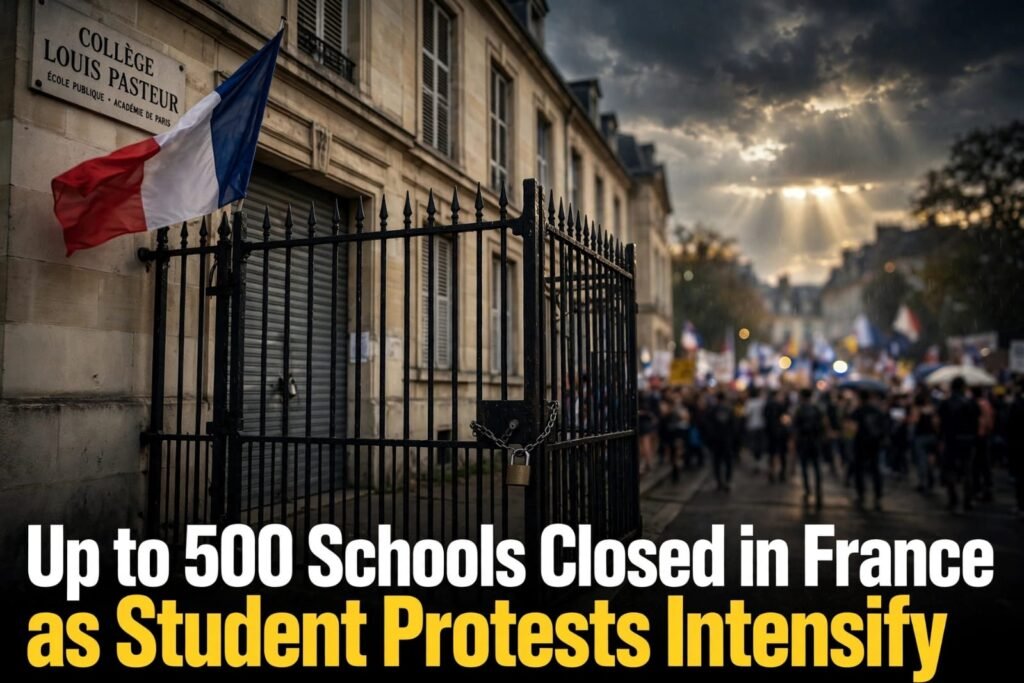
Up to 500 Schools Closed in France as Student Protests Intensify
France is facing a major wave of student protests that has disrupted education across the country. 500 schools closed in France became one of the biggest headlines as authorities announced that hundreds of high schools would have classes fully or partially suspended because security conditions were not considered safe. The protests began over concerns about teacher shortages, overcrowded classrooms, long school days and deteriorating school buildings, but the movement has since expanded into a much larger national demonstration.
The situation has continued to develop rapidly. Education Minister Édouard Geffray said around 400 to 500 high schools could be fully or partially closed during the latest wave of demonstrations. Authorities described the closures as a security measure following clashes, damage to school buildings and injuries during the protests.
Why Are Schools Closing in France?
The decision to close schools is mainly connected to safety concerns surrounding the student demonstrations. Protests that initially focused on education conditions have spread to cities across France, with some demonstrations becoming confrontational.
French authorities reported that several schools had been burned or ransacked during the unrest. Education officials also reported injuries among school staff and students. Because of these incidents, some schools were considered unsafe for normal classes.
The announcement that 500 schools closed in France therefore does not mean that every school in the country permanently shut down. The closures were described as full or partial suspensions of lessons, with the exact situation varying from one school and region to another.
What Started the Student Protests?
The protests began in September at a high school in the Paris region before spreading to other parts of France. Students complained about problems they say have affected their education for a long time.
One major concern is the shortage of teachers. Students have said that absent teachers are not always replaced quickly, leaving some classes without proper instruction.
Another complaint is overcrowding. Some students have reported classrooms with large numbers of pupils and insufficient resources. They argue that crowded classrooms make it harder to concentrate and receive individual attention from teachers.
Students have also raised concerns about old and poorly maintained school buildings.
These issues have helped turn local frustrations into a nationwide education protest movement.
500 Schools Closed in France Amid Safety Concerns
The figure of 500 schools closed in France refers to the government’s estimate that around 400 to 500 high schools could have lessons fully or partially suspended during the protests.
France has thousands of high schools, so the figure does not mean that the entire education system has stopped operating. Instead, authorities have been making decisions based on local security conditions.
Earlier in the protests, France’s Education Ministry reported that at least 400 of approximately 3,700 high schools were closed on one Friday, while hundreds more were affected by demonstrations or disruptions.
The situation then changed quickly as more demonstrations were announced.
By October 6, the High School Students Union said that nearly 1,800 high schools had been blockaded, disrupted or closed for the day. That figure reflects the wider impact of the protests and is not the same as the government’s earlier estimate of schools officially closed for security reasons.
Students Demand Better Education Conditions
Students taking part in the demonstrations have highlighted several problems affecting their daily school experience.
Teacher shortages are among the most frequently reported complaints. Students say that when teachers are absent and replacements are unavailable, lessons can be cancelled or disrupted.
School infrastructure is another major issue. Protesters have pointed to buildings that need repairs and facilities they consider unsuitable for modern education.
Some students have also complained about long school days and short lunch breaks. They argue that the structure of the school day puts additional pressure on pupils.
The government has acknowledged several of these concerns and has ordered ministers to examine possible changes.
Protests Spread Across French Cities
The demonstrations are no longer limited to the Paris area.
Large gatherings have taken place in cities including Paris, Strasbourg, Toulouse, Marseille, Lyon, Nantes and Rennes. In some places, protests have remained peaceful, while other demonstrations have involved clashes between protesters and police.
On October 6, more than 250,000 people took part in demonstrations across France according to figures from the Interior Ministry, while organisers gave a higher estimate. Teachers, parents and students participated in the nationwide mobilisation.
The size of the demonstrations shows how the original student movement has expanded beyond students alone.
Police Clash With Protesters
Police have been deployed around schools and demonstration areas as authorities attempt to prevent violence and property damage.
In some cities, riot police used tear gas and water cannons when clashes broke out. Protesters were also reported to have thrown objects and started fires in some locations.
The police response has become another controversial part of the story. Some rights groups, parents and protesters have questioned whether the force used against young demonstrators was appropriate. Government officials, meanwhile, have emphasized the need to protect people and public property.
The debate has become particularly serious because many of the protesters are teenagers.
Teenager Seriously Injured During Protest
One of the most serious incidents occurred in the northern city of Lens.
A 15-year-old teenager suffered devastating injuries after picking up a police dispersal grenade that exploded during clashes on October 5, according to reports. Reuters reported that the teenager lost his hand and part of his lower arm.
The incident intensified concerns about the risks faced by young people during the demonstrations.
It also increased scrutiny of the methods used by police to control protests.
How Many People Have Been Arrested?
The protests have also resulted in a large number of arrests.
Reuters reported that more than 1,800 people were facing prosecution, including 1,483 minors, while French authorities said hundreds of police officers had also been injured during the unrest.
Earlier reports put the number of arrests since the beginning of the protest movement at several thousand.
The large number of young people involved has made the situation particularly sensitive for parents, teachers and government officials.
Government Promises Changes
Prime Minister Sébastien Lecornu has promised to respond to the concerns raised by students.
The government is looking at issues including teacher replacements, school infrastructure, school-day schedules and lunch breaks. Ministers have been asked to prepare proposals addressing the main complaints by the end of October.
The government is therefore facing pressure to demonstrate that the protests have produced meaningful action.
However, some parents and education workers remain skeptical. They want to see practical improvements rather than only government promises.
Why School Infrastructure Is a Major Issue
The condition of school buildings has become an important part of the debate.
Students have described problems ranging from poor maintenance to inadequate facilities. Reuters reported complaints including water leaks and other basic maintenance issues.
For students, the issue is not simply about appearance. They argue that damaged or poorly maintained buildings can affect comfort, concentration and the overall learning environment.
Improving thousands of school buildings would also require significant public investment, creating an additional challenge for the government.
Parents and Teachers Join the Movement
The protests have increasingly attracted support from people outside the student movement.
Teachers and parents have joined demonstrations, saying that many of the issues raised by students also affect them.
Teachers have their own concerns about staffing, workload and working conditions. Parents are worried about whether their children are receiving consistent education and whether schools are safe during periods of unrest.
This wider support has helped turn the protests into a national discussion about the future of education in France.
What Does 500 Schools Closed in France Mean for Students?
For students, the immediate impact is disruption to their education.
When schools close or lessons are suspended, students can miss classes, tests and other activities. If disruptions continue for a long period, schools may need to find ways to reorganize lessons and academic schedules.
Some education authorities have considered online learning or other temporary arrangements where appropriate.
However, online education cannot necessarily replace normal classroom teaching for every student. This is particularly important for practical subjects and students who depend on school facilities.
Could More French Schools Close?
The situation remains uncertain because protests are continuing.
Authorities have already suspended classes in hundreds of schools at different stages of the unrest. Further closures could occur if demonstrations create security problems around individual schools.
At the same time, the government wants schools to return to normal as quickly as possible when conditions allow.
The latest reports show that the situation can change rapidly from one day to another. The number of schools affected by blockades and demonstrations may therefore be different from the number officially closed by authorities.
What Happens Next?
The next stage will depend on both the protest movement and the government’s response.
Students are demanding concrete improvements, while government officials are trying to restore normal education and prevent violence.
The government has promised to examine teacher shortages, school buildings, school schedules and other concerns. Ministers are expected to work on proposals during October.
If students see meaningful progress, the pressure on schools could eventually decrease. If they believe their concerns are being ignored, further demonstrations and disruptions may continue.
Conclusion
The story of 500 schools closed in France has become a major national education story. What started as student complaints about teacher shortages, overcrowded classrooms and poor school conditions has developed into widespread demonstrations involving students, teachers and parents.
The closures were introduced mainly because authorities considered security conditions unsuitable for normal lessons in hundreds of schools. At the same time, the wider protest movement has affected many more schools through blockades and disruptions.
The French government now faces the challenge of addressing genuine concerns about education while maintaining safety for students, teachers and the public.
For thousands of young people, the protests are ultimately about their everyday education and future opportunities. The coming weeks will show whether government promises can lead to practical improvements and whether France’s schools can return to normal after one of the country’s most significant student protest movements in years.
FAQs
1. Why were 500 schools closed in France?
Around 400 to 500 high schools were expected to have classes fully or partially suspended because authorities said security conditions had not been met during the student protests.
2. Are all 500 schools permanently closed?
No. The 500 schools closed in France figure refers mainly to schools where lessons were fully or partially suspended as a security measure. It does not mean those schools permanently shut down.
3. Why are French students protesting?
Students are protesting over issues including teacher shortages, overcrowded classrooms, poor school infrastructure, long school days and limited resources.
4. When did the protests in France begin?
The current student protest movement began in September at a high school in the Paris region and later spread to cities across France.
5. How many schools have been affected by the protests?
The number varies depending on how schools are counted. Authorities previously reported hundreds of official closures, while the High School Students Union later said around 1,800 high schools had been blockaded, disrupted or closed during the nationwide mobilisation.
6. Are teachers supporting the French student protests?
Teachers and education workers have participated in demonstrations and expressed concerns that overlap with student complaints, particularly regarding staffing and school conditions.
7. Were French schools damaged during the protests?
Yes. French officials reported that 24 schools had been burned or ransacked since the protests began.
8. Was anyone seriously injured during the protests?
Yes. A 15-year-old teenager suffered severe injuries after a police dispersal grenade exploded in Lens on October 5.
9. Will French schools reopen?
Schools can reopen when authorities consider local security conditions safe. However, further closures or disruptions remain possible while protests continue.
10. What is the French government doing about the protests?
Prime Minister Sébastien Lecornu has instructed ministers to examine issues raised by students, including teacher replacements, school infrastructure, school-day length and lunch breaks.
11. Why is the France school protest important?
The protests have drawn attention to long-standing concerns about education funding, staffing, school facilities and students’ daily learning conditions. Their national scale has made education a major public issue.
12. Could the protests continue?
Yes. Student groups have called for further demonstrations, and the government is under pressure to provide concrete responses to the concerns raised by students and education workers.
Read more latest world news and breaking international updates to stay informed about major developments around the globe.
UK Expel Israeli Diplomats: Britain Considers Response Over Jerusalem Consulate Dispute