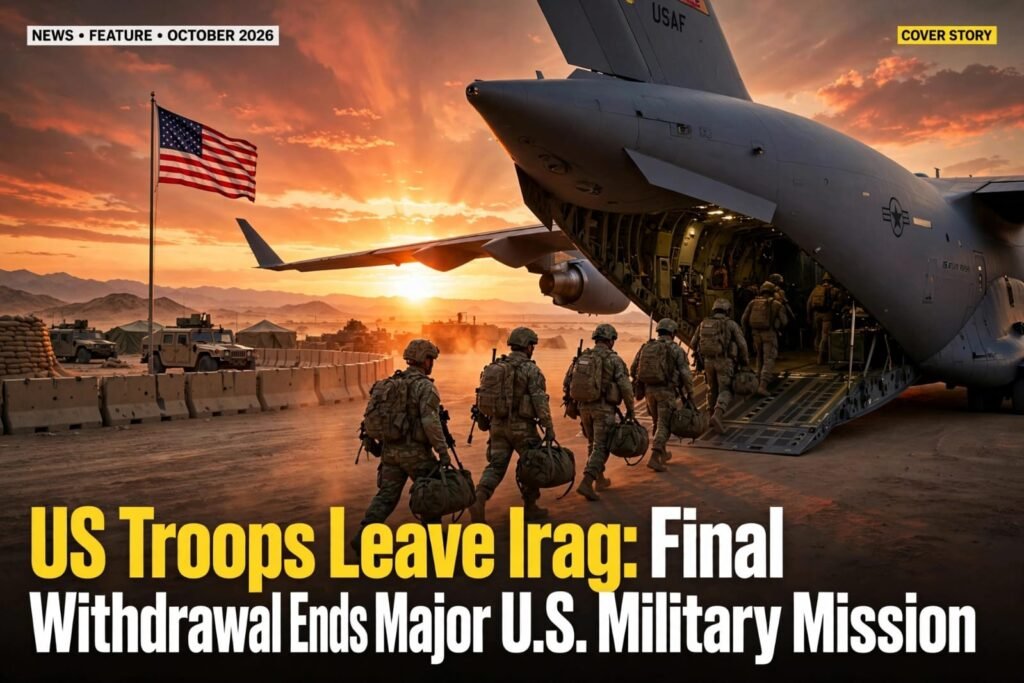
US Troops Leave Iraq: Final Withdrawal Ends Major U.S. Military Mission
The US troops leave Iraq milestone has officially arrived, marking the end of the latest chapter in America’s long military involvement in the country. On September 30, 2026, the United States completed the withdrawal of its remaining forces and equipment from Iraq, formally ending the Operation Inherent Resolve mission there.
The final departure took place from Erbil Air Base in northern Iraq. The withdrawal followed a previously agreed transition between Washington and Baghdad and moves the relationship toward a bilateral security partnership rather than a large coalition military mission.
The decision has attracted international attention because U.S. forces have played a major role in Iraq for more than two decades, first following the 2003 invasion and later returning as part of the international campaign against the Islamic State group.
US Troops Leave Iraq After Years of Military Operations
When US troops leave Iraq, the move represents the conclusion of a long and complicated period of American military involvement in the country.
The United States invaded Iraq in 2003, removing Saddam Hussein from power and beginning years of military operations. American forces later withdrew in 2011, but the situation changed after Islamic State militants captured large areas of Iraq and Syria in 2014.
The United States returned with an international coalition to support Iraqi and regional forces against ISIS. Operation Inherent Resolve was established as part of that effort and continued for approximately 12 years.
According to the Pentagon, the campaign defeated ISIS as an organized military threat in Iraq, allowing the mission to transition toward an Iraqi-led security effort.
Final U.S. Forces Depart From Erbil
The final stage of the withdrawal focused on Erbil Air Base, which had been a major hub for the coalition’s counter-ISIS operations.
U.S. Central Command confirmed that American forces and equipment completed their orderly departure from the base on September 30.
The move marked the formal conclusion of Operation Inherent Resolve in Iraq. The Combined Joint Task Force associated with the mission remains active, but its headquarters is now based in Jordan.
This means the end of the Iraq-based mission does not mean the United States has completely ended its military involvement in the wider fight against ISIS.
The Anti-ISIS Mission Continues From Jordan
Although US troops leave Iraq, the United States and its coalition partners are continuing counter-ISIS activities from outside Iraq.
The Combined Joint Task Force has moved its headquarters to Jordan, where it will continue supporting operations against ISIS in Syria alongside coalition partners and the Syrian government.
This arrangement represents a change in military structure rather than an immediate end to all regional counterterrorism cooperation.
The United States has also indicated that it will maintain the ability to respond to emerging threats in the region if necessary.
Iraq Takes Greater Responsibility for Its Security
One of the biggest consequences of the withdrawal is that Iraqi security forces now have a larger responsibility for protecting the country.
The Pentagon said the transition moves Iraq from a wartime coalition mission toward an Iraqi-led security effort supported by a more normal bilateral defense relationship.
Iraqi forces, including the Iraqi Security Forces and security forces in the Kurdistan Region, are expected to continue the fight against remaining ISIS elements.
U.S. officials have argued that Iraqi forces now have greater operational independence and the ability to handle the country’s security challenges.
The transition is therefore intended to demonstrate Iraq’s growing responsibility for its own national defense.
Why Did the United States Withdraw?
The withdrawal was not announced suddenly in September 2026. It followed a previously agreed process between the United States and Iraq.
Washington and Baghdad agreed on a phased transition that would eventually end the coalition’s military mission in Iraq.
American and coalition forces had already begun leaving federal Iraqi bases before the final departure from Erbil. The September 30 movement represented the final stage of that process.
The aim was to move away from the large coalition military structure and establish a more traditional bilateral security relationship between the two countries.
What Happens to the U.S.-Iraq Relationship?
The end of the military mission does not mean the United States and Iraq are ending their relationship.
Instead, both countries are moving toward bilateral defense cooperation.
This can include areas such as security discussions, training, intelligence cooperation and other forms of military partnership.
The difference is that Iraq is no longer hosting the same type of large U.S.-led coalition operation that existed during the fight against ISIS.
The new arrangement gives the Iraqi government greater responsibility while allowing Washington to maintain a security relationship with Baghdad.
Reactions Inside Iraq
The withdrawal has produced different reactions across Iraq.
Some Iraqis have viewed the departure as an important symbol of national sovereignty after years of foreign military involvement.
Iraq even marked the end of the coalition mission with events described as “Sovereignty Day,” reflecting the significance of the departure for supporters of greater Iraqi independence.
At the same time, some officials and analysts have expressed concerns about what could happen if ISIS remnants become stronger or if other armed groups increase their influence.
The different reactions demonstrate how complicated the U.S. military presence has been in Iraq.
Concerns About Security After the Withdrawal
The decision also raises questions about Iraq’s security environment.
Reuters reported that some Iraqis welcomed the departure while others worried about a potential security vacuum, particularly involving ISIS remnants and Iran-backed armed groups.
ISIS no longer controls large territories in Iraq as it once did, but the organization has not completely disappeared.
Small militant cells and sleeper networks can still pose security challenges.
The Iraqi government therefore faces the task of preventing these groups from rebuilding their capabilities.
The Role of ISIS After the Withdrawal
ISIS was once capable of controlling major cities and large areas of territory across Iraq and Syria.
The international coalition’s military campaign significantly reduced the group’s territorial control.
Today, the threat is very different from the period when ISIS controlled major population centers. However, security forces still have to deal with remaining militant networks.
The Pentagon has stated that Iraqi security forces are expected to keep ISIS remnants suppressed following the conclusion of the U.S.-led mission.
This makes the strength and readiness of Iraqi security institutions especially important after the withdrawal.
What Does the Withdrawal Mean for Kurdistan?
The Kurdistan Region has been an important part of the international campaign against ISIS.
Erbil was particularly significant because the air base there served as a major operational location for coalition forces.
The departure therefore has particular importance for Kurdish security officials and communities.
The Kurdish security forces, known as the Peshmerga, are expected to remain part of Iraq’s wider security structure.
However, concerns about future security arrangements remain, particularly because the region has experienced attacks from different armed groups in recent years.
Iran’s Role in the New Situation
The U.S. withdrawal is also significant because of Iran’s influence in Iraq.
Iran has developed strong political, economic and security relationships with various Iraqi groups over the years.
Some Iran-aligned militias have celebrated the departure of U.S. forces as an important development.
However, the future balance between Iraq’s government, political groups, armed organizations and foreign powers remains uncertain.
The U.S. withdrawal changes the military presence on the ground, but it does not remove the wider geopolitical competition surrounding Iraq.
A Major Change After More Than Two Decades
The US troops leave Iraq development closes a major chapter in the history of American involvement in the country.
The United States spent years conducting military operations, training Iraqi forces and supporting the international campaign against ISIS.
The withdrawal also comes after multiple phases of American involvement, including the 2003 invasion, the 2011 withdrawal and the return of U.S. forces in 2014.
The latest departure is therefore different from a simple end to one military operation. It represents another major change in the broader U.S.-Iraq relationship.
What Comes Next for Iraq?
The next phase will depend heavily on Iraq’s ability to maintain security independently.
The Iraqi government will need to continue strengthening its security institutions while dealing with ISIS remnants and other armed groups.
Political stability will also remain important.
Economic development, public services and relations with neighboring countries will influence Iraq’s future just as much as military policy.
The country’s leaders now have greater responsibility for ensuring that the end of the coalition mission does not create new security problems.
What Comes Next for the United States?
For Washington, the withdrawal reduces the number of American troops directly stationed in Iraq while preserving a broader relationship with Baghdad.
The U.S. can continue diplomatic and security engagement without maintaining the same large-scale military mission.
The counter-ISIS operation in Syria will continue to be coordinated from Jordan, according to U.S. Central Command.
This gives the United States a different regional military structure while reducing its direct footprint inside Iraq.
The US troops leave Iraq milestone officially took place on September 30, 2026, when the final U.S. forces and coalition equipment departed Erbil Air Base. The move ended Operation Inherent Resolve in Iraq after a 12-year campaign against ISIS.
The withdrawal marks an important change in the relationship between Washington and Baghdad. Iraq is now expected to take greater responsibility for its own security, while the United States shifts toward a bilateral defense relationship.
The coalition’s counter-ISIS headquarters has moved to Jordan, meaning regional efforts against ISIS will continue even though the Iraq-based mission has ended.
For Iraq, the next challenge will be maintaining security, preventing ISIS remnants from rebuilding and managing relationships with powerful domestic and regional actors.
For the United States, the withdrawal represents a significant reduction in its military presence in Iraq while keeping the possibility of continued security cooperation.
The long-term impact of the withdrawal will depend on how effectively Iraq manages its new security responsibilities and how Washington and Baghdad develop their relationship in this new phase.
FAQs
1. When did the US troops leave Iraq?
The final U.S. forces and coalition equipment completed their departure from Iraq on September 30, 2026.
2. Where did the final U.S. troops leave from?
The final forces departed from Erbil Air Base in northern Iraq.
3. Why did US troops leave Iraq?
The withdrawal followed a planned transition agreed between the United States and Iraq to end the coalition’s military mission and move toward a bilateral defense relationship.
4. Has the U.S. completely ended its military activities against ISIS?
No. The Iraq-based Operation Inherent Resolve mission has ended, but the coalition’s headquarters has moved to Jordan and counter-ISIS operations in Syria continue.
5. What was Operation Inherent Resolve?
Operation Inherent Resolve was the U.S.-led international military campaign established in 2014 to fight ISIS in Iraq and Syria.
6. Who is responsible for Iraq’s security now?
Iraqi security forces are expected to take primary responsibility for the country’s security, with the United States maintaining a bilateral defense relationship.
7. Does the withdrawal mean the U.S. and Iraq have ended their relationship?
No. The two countries are transitioning toward a bilateral defense and security relationship.
8. What happens to the fight against ISIS?
The fight continues in the region, particularly in Syria, with the coalition’s headquarters now operating from Jordan.
9. Why is the withdrawal important?
It ends the latest major U.S.-led military mission in Iraq and represents a significant transition toward Iraqi-led security.
10. Could U.S. forces return to Iraq?
The current arrangement ends the coalition mission in Iraq, but U.S. officials have indicated that regional forces remain prepared to respond to emerging ISIS threats when necessary.
Punjab Housing and Town Planning Agency Award: Punjab Wins Global Recognition for Affordable Housing