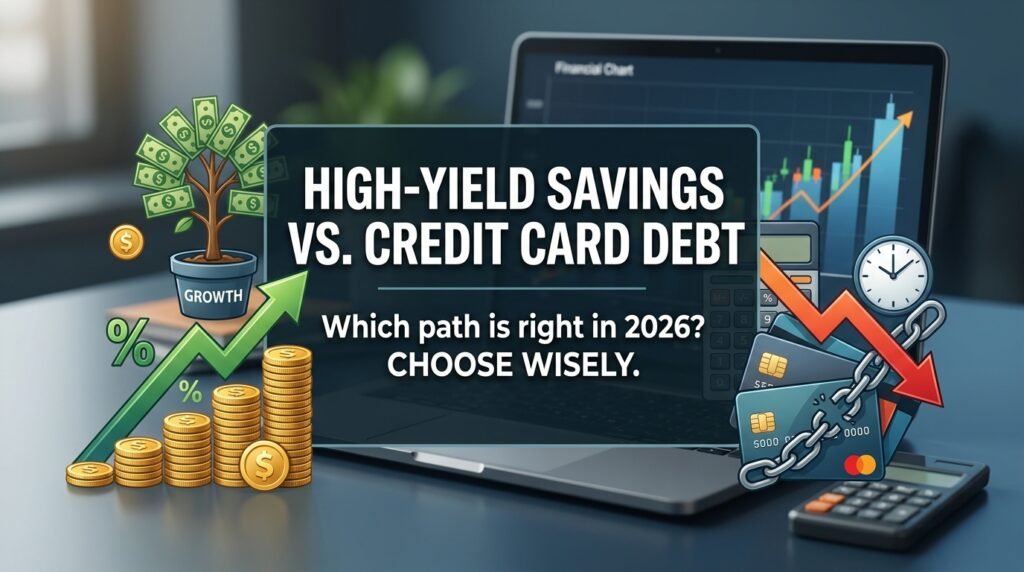
When you have extra money available, deciding what to do with it can be difficult. Should you put the money into a high-yield savings account or use it to pay off credit card debt?
The answer depends on your interest rates, emergency savings, monthly budget, and financial priorities. In 2026, this question remains especially relevant because credit card borrowing costs can be much higher than the rates available on savings accounts.
The Federal Reserve raised its federal funds target range to 3.75% to 4.00% in September 2026. However, the federal funds rate is not the same as the rate you personally receive on a savings account or pay on a credit card. Your actual rates depend on the financial product and provider.
Understanding the difference between earning interest on savings and avoiding interest on debt can help you decide where your extra money may have the greatest financial impact.
How High-Yield Savings Accounts Work

A high-yield savings account is a savings account that generally offers a higher annual percentage yield, or APY, than a traditional savings account.
When you deposit money into the account, the bank pays you interest based on the account’s terms and APY. Your savings can continue earning interest while remaining relatively accessible for emergencies and other short-term needs.
For example, suppose you have $5,000 available and a savings account offers a 4% APY. The account could generate interest over time, although the actual amount you earn depends on the APY, balance, and how long the money remains deposited.
High-yield savings accounts can therefore be useful for building an emergency fund or saving for planned expenses.
How Credit Card Interest Works
Credit card debt works in the opposite direction.
Instead of earning interest, you are paying interest when you carry a balance subject to interest charges.
For example, if you have a credit card balance with a 22% APR, that debt can become significantly more expensive than money sitting in a savings account earning a lower APY.
Your actual credit card interest depends on your balance, APR, payment activity, and the issuer’s calculation method.
This difference is important when deciding what to do with extra cash.
If your credit card APR is substantially higher than the APY you can earn on savings, paying down the credit card balance can reduce future interest costs.
Compare the Rates Before Making a Decision
One of the simplest ways to approach the decision is to compare the two rates.
Suppose you have:
- $5,000 in available cash
- A savings account earning 4% APY
- A credit card charging 22% APR
If you keep the full $5,000 in savings, you may earn interest on that money.
If you use the $5,000 to pay down eligible credit card debt, you can reduce the amount of debt subject to the credit card’s APR.
The rates are not perfectly comparable because APY and credit card APR work differently, and taxes may also apply to savings interest. However, the comparison can still provide useful context.
When the interest rate on your credit card is much higher than the rate you can earn from savings, reducing the credit card balance may have a larger financial effect.
Do Not Ignore Your Emergency Fund
There is one important reason you may not want to put every available dollar toward credit card debt: emergencies happen.
A car repair, medical expense, home repair, or temporary income disruption could require immediate access to cash.
If you use all your savings to pay off a credit card and then face an unexpected expense, you may have to borrow again.
That is why it can make sense to maintain at least some emergency savings while paying down high-interest debt.
Our guide on Emergency Fund vs. Paying Off Debt explains how savings and debt repayment can work together rather than treating them as completely separate goals.
Consider Building a Starter Emergency Fund
If you have no savings at all, consider building a small cash cushion before directing every extra dollar toward debt.
The exact amount depends on your income, expenses, job stability, and financial situation.
The purpose of a starter emergency fund is not necessarily to cover every possible emergency. Instead, it can provide some cash for unexpected expenses without immediately relying on a credit card.
Once you have a basic cash cushion, you may be able to direct more of your extra money toward high-interest credit card debt.
Paying More Than the Minimum Can Matter
If you decide to prioritize credit card repayment, avoid relying only on the minimum payment when you can reasonably pay more.
Minimum payments can keep your account current, but they may result in a longer repayment period and more interest costs.
For example, a $3,000 credit card balance can take much longer to repay if you make only small minimum payments compared with making a larger fixed payment every month.
You can learn more about this issue in our guide to Credit Card Minimum Payment vs Full Payment.
Even a modest additional payment can help reduce the balance faster.
When Saving More May Make Sense

Paying off credit card debt is not always the only financial priority.
You may want to put more money into savings if:
- You have no emergency fund
- Your credit card balance has a relatively low APR
- You have an upcoming essential expense
- Your income is uncertain
- You need accessible cash for a specific financial goal
- Your employer offers a retirement contribution match you are not currently receiving
The right approach depends on your overall financial situation rather than one interest rate alone.
For example, if your credit card APR is relatively low and you have no emergency savings, building a cash cushion may be more important than immediately paying the balance down to zero.
What About a Balance Transfer?
A balance transfer may be another option if your credit card APR is high.
Some balance transfer cards offer promotional APRs for a limited period. This can potentially reduce interest costs while you work toward paying off the balance.
However, balance transfers can involve fees, and promotional periods eventually end.
Before applying, compare the transfer fee, promotional period, regular APR, and the amount you can realistically repay during the promotional period.
Our guide on What Is a Balance Transfer Credit Card and How Does It Work? explains how these cards work and what borrowers should check before transferring debt.
A balance transfer does not eliminate debt. It simply moves eligible debt to another account.
A Simple Way to Split Your Extra Money
You do not always have to choose between savings and debt repayment completely.
You could divide your extra money between the two goals.
For example, suppose you have an additional $400 available each month. You could put $100 toward savings and $300 toward your credit card balance until you reach a basic emergency cushion.
After building that cushion, you could redirect more of the monthly amount toward your credit card debt.
This approach can provide both liquidity and progress toward reducing high-interest debt.
What Should You Prioritize in 2026?
A useful starting point is to look at your credit card APR and savings APY.
If your credit card APR is significantly higher than the APY on your savings account, paying down the credit card balance can reduce future interest costs.
However, maintaining some emergency savings can help prevent unexpected expenses from becoming new credit card debt.
The decision also depends on whether you have other financial priorities, such as retirement contributions, upcoming expenses, or other high-interest debts.
Final Thoughts
The choice between a high-yield savings account and paying off credit card debt is not always an all-or-nothing decision.
High-yield savings can help you earn interest while keeping money available for emergencies. Paying off credit card debt can reduce the interest you would otherwise pay on a revolving balance.
In many situations, a practical approach is to build a basic emergency cushion first, continue making required debt payments, and then direct additional money toward high-interest credit card balances.
Before making a decision, compare your actual savings APY with your credit card APR, consider your need for emergency cash, and choose a strategy that fits your monthly budget.
The goal is to make your available money work more effectively while avoiding a cycle of new high-interest debt.