
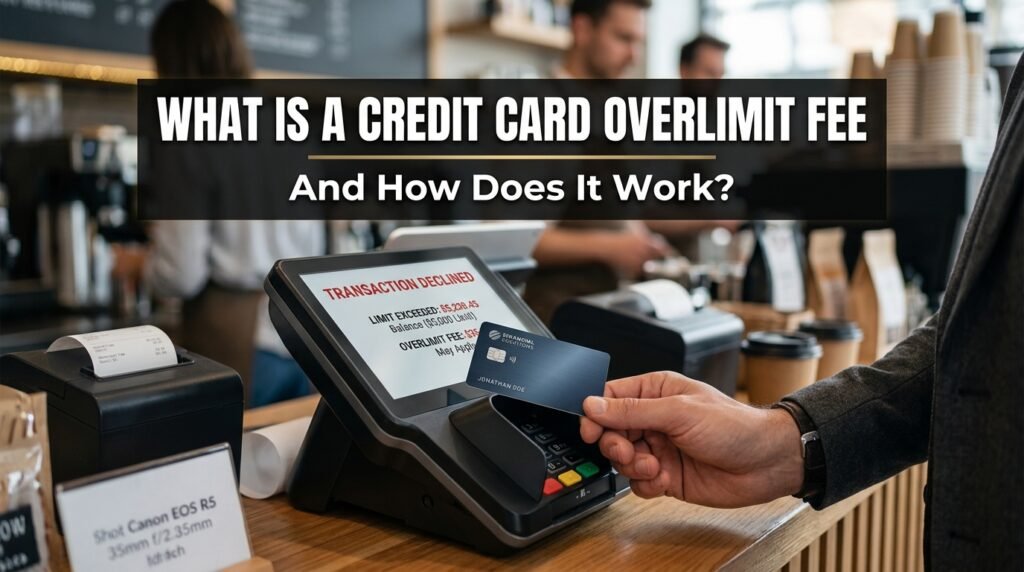
A credit card gives you access to a specific amount of available credit, but spending close to or above that limit can create unexpected problems. One charge that borrowers may encounter is a credit card overlimit fee.
An overlimit fee is a charge associated with exceeding your credit limit, although whether you can actually be charged one depends on your card agreement and applicable rules. In many cases, card issuers require your permission before allowing transactions that would take your balance above the credit limit.
Understanding how overlimit fees work can help you monitor your available credit, avoid unexpected charges, and manage your credit card more carefully.
What Is a Credit Card Overlimit Fee?
A credit card overlimit fee is a charge that may apply when your credit card balance exceeds the credit limit set by the card issuer.
For example, suppose your credit card has a $5,000 credit limit and your balance is already $4,900. If a new transaction causes your balance to exceed $5,000, the account could become over the credit limit.
However, credit card issuers do not all handle over-limit transactions in the same way. Some may decline a transaction that would exceed your limit, while others may approve it under certain circumstances if you have agreed to the applicable arrangement.
This means you should check your specific credit card agreement rather than assuming every issuer handles overlimit transactions identically.
How Does a Credit Card Limit Work?
Your credit limit is the maximum amount of revolving credit the issuer makes available to you under the account terms.
Suppose your credit limit is $8,000 and your current balance is $2,000. Your available credit would generally be $6,000, assuming there are no pending transactions or other adjustments.
As you make purchases, your available credit decreases. As you make payments, available credit generally increases again after the payment is processed and credited to your account.
Your balance can also increase because of interest charges, fees, cash advances, or other transactions.
Because of this, simply checking your recent purchases may not always tell you exactly how much available credit you have.
Can You Still Go Over Your Credit Limit?
Whether a transaction can take you above your credit limit depends on the card issuer and the terms of your account.
Some transactions may be declined if approving them would exceed your available credit. Other transactions may be processed even when they temporarily push the balance above the limit.
There can also be situations where your balance exceeds the limit without a new purchase directly causing it. For example, interest charges or fees could increase your balance after a purchase has already been authorized.
This is why it is important to monitor both your balance and available credit.
Are Credit Card Overlimit Fees Still Common?
Overlimit fees are not automatically charged simply because a balance exceeds a credit limit.
For U.S. credit cards, federal rules generally require consumers to opt in before an issuer can charge an over-the-limit fee. If you do not opt in, the issuer generally cannot charge the fee, although the issuer may decline transactions that would exceed your limit.
The exact rules and account terms can vary, so borrowers should review their cardholder agreement for details.
An issuer may also have different procedures for handling transactions that would exceed available credit.
How Much Can an Overlimit Fee Cost?
The amount of an overlimit fee depends on the credit card agreement and applicable regulations.
However, borrowers should not focus only on the fee itself. Going over a credit limit can have broader financial consequences.
For example, a high balance can increase your credit utilization ratio. Credit utilization measures the amount of revolving credit you are using compared with your available credit.
You can learn more about this relationship in our recently published guide on credit utilization and how the 30% rule actually works.
The URL above is a recently published CoreFoxes article, although its current URL slug does not match its article title. Always verify the live URL before publishing if your CMS or SEO setup has changed.
How Can Going Over Your Limit Affect Credit Utilization?
Credit utilization is one reason exceeding your credit limit can be significant.
Imagine that you have a $5,000 credit limit and a $4,500 balance. Your utilization would be 90%.
If your balance increases to $5,100, you would be using more than 100% of the stated credit limit.
High utilization can affect credit scoring because credit scoring models consider revolving credit balances and available credit as part of the information used to calculate scores.
However, there is no universal percentage at which every consumer experiences the same credit-score effect. Credit scoring depends on the broader credit profile and the scoring model being used.
Why Your Statement Date Matters
Your credit card statement date can also be important when monitoring your balance.
The statement closing date marks the end of a billing cycle. The issuer may report the balance associated with that cycle to credit bureaus.
For example, suppose you have a $10,000 credit limit, and your balance reaches $4,000 during the month. You then make a $3,000 payment before the statement closes. Your reported balance may be significantly lower than the highest balance you carried during the billing cycle.
Our recently published guide on the credit card statement date and how reported balances work explains why the statement closing date can matter when managing reported credit utilization.
However, reducing your reported balance does not replace making your required payment by the due date.
What Happens If You Accidentally Exceed Your Limit?
If your balance exceeds your credit limit, the first step is to check your account and determine why.
Possible reasons include:
- A purchase pushed the balance above the limit
- Interest was added
- A fee increased the balance
- A pending transaction was processed
- A payment was reversed or returned
- The issuer adjusted your available credit
If you can afford to do so, reducing the balance may restore available credit. You should also review your account for unfamiliar transactions or unexpected charges.
Contacting the card issuer can help clarify how the account is being handled and whether any specific restrictions apply.
Can Going Over the Limit Affect Your Credit Score?
Potentially, yes.
The balance and credit limit reported to credit bureaus can influence credit utilization calculations. A balance above the stated limit can therefore create a very high utilization ratio.
However, a credit score is based on multiple factors, including payment history and other information in your credit report.
Going over your limit is not necessarily the same thing as missing a payment. These are separate issues, although they can occur together.
For example, if your account becomes difficult to manage and you subsequently miss the required minimum payment, you could face additional consequences.
Our guide on how a late credit card payment can affect your credit explains the difference between being late and the other consequences that can arise when a required payment is not made on time.
How Can You Avoid an Overlimit Situation?

The easiest way to reduce the risk of going over your credit limit is to monitor your account regularly.
Consider these habits:
Check Available Credit
Do not rely only on your total credit limit. Check your available credit before making a large purchase.
Track Pending Transactions
Pending purchases can reduce your available credit even before they are fully posted.
Pay Attention to Interest and Fees
If you carry a balance, interest and fees can increase the amount you owe.
Make Payments on Time
Making at least the required minimum payment by the due date helps keep the account current.
Avoid Maxing Out Your Card
Using most of your available credit can increase utilization and leave less room for unexpected expenses.
What Should You Do If You Are Close to Your Credit Limit?
If your balance is approaching the credit limit, review your spending and determine whether you can reduce the balance.
You may also want to avoid unnecessary new purchases until more available credit is restored.
If the balance is difficult to manage, review your budget and consider whether you need to adjust your repayment strategy.
Most importantly, do not ignore the account. Regularly checking your balance, available credit, statement date, and payment due date can help you spot problems before they become more difficult to handle.
Final Thoughts
A credit card overlimit fee is a charge that may be associated with exceeding your credit limit, but whether it applies depends on your account terms and applicable rules.
Going over your limit can also create concerns beyond a potential fee. A very high balance can increase credit utilization, reduce available credit, and make it harder to manage your account.
The best way to avoid surprises is to monitor your available credit, understand your cardholder agreement, track statement and payment dates, and make payments on time.
By understanding how your credit card works before your balance reaches the limit, you can reduce the risk of unexpected charges and keep better control over your revolving credit.