
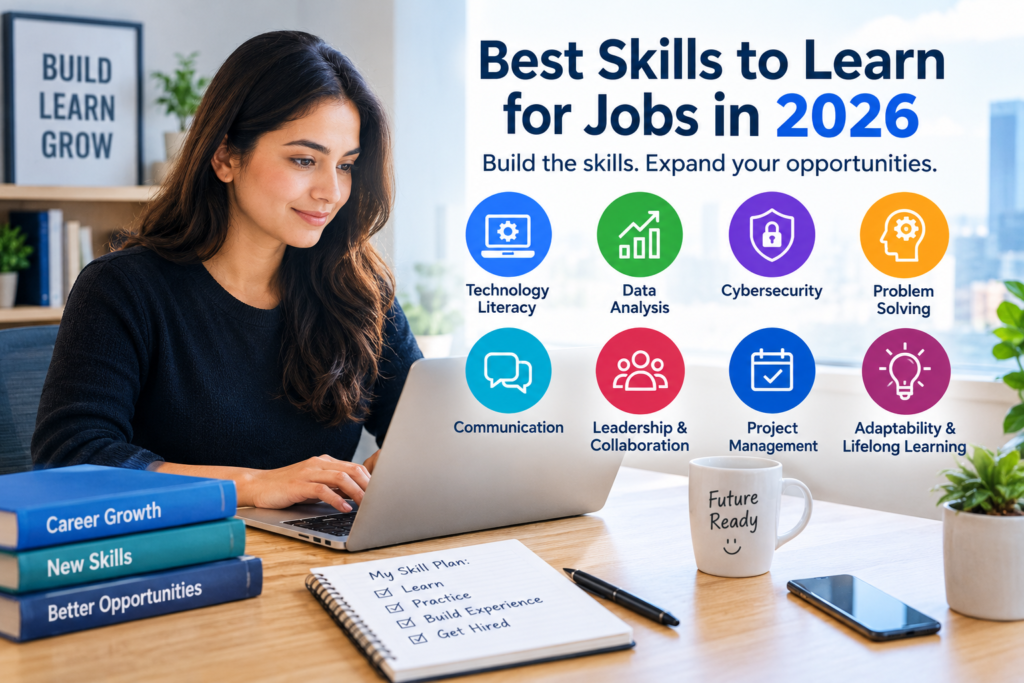
A strong resume can help you get noticed, but relevant skills can determine whether you qualify for the job in the first place.
Employers continue to look for people who can solve problems, work with technology, communicate clearly, and adapt to changing requirements. The exact skills vary by industry, but several skills can help across multiple career paths.
The best skills to learn for jobs in 2026 are not limited to technical abilities. Employers also need people who can think critically, communicate with others, learn new tools, manage projects, and make sound decisions.
The right skills can also help students, recent graduates, career changers, and experienced professionals expand their options.
Why Job Skills Matter in 2026
Job requirements can change as businesses adopt new technologies and adjust their operations.
The World Economic Forum’s Future of Jobs Report 2025 identifies analytical thinking as the leading core skill reported by employers. It also highlights resilience, flexibility, leadership, creative thinking, technological literacy, and lifelong learning as important skills.
The report also identifies artificial intelligence and big data, networks and cybersecurity, and technological literacy among the fastest growing skill areas.
US employment projections show similar demand in several technology related occupations. The Bureau of Labor Statistics projects strong growth between 2024 and 2034 for data scientists and information security analysts.
This does not mean everyone needs to become a programmer or data scientist.
Instead, job seekers can build a combination of technical and professional skills that fits their target career.
1. Artificial Intelligence and Technology Literacy
Technology skills are among the most useful areas to develop in 2026.
You do not necessarily need advanced programming knowledge. Basic technology literacy can help you work more effectively in many roles.
Technology literacy can include understanding how digital tools work, choosing the right software for a task, managing digital information, and learning new workplace platforms.
Professionals can also learn how artificial intelligence tools support research, writing, analysis, customer service, administration, and other tasks.
The most useful approach is to understand how technology applies to your specific occupation.
For example, a marketing professional could learn technology used for analytics and campaign management. An office professional could improve skills with productivity and automation tools.
A healthcare professional may need different technology skills related to records, scheduling, data, or patient services.
How to build this skill
Start with tools that appear frequently in job descriptions for your target role.
Learn the basic functions first.
Then complete practical projects that demonstrate what you can do.
A certificate can support your application, but practical ability is often easier to demonstrate through examples.
2. Data Analysis
Data is used across many industries.
Companies use information to understand customers, measure performance, manage operations, identify problems, and make decisions.
That makes data analysis a useful career skill even outside traditional data jobs.
Basic data skills can include:
- Spreadsheet analysis
- Data cleaning
- Charts and dashboards
- Statistical concepts
- Data visualization
- Reporting
- Trend analysis
- Interpreting business data
You can start with spreadsheet software.
Learn formulas, sorting, filtering, pivot tables, charts, and basic data organization.
After that, you can explore tools such as SQL, Python, or business intelligence platforms if they match your career goals.
The Bureau of Labor Statistics projects data scientist employment to grow by 34 percent from 2024 to 2034. It also projects about 23,400 openings for data scientists each year on average during that period.
Data science is a specialized career, but the broader lesson is useful.
Learning to understand and communicate data can support many different jobs.
3. Cybersecurity
Businesses increasingly depend on digital systems and connected technology.
That creates a need for professionals who understand how to protect systems, information, and networks.
Cybersecurity is a specialized field, but basic security knowledge can benefit professionals in many roles.
Useful areas include:
- Password security
- Access management
- Data protection
- Network security basics
- Security awareness
- Risk management
- Privacy practices
- Incident response concepts
People interested in a dedicated cybersecurity career can continue into networking, security operations, cloud security, or information security.
The Bureau of Labor Statistics projects information security analyst employment to grow by 29 percent between 2024 and 2034.
Cybersecurity therefore offers a potential career path for people who enjoy technology, investigation, and problem solving.
4. Analytical Thinking
Technology can process large amounts of information, but professionals still need to understand what the information means.
Analytical thinking helps you break a complicated problem into smaller parts.
It can help you compare options, identify patterns, evaluate evidence, and make decisions.
This skill applies to almost every industry.
A business analyst uses analytical thinking to evaluate performance.
A manager uses it to solve operational problems.
A healthcare professional uses it to evaluate information.
A student uses it to assess research and arguments.
How to improve analytical thinking
Practice asking simple questions.
What is the actual problem?
What evidence supports the conclusion?
What information is missing?
What are the possible causes?
What could happen if the decision changes?
This approach can improve both workplace decisions and academic work.
5. Communication
Strong communication remains one of the most practical career skills.
Employers need people who can explain information clearly to customers, colleagues, managers, and other stakeholders.
Communication includes more than speaking.
It involves:
- Writing
- Listening
- Presenting
- Explaining technical information
- Asking useful questions
- Giving feedback
- Communicating with customers
- Writing professional emails
Good communication can make technical knowledge more useful.
A skilled analyst who cannot explain findings may struggle to influence decisions.
A technically capable employee who communicates clearly can often work more effectively with people outside their specialty.
6. Problem Solving
Employers do not only hire people to complete instructions.
They also need employees who can identify problems and find workable solutions.
Problem solving involves understanding the issue, collecting relevant information, comparing options, taking action, and reviewing the result.
You can develop this skill through practical projects.
For example, find a process that takes too much time.
Map the steps.
Identify where delays occur.
Propose a change.
Then measure the result if possible.
This creates a concrete example that you can discuss during an interview.
7. Cybersecurity and Digital Risk Awareness
Cybersecurity deserves special attention because digital risk affects employees across many departments.
You do not need to become a security specialist to understand basic security practices.
Employees may handle customer information, financial records, company files, passwords, or confidential communications.
Understanding common risks can help prevent mistakes.
Learn how phishing attacks work.
Understand why strong authentication matters.
Know how sensitive information should be handled.
Learn the basic principles of access control and secure file sharing.
These skills can complement almost any office based career.
8. Project Management
Project management skills are useful when work involves deadlines, people, budgets, tasks, and deliverables.
You do not need to become a project manager to benefit from these skills.
Learn how to:
- Define project goals
- Break work into tasks
- Set deadlines
- Track progress
- Identify risks
- Communicate updates
- Manage priorities
- Document decisions
These abilities can help employees organize their own work and collaborate with teams.
Students can develop project management skills through academic projects, volunteer work, internships, or personal projects.
9. Adaptability and Lifelong Learning
A skill can become less valuable when technology or business practices change.
That makes the ability to learn important.
The World Economic Forum identifies curiosity and lifelong learning among the skills expected to increase in importance through 2030.
Adaptability does not mean learning every new tool.
It means being willing to understand what is changing and determine what matters for your career.
A professional who learns one useful tool deeply may gain more value than someone who collects dozens of basic certificates.
Focus on skills that connect to real work.
10. Leadership and Collaboration
Leadership is not limited to people with management titles.
An employee can demonstrate leadership by taking responsibility, helping colleagues, organizing work, solving problems, and communicating clearly.
Collaboration is equally important.
Most workplaces require people to work with others.
You may need to cooperate with people from different departments, backgrounds, or professional specialties.
Useful collaboration skills include:
- Active listening
- Conflict management
- Delegation
- Feedback
- Team communication
- Accountability
- Decision making
Students can begin developing these skills through group projects, student organizations, internships, and volunteer activities.
11. Customer Service and Relationship Skills
Customer service skills apply to far more careers than traditional customer service jobs.
Sales, healthcare, hospitality, banking, technology, consulting, education, and many other industries require employees to understand customer needs.
Important skills include listening, patience, empathy, clear communication, and problem solving.
A professional who can understand a customer’s problem and explain a solution clearly can provide value across many industries.
These skills can also complement technical abilities.
For example, a technology professional may need to explain a complex issue to a customer without using unnecessary technical language.
12. Writing and Research
Professional writing remains useful even when technology changes how people create documents.
Employees write emails, reports, proposals, presentations, instructions, project updates, and customer communications.
Research skills are also valuable.
Good research involves finding reliable information, checking sources, comparing evidence, and communicating findings accurately.
Students can build these skills through academic research.
Professionals can develop them through reports, industry research, and workplace projects.
The combination of research and writing can be particularly useful in business, marketing, communications, education, consulting, and policy related roles.
How to Choose the Right Skills for Your Career
You do not need to learn every skill on this list.
Start with your target occupation.
Step 1, Find Your Target Jobs
Search several job listings for the type of position you want.
Save around 10 to 20 relevant listings.
Look for skills that appear repeatedly.
Step 2, Create a Skills List
Divide the requirements into three groups.
Already have: Skills you can demonstrate today.
Need to improve: Skills you understand but need to practice.
Need to learn: Skills that are new to you.
This gives you a clear starting point.
Step 3, Choose Two or Three Skills
Avoid trying to learn everything at once.
Choose two or three skills that appear frequently in your target jobs.
Build those skills before moving to another area.
Step 4, Create Evidence
Do not only say that you have a skill.
Show what you have done with it.
A data analysis project can demonstrate data skills.
A portfolio can demonstrate design or writing.
A completed security project can demonstrate technical knowledge.
A project plan can demonstrate organization and management skills.
Evidence can make your resume more credible.
Common Mistakes When Learning Job Skills
Learning Skills Without a Career Goal
A long list of random courses does not automatically create a strong career profile.
Start with the jobs you want.
Then identify the skills those jobs require.
Collecting Certificates Without Practice
A certificate can show that you completed training.
It does not always demonstrate that you can apply the knowledge.
Build projects alongside your courses.
Trying to Learn Too Many Tools
Knowing the basics of many tools can be useful.
However, shallow knowledge may not help you qualify for specialized positions.
Learn the tools that matter most for your target career.
Ignoring Communication Skills
Technical skills can attract attention, but communication can determine how effectively you use them.
Practice explaining your work to someone without technical knowledge.
If you can make a complex idea understandable, you are building a valuable professional skill.
How Students Can Build Career Skills
Students do not need to wait until graduation.
Start with coursework.
Choose projects that allow you to practice useful skills.
Internships can provide another opportunity to connect academic knowledge with workplace tasks.
Student organizations can also develop leadership and communication skills.
Personal projects can help when formal work experience is limited.
For example, a student interested in data could analyze a public dataset and present the findings.
Someone interested in marketing could create a sample campaign plan.
A cybersecurity student could build a controlled learning project.
The goal is to create evidence of practical ability.
How Career Changers Can Build New Skills
Career changers often already possess transferable skills.
The challenge is identifying them.
A sales professional may have communication, negotiation, customer service, and data tracking experience.
An administrative professional may have organization, scheduling, documentation, and project coordination skills.
A teacher may have presentation, planning, training, communication, and leadership experience.
Identify these skills before deciding that you need to start over.
Then add the technical skills required for your target occupation.
This can create a more realistic transition plan.
A Simple 90 Day Skills Plan
A structured plan can make learning easier.
First 30 Days
Choose one technical or professional skill.
Complete a structured course or learning program.
Practice the skill several times each week.
Days 31 to 60
Start a practical project.
Use the skill to solve a realistic problem.
Document your process and results.
Days 61 to 90
Add the project to your portfolio or resume where appropriate.
Apply for jobs that match your developing skills.
Continue improving based on employer requirements and interview feedback.
This approach creates a connection between learning and employment.
Which Skills Should You Prioritize?
The answer depends on your career.
For technology careers, consider data analysis, cybersecurity, technology literacy, and programming.
For business careers, consider communication, data analysis, project management, and problem solving.
For healthcare careers, consider communication, technical knowledge, documentation, and specialized credentials.
For creative careers, consider design, communication, technology literacy, and project management.
For management careers, consider leadership, communication, analytical thinking, and resource management.
The strongest skill combination is usually the one that matches your target occupation.
Final Thoughts
The best skills to learn for jobs in 2026 combine technical knowledge with strong human abilities.
Technology literacy, data analysis, cybersecurity, analytical thinking, communication, problem solving, project management, adaptability, leadership, and research can support a wide range of careers.
You do not need to master everything.
Choose skills based on the jobs you want, practice them through real projects, and keep evidence of what you can do.
US employment projections also show continued growth in several occupations that rely on data, technology, healthcare, and specialized expertise. The Bureau of Labor Statistics projects particularly strong growth for data scientists and information security analysts through 2034.
The most useful career strategy is therefore not simply learning more skills.
It is learning the right skills for the work you want to do and proving that you can apply them.