
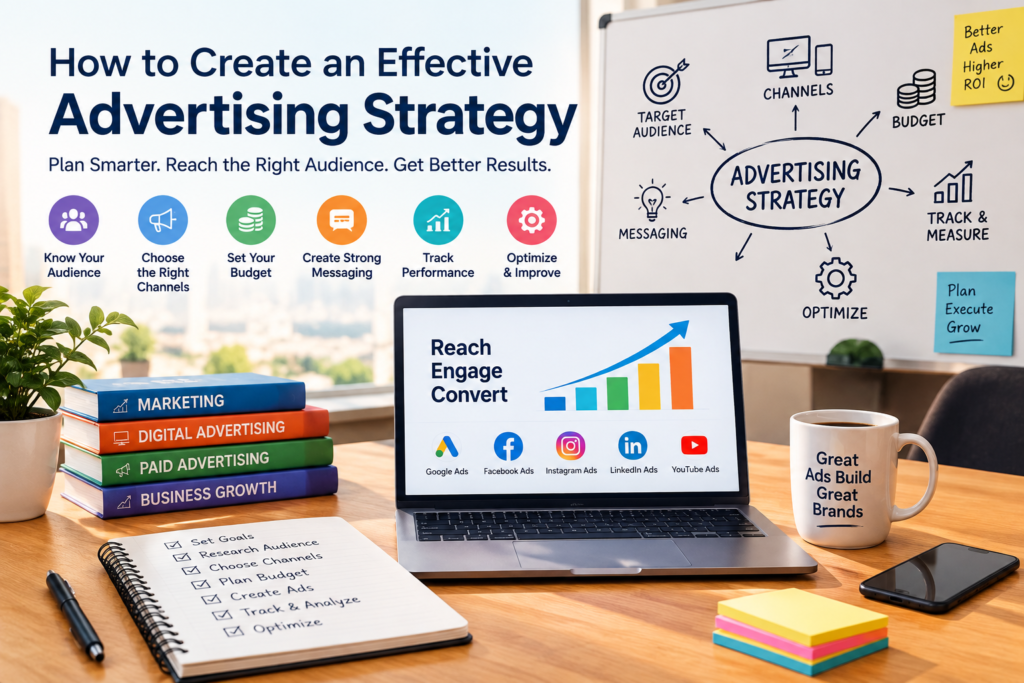
Spending money on advertising does not automatically bring more customers.
A business can launch ads, attract thousands of views, and still struggle to generate meaningful results. The problem often starts before the first ad goes live.
A clear advertising strategy gives every campaign a purpose. It helps a business decide who to reach, where to advertise, what message to use, how much to spend, and which results to track.
This matters even more as businesses gain access to more advertising channels. U.S. internet advertising revenue reached $294.6 billion in 2025, according to the IAB and PwC. That represented a 13.9 percent increase from 2024.
The goal is not to advertise everywhere. The goal is to build a strategy around the customers you want to reach and the results you want to achieve.
What Is an Advertising Strategy?
An advertising strategy is a planned approach for promoting a business, product, service, or offer to a specific audience.
It connects several important decisions.
These include:
- Business goals
- Target audience
- Advertising channels
- Campaign budget
- Advertising message
- Creative content
- Landing pages
- Campaign tracking
- Performance analysis
A strategy gives your advertising direction before you spend money.
For example, a local home improvement company may want more service inquiries from homeowners within its service area.
Its advertising strategy could focus on search advertising, local targeting, service specific landing pages, and lead tracking.
A clothing brand with a national customer base may need a different approach. It could focus on social media, video, shopping ads, and remarketing.
The right advertising strategy depends on the business and its customers.
Why Your Business Needs an Advertising Strategy
Without a clear strategy, advertising can become a series of disconnected campaigns.
One month, a business may run social media ads. The next month, it may switch to search advertising. Another campaign may promote brand awareness without any clear measurement plan.
This approach makes it difficult to understand what is working.
A strong advertising strategy helps you:
- Set clear campaign goals
- Reach relevant customers
- Control advertising spending
- Create consistent messaging
- Choose suitable advertising channels
- Measure meaningful results
- Identify weak areas
- Improve campaigns over time
It also helps prevent one of the most common advertising mistakes.
That mistake is spending money first and deciding what the campaign should accomplish later.
Step 1. Define Your Advertising Goal
Every advertising strategy should start with a specific objective.
Your goal determines how you structure the campaign and measure its performance.
Common advertising goals include:
- Increasing brand awareness
- Generating leads
- Increasing online sales
- Promoting a new product
- Driving website traffic
- Increasing bookings
- Encouraging phone calls
- Promoting a seasonal offer
- Reaching a new market
Avoid goals that are too vague.
“Get more customers” does not provide enough direction.
Instead, identify the result you want to influence.
For example, a dentist might want more appointment requests. A software company might want more product demonstrations. An online retailer might want more purchases.
The advertising campaign should support that specific business objective.
Step 2. Identify Your Target Audience
Your advertising strategy should identify who you want to reach.
A target audience can be defined using several factors.
These may include:
- Location
- Age
- Interests
- Search behavior
- Purchasing needs
- Previous website activity
- Industry
- Job role
- Business size
- Customer type
The information you need depends on your business.
A local restaurant may care more about location and customer interests.
A business software company may focus on industry, company size, and job responsibilities.
Avoid targeting everyone simply because you want more exposure.
A broad audience can make advertising messages less relevant. A more focused audience can make it easier to explain why the product or service matters.
Step 3. Understand Your Customer’s Problem
Effective advertising does more than describe a product.
It addresses a customer need.
Ask yourself what problem your audience is trying to solve.
For example, a customer searching for emergency plumbing help is not simply looking for a plumbing company. They need a solution to an immediate problem.
An accounting firm may advertise around tax preparation, bookkeeping, or business financial management.
A fitness business may focus on specific customer goals instead of simply advertising gym memberships.
Understanding the problem helps you create advertising messages that connect with customer intent.
Step 4. Choose the Right Advertising Channels
There is no single advertising channel that works for every business.
Your choice should depend on your audience and campaign goal.
Search Advertising
Search advertising can work well when customers already have a specific need.
Someone searching for “roof repair near me” has different intent from someone casually watching a home improvement video.
Search campaigns can therefore be useful for businesses that provide services or products people actively search for.
Social Media Advertising
Social advertising can help businesses reach people based on audience characteristics and platform activity.
Businesses can promote images, videos, products, offers, events, and lead generation campaigns.
Social media can also support brand awareness when customers are not actively searching for a product.
Display Advertising
Display advertising uses visual advertisements across websites and digital platforms.
It can support awareness campaigns and help businesses remain visible to potential customers.
Video Advertising
Video allows businesses to demonstrate products, explain services, and communicate more detailed messages.
It can be useful when customers need more information before taking action.
Local Advertising
Local businesses can focus advertising on specific cities, regions, or service areas.
This approach can prevent a business from paying to reach people who cannot become customers.
A local contractor, for example, may have little value from advertising outside the areas where it operates.
Step 5. Set an Advertising Budget
Your advertising budget should reflect your business goal and available resources.
There is no universal amount that every business should spend.
Google Ads uses average daily budgets for campaigns. Google also explains that actual costs can vary and provides spending controls for advertisers.
Start by deciding what you can reasonably spend while maintaining the campaign long enough to gather useful information.
Do not build a budget around a promise of guaranteed results.
Instead, treat the initial campaign as a structured process for reaching customers, collecting data, and learning which approaches perform better.
Your budget should also account for more than media spending.
You may need resources for:
- Ad design
- Video production
- Copywriting
- Landing pages
- Campaign management
- Analytics
- Testing
- Software
A low advertising budget can still benefit from a focused strategy.
A larger budget does not automatically fix poor targeting or weak messaging.
Step 6. Create a Strong Advertising Message
Your advertising message should quickly explain why someone should care.
A useful advertisement normally communicates three things.
What are you offering?
Why should the customer care?
What should the customer do next?
Keep the message relevant to the audience.
For example, a home services company could focus on the service problem it solves and the next step for requesting service.
An online retailer could highlight a product benefit and direct customers to the product page.
Avoid filling the advertisement with every feature your business offers.
One clear message is often easier to understand than a long list of unrelated benefits.
Step 7. Create a Relevant Landing Page
Your advertisement is only one part of the customer experience.
After someone clicks the ad, the landing page needs to support the same message.
Suppose an advertisement promotes a specific service.
The landing page should explain that service rather than sending visitors to a generic page with dozens of unrelated options.
A strong landing page should make the next step obvious.
Depending on the campaign, that action could be:
- Requesting a quote
- Booking an appointment
- Making a purchase
- Calling the business
- Completing a form
- Downloading information
- Starting a free trial
Keep the process simple.
Every unnecessary step can create another opportunity for a potential customer to leave.
Step 8. Track the Right Advertising Metrics
An advertising strategy needs measurement.
The right metrics depend on the campaign objective.
Common advertising metrics include:
- Impressions
- Reach
- Clicks
- Click through rate
- Cost per click
- Leads
- Conversion rate
- Cost per lead
- Sales
- Revenue
- Return on advertising spend
Do not focus on one metric in isolation.
A campaign may generate many clicks but few qualified leads.
Another campaign may produce fewer clicks but generate more valuable customers.
For that reason, businesses should connect advertising data with meaningful business outcomes whenever possible.
Step 9. Test Different Approaches
Advertising rarely becomes perfect after one campaign.
Testing helps identify what works better.
You can test different:
- Headlines
- Images
- Videos
- Offers
- Calls to action
- Audiences
- Keywords
- Landing pages
- Ad formats
Change one meaningful element at a time when practical.
This makes it easier to understand why performance changed.
Avoid making major decisions from a very small amount of data.
Campaign performance can change because of audience behavior, competition, seasonality, budget changes, and other factors.
Step 10. Optimize Your Advertising Strategy
Once you have campaign data, look for areas that need improvement.
Start with the customer journey.
If people see your advertisements but rarely click, review your targeting, message, creative, and offer.
If people click but do not convert, examine your landing page and customer experience.
If people convert but generate little business value, review the quality of your audience and the economics of the campaign.
Optimization should be based on evidence rather than assumptions.
A campaign that performs well in one location may not perform the same way in another.
Likewise, a message that works for one customer group may not work for another.
A Simple Advertising Strategy Example
Consider a fictional local landscaping company in Texas.
The company wants to generate more residential service inquiries.
Its advertising strategy could look like this.
Goal
Generate qualified service inquiries.
Audience
Homeowners within the company’s service area.
Channel
Search advertising focused on relevant landscaping services.
Message
Highlight the specific services offered and encourage potential customers to request an estimate.
Landing page
Create a service page that explains the offer and provides a simple inquiry form.
Measurement
Track calls, forms, qualified leads, and customer acquisitions.
Optimization
Review search terms, advertisements, locations, and landing page performance.
This example shows why an advertising strategy needs to connect every part of the campaign.
The advertisement should reach the right audience. The message should match the customer’s need. The landing page should support the advertisement. Measurement should show what happens after the click.
Common Advertising Strategy Mistakes
Trying to Use Every Platform
Businesses do not need to advertise everywhere.
Using too many platforms can spread the budget and management resources too thin.
Start with channels that match your audience and objective.
Focusing Only on Traffic
Website traffic can be useful, but traffic alone does not necessarily produce business results.
Look beyond clicks when your goal involves leads, sales, bookings, or revenue.
Using the Same Message Everywhere
Different platforms create different customer experiences.
A search advertisement can address an immediate need. A social media advertisement may need to create interest before someone takes action.
Adapt the message to the channel.
Sending Every Visitor to the Homepage
A generic homepage may not match the promise made in an advertisement.
Use relevant landing pages when possible.
Ignoring Advertising Rules
Advertising claims must be truthful and supported by evidence.
The Federal Trade Commission states that advertising must not be deceptive or unfair and that advertisers need evidence to support their claims. These requirements also apply to online advertising.
Avoid unsupported claims about guaranteed results, savings, performance, health outcomes, or product effectiveness.
Google also prohibits false or misleading claims in its advertising policies.
How to Make Your Advertising Strategy More Effective
A few practical principles can improve your approach.
Match the Message to Customer Intent
Someone actively searching for a service may need a different message from someone discovering a brand for the first time.
Consider what the customer already knows before writing the advertisement.
Make the Offer Easy to Understand
Customers should not have to interpret complicated advertising copy.
Explain the product, service, offer, or next step clearly.
Keep the Customer Journey Consistent
The advertisement, landing page, and follow up process should make sense together.
A disconnect between these stages can reduce the value of your advertising spend.
Measure Business Outcomes
Connect advertising metrics with actual business results when possible.
This provides more useful information than judging campaigns only by impressions or clicks.
Review Campaigns Regularly
Advertising requires ongoing attention.
Review performance, identify weak points, test improvements, and adjust your strategy based on the available evidence.
Advertising Strategy FAQs
What is the most important part of an advertising strategy?
A clear business objective is a strong starting point. Your goal determines your audience, channel selection, messaging, budget, and measurement approach.
How much should a small business spend on advertising?
There is no universal budget that fits every small business. The appropriate amount depends on the business goal, audience, market, channel, and available resources.
Which advertising channel should a business use?
The right channel depends on where the target audience can be reached and what the campaign needs to accomplish. Search, social media, display, video, and local advertising can serve different purposes.
How long does an advertising strategy take to work?
There is no universal timeframe. Results depend on factors such as the campaign objective, audience, budget, competition, offer, advertising channel, and customer buying cycle.
Should a business use multiple advertising channels?
It can, but using more channels does not automatically improve results. Businesses should choose channels based on audience fit, objectives, budget, and measurement capabilities.
Final Thoughts
An effective advertising strategy starts long before an advertisement appears on a screen.
Define the business goal first. Then identify the audience, choose suitable channels, create a clear message, set a realistic budget, and build a relevant customer journey.
Once the campaign launches, measure meaningful results and use the data to improve it.
Advertising should not be treated as a single activity that ends when an ad goes live. It works better as an ongoing process of planning, testing, measuring, and refining.
The strongest strategy is one that connects advertising activity with a clear business objective and gives the business enough information to make better decisions over time.

