
When you invest in dividend-paying stocks or funds, you may receive cash distributions from your investments. Instead of taking those dividends as cash, you can choose to use them to purchase additional shares. This process is known as dividend reinvestment.
A Dividend Reinvestment Plan, commonly called a DRIP, allows investors to automatically reinvest eligible dividends into additional shares of the investment. Over time, this can increase the number of shares an investor owns and potentially increase future dividend payments.
Dividend reinvestment is a relatively simple concept, but understanding how it works, its potential benefits, taxes, and risks can help investors decide whether it fits their long-term investment strategy.
What Is Dividend Reinvestment?
Dividend reinvestment means using dividends received from an investment to purchase additional shares instead of receiving the dividend as cash.
For example, suppose you own 100 shares of a company and receive a $1 dividend per share. Your dividend would be $100.
Instead of receiving that $100 in cash, a dividend reinvestment plan could use it to purchase additional shares.
If the stock price were $50 per share, the $100 dividend could purchase two additional shares.
You would then own 102 shares rather than 100.
The actual number of shares purchased depends on the dividend amount, investment price, and whether fractional shares are available.
What Is a DRIP?
DRIP stands for Dividend Reinvestment Plan.
A DRIP is a program that automatically uses dividends from eligible investments to purchase additional shares of the same investment.
Depending on the brokerage or company offering the plan, investors may be able to reinvest dividends automatically without manually placing a new trade each time a dividend is paid.
Some brokerages offer dividend reinvestment for stocks and exchange-traded funds, while others may have different rules or eligibility requirements.
The important feature is automation. Once the reinvestment option is activated, eligible dividends can be used to purchase additional shares according to the brokerage’s or plan’s terms.
How Does a Dividend Reinvestment Plan Work?
The process is generally straightforward.
First, an investor purchases a dividend-paying stock or fund.
Next, the investment pays an eligible dividend.
If dividend reinvestment is enabled, the dividend is used to purchase additional shares rather than being paid entirely as cash.
The additional shares are then added to the investor’s account.
Future dividends may be based on the investor’s increased share ownership.
For example, imagine you start with 100 shares and receive dividends that allow you to purchase two additional shares. You now own 102 shares.
If the company later pays another dividend, you may receive a dividend based on 102 shares rather than the original 100, assuming the dividend remains unchanged.
This process can continue over many years.
What Is Dividend Compounding?
Dividend reinvestment can contribute to a compounding effect.
Compounding occurs when returns generated by an investment are reinvested and those reinvested amounts can generate additional returns in the future.
With dividend-paying investments, reinvested dividends can purchase more shares. Those additional shares may then produce more dividends.
For example:
- You own 100 shares.
- Your investment pays dividends.
- The dividends purchase additional shares.
- Your share count increases.
- Future dividends may be calculated on the larger number of shares.
- Those dividends can purchase additional shares again.
This does not guarantee that the investment will increase in value or that future dividends will remain unchanged. However, reinvesting distributions can increase exposure to the investment over time.
Does Dividend Reinvestment Increase Your Returns?
It can increase the amount invested in a dividend-paying asset, but it does not guarantee higher returns.
The total return of an investment can come from multiple sources, including changes in the investment’s price and income such as dividends.
When dividends are reinvested, the investor remains invested rather than taking the distribution as cash.
If the underlying investment performs well over the long term, reinvested dividends can contribute to portfolio growth.
However, dividends are not guaranteed. Companies can reduce, suspend, or eliminate dividends, and investment prices can fall.
Therefore, dividend reinvestment should not be viewed as a risk-free way to grow wealth.
DRIP vs. Taking Dividends as Cash
Investors generally have two broad choices when receiving dividends.
The first is to take the dividend as cash.
This can be useful if you need income for living expenses, bills, or other financial goals.
The second is to reinvest the dividend.
Reinvestment may be more suitable for investors focused on long-term growth who do not currently need the income.
For example, someone saving for a long-term goal may prefer to keep dividends invested, while someone using an investment portfolio to generate current income may prefer cash distributions.
The right choice depends on the investor’s goals, risk tolerance, time horizon, and overall financial situation.
Can DRIPs Buy Fractional Shares?
Many modern brokerage platforms allow fractional shares, although availability depends on the brokerage and investment.
Fractional shares can be useful because dividend payments do not always equal enough money to purchase a whole share.
For example, suppose your dividend payment is $18 and the stock trades at $100.
If fractional shares are supported, the $18 could potentially purchase 0.18 shares.
This allows more of the dividend to remain invested rather than waiting until enough cash accumulates to purchase a whole share.
Investors should check their brokerage’s specific rules regarding fractional shares and dividend reinvestment.
Are Reinvested Dividends Taxable?
Dividend taxation depends on the investor’s country, account type, and applicable tax rules.
In some taxable investment accounts, receiving a dividend can create a tax obligation even if the dividend is automatically reinvested rather than received as cash.
This is an important point because reinvesting a dividend does not necessarily mean the dividend is ignored for tax purposes.
Tax rules can also differ between qualified and non-qualified dividends in the United States and may vary in other countries.
Investors should review the tax treatment applicable to their specific account and jurisdiction or consult a qualified tax professional when necessary.
What Happens When the Stock Price Falls?
Dividend reinvestment does not protect an investor from falling investment prices.
Suppose you receive a $100 dividend and automatically reinvest it when the stock price is $50. You would purchase two shares.
If the stock price later falls to $40, those two shares would have a market value of $80.
The reinvested dividend has increased your share count, but the investment can still lose market value.
This is why dividend reinvestment should be considered as part of a broader investment strategy rather than as a guarantee of profit.
DRIPs and Long-Term Investing
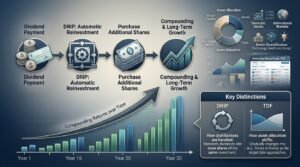
Dividend reinvestment can be particularly relevant for long-term investors because it keeps distributions invested.
Investors with longer time horizons may have more opportunity for reinvested dividends and additional shares to contribute to portfolio growth.
However, diversification remains important.
A portfolio should not necessarily be built around dividend payments alone. Investors may consider different asset classes, sectors, geographic markets, and investment funds based on their individual goals.
For example, investors who want a fund designed to gradually change its asset allocation over time may also research how target-date funds work.
The important distinction is that a DRIP describes what happens to distributions, while a target-date fund describes a type of investment strategy and fund structure.
How Inflation Can Affect Dividend Investing
Inflation is another factor investors should consider.
If the cost of goods and services increases over time, the purchasing power of investment income can change.
For example, receiving the same $1,000 of dividend income several years from now may not provide the same purchasing power if prices have increased significantly.
Understanding the relationship between inflation, savings, investment returns, and purchasing power can therefore be useful for long-term planning. Our guide to inflation in Pakistan in 2026 and what it means for your money explains how changing prices can affect household finances and purchasing power.
Should You Always Reinvest Dividends?
No.
There are situations where taking dividends as cash may make more sense.
For example, an investor who is retired may use dividend income to help cover regular expenses.
Someone building an emergency fund may also prefer to direct investment income toward cash savings instead of automatically reinvesting everything. Our recently published guide on emergency savings accounts and where to keep emergency money explains why accessible savings can play an important role in financial planning.
Investors should also consider whether their portfolio has become too concentrated in a particular company or sector.
If dividends are continually reinvested into the same investment, the investor’s exposure to that investment can increase over time.
Final Thoughts
Dividend reinvestment allows investors to use dividend payments to purchase additional shares instead of taking the money as cash.
A DRIP can automate this process and may help investors increase their share ownership over time. When reinvested dividends purchase additional shares, those shares may generate future dividends, creating a potential compounding effect.
However, dividend reinvestment does not eliminate investment risk. Share prices can fall, dividends can be reduced or eliminated, and taxes may apply even when dividends are automatically reinvested.
Whether to reinvest dividends or receive them as cash depends on your financial goals, income needs, investment horizon, tax situation, and overall portfolio strategy.
For long-term investors who do not need current dividend income, automatic reinvestment can be one way to keep more money invested and potentially benefit from compounding over time.