
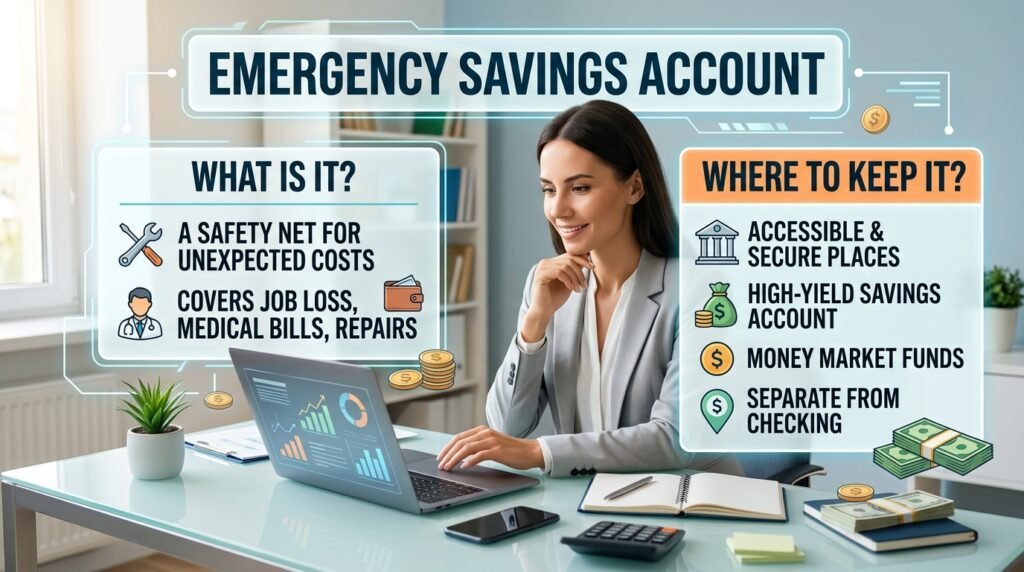
An emergency savings account is a place where you keep money specifically for unexpected and necessary expenses. A sudden car repair, medical bill, home repair, job loss, or urgent travel expense can put pressure on your budget if you do not have cash available.
Keeping emergency money in a dedicated account can help you avoid relying on credit cards or personal loans when an unexpected expense occurs. But choosing the right account matters. You want your emergency savings to be safe, accessible, and capable of earning a reasonable amount of interest.
So, what is an emergency savings account, and where should you keep it?
What Is an Emergency Savings Account?
An emergency savings account is a savings account used specifically for unexpected financial needs.
Unlike money saved for a vacation, new car, or planned purchase, emergency savings are intended for expenses you did not reasonably expect and cannot easily cover from your normal monthly income.
Common examples include:
- Unexpected car repairs
- Urgent home repairs
- Necessary medical expenses
- Temporary loss of income
- Emergency travel
- Unexpected essential bills
- Major appliance replacement
The purpose is simple: keep accessible cash available so an unexpected expense does not automatically become new debt.
Why Do You Need an Emergency Savings Account?
Without emergency savings, even a relatively small financial problem can disrupt your entire budget.
For example, imagine your car suddenly needs a $1,200 repair. If you do not have savings available, you may need to put the expense on a credit card or borrow money.
That can create a balance that takes months to repay and may generate interest.
An emergency savings account provides a financial buffer between an unexpected expense and your borrowing options.
It can also provide greater flexibility during periods of reduced income.
How Much Should You Keep in Emergency Savings?
There is no single amount that works for everyone.
Your emergency fund target should reflect your income, essential expenses, job stability, household responsibilities, insurance coverage, and debt obligations.
If you are starting from zero, you do not necessarily need to save several months of expenses immediately.
A smaller starter fund can be a useful first milestone. Once you have established that cushion, you can gradually increase it based on your circumstances.
Our recent guide, Emergency Fund vs. Paying Off Debt: Which Should You Prioritize First?, explains how emergency savings and debt repayment can work together when you have limited extra money.
Where Should You Keep Your Emergency Fund?
The ideal location for emergency savings generally combines three characteristics:
Safety: Your money should not be exposed to unnecessary investment risk.
Liquidity: You should be able to access the money relatively quickly when a genuine emergency occurs.
Interest earning potential: Your money should earn a reasonable return while it sits unused.
For many people, a federally insured savings account can provide this combination.
High-Yield Savings Account
A high-yield savings account can be an attractive option for emergency savings because it can offer a higher APY than many traditional savings accounts.
Your money remains in a savings account rather than being exposed to stock market fluctuations.
Interest rates can change, so the APY you receive today may not remain the same indefinitely.
When comparing high-yield savings accounts, look beyond the advertised APY.
Check the account’s fees, minimum balance requirements, withdrawal rules, transfer times, and deposit insurance.
Traditional Savings Account
A traditional savings account at a bank or credit union can also work for emergency savings.
The biggest advantage may be convenience. If you already use the institution for checking and other financial services, transferring money between accounts may be straightforward.
The trade-off is that some traditional savings accounts may offer lower interest rates than competitive high-yield accounts.
If the account is easy to use and encourages you to keep your emergency money separate, however, convenience can still have value.
Money Market Account
A money market account can also be considered for emergency savings.
Depending on the institution and account, it may offer competitive interest while providing relatively convenient access to your money.
However, money market accounts can have different minimum balance requirements, transaction rules, and fees.
Read the account terms before deciding whether one fits your emergency savings strategy.
Should You Keep Emergency Savings in a Checking Account?
You can, but there are potential drawbacks.
A checking account is designed for everyday spending. If your emergency money sits alongside your regular spending money, it may be easier to accidentally spend it on non-emergency purchases.
Keeping emergency savings separate can create a psychological barrier between money you can spend today and money reserved for unexpected needs.
You can still keep a small cash buffer in checking for normal expenses while maintaining your larger emergency fund in a separate savings account.
Should You Keep Emergency Savings in a CD?
Certificates of deposit can offer attractive interest rates, but they are not always ideal for your entire emergency fund.
A CD typically requires you to leave money deposited for a specific period. Accessing the money early may result in an early-withdrawal penalty.
Emergency money should generally be accessible when you need it.
For this reason, locking your entire emergency fund into long-term CDs may create an access problem.
Some people may choose to keep the majority of emergency savings in an accessible savings account while using CDs separately for money they are unlikely to need immediately.
Should You Invest Your Emergency Fund?
Generally, emergency savings are different from long-term investment money.
Stocks, exchange-traded funds, and other investments can fluctuate in value. If an emergency happens when markets are down, you could be forced to sell investments at an unfavorable time.
The purpose of emergency savings is primarily stability and access, rather than maximizing investment returns.
Your long-term investments can serve a different purpose.
Keep Emergency Savings Separate From Sinking Funds

Emergency funds and sinking funds are often confused.
An emergency fund is designed for unexpected expenses.
A sinking fund is designed for expenses you expect to happen.
For example, you might know that your car insurance is due every year or that you will need holiday gifts later in the year. These are predictable expenses, even if the exact amount varies.
Our recently published guide, Sinking Funds Explained: How to Prepare for Big Expenses Without Debt, explains how sinking funds can help you plan for expenses without dipping into your emergency savings.
Keeping these categories separate can make it easier to know what your savings are actually available for.
How to Build an Emergency Savings Account
Building an emergency fund does not have to happen all at once.
Start by choosing a realistic monthly amount.
For example, suppose you can save $150 per month.
You would accumulate:
- $450 after 3 months
- $900 after 6 months
- $1,800 after 12 months
The important part is consistency.
You can increase your contribution later if your income rises or your expenses decrease.
Automate Your Emergency Savings
One of the easiest ways to make emergency saving consistent is to automate transfers.
You can schedule an automatic transfer from your checking account to your emergency savings account after your paycheck arrives.
This reduces the need to remember to save every month.
Our recent article, Automating Your Finances: How to Save Money Without Relying on Willpower, explains how automatic transfers can help turn saving into a regular financial system.
Even a small automatic transfer can gradually build your emergency fund.
What Should You Look for in an Emergency Savings Account?
Before choosing an account, compare several important features.
APY
A higher APY can help your emergency savings earn more interest, although rates can change.
Deposit Insurance
For U.S. accounts, check whether the bank is FDIC-insured or the credit union is federally insured through the NCUA.
Fees
Look for monthly maintenance fees, excessive transaction fees, and other account charges.
Accessibility
Make sure you understand how quickly you can access your money when an emergency occurs.
Minimum Balance Requirements
Some accounts require a minimum balance to earn a particular APY or avoid fees.
Withdrawal Rules
Check whether the institution limits certain transfers or withdrawals and whether fees apply after exceeding any limits.
Common Emergency Savings Mistakes
Keeping Too Little
Having no emergency savings can leave you dependent on credit when unexpected expenses appear.
Keeping Too Much in Checking
Large amounts sitting in your everyday spending account may be easier to spend accidentally.
Chasing the Highest Rate
The highest APY is not necessarily the only factor that matters. Account access, fees, insurance, and reliability are also important.
Using Emergency Money for Planned Purchases
A vacation or annual insurance bill is usually not an emergency. Separate sinking funds can help handle predictable expenses.
Forgetting to Rebuild the Fund
If you use $1,000 from your emergency savings for an unexpected repair, your next goal should be rebuilding the amount you used.
Final Thoughts
An emergency savings account gives you a dedicated source of cash for unexpected and necessary expenses.
For many people, a federally insured savings account can provide a useful combination of safety, liquidity, and interest earnings. A high-yield savings account may offer a competitive APY, while a traditional savings account can provide convenience.
The most important thing is to choose an account that you can access when you genuinely need the money while keeping the funds separate from everyday spending.
Start with an achievable savings goal, automate your contributions, and increase your target as your financial situation improves. Over time, an emergency savings account can become an important part of a financial system designed to keep unexpected expenses from turning into expensive debt.