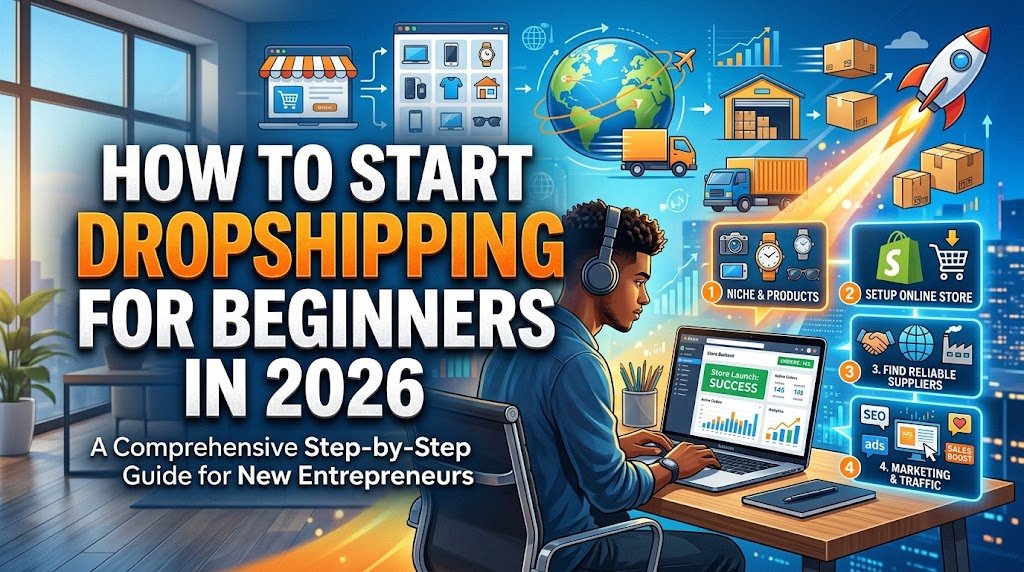
To start dropshipping in 2026, choose a focused product niche, find a reliable supplier, build an online store, connect a payment method, set clear shipping and return policies, and market your products to the right audience. You don’t need to buy inventory upfront because the supplier stores and ships products after customers place orders. However, you’ll still need money for your store, domain, marketing, payment processing, and other business costs.
What Is Dropshipping and How Does It Work?
Dropshipping is an ecommerce fulfillment method where you sell products without keeping them in your own inventory. When a customer orders from your store, you send the order to your supplier, and the supplier packages and ships the product directly to the customer. You remain responsible for the customer relationship, pricing, refunds, and support.
For beginners, dropshipping can be one way to enter the broader Online Business space without purchasing a warehouse full of stock. However, the fulfillment model doesn’t remove the need to understand customers, pricing, marketing, payments, and customer service.
For example, suppose your supplier charges $12 for a product and you list it for $29.99. A customer pays you $29.99, you place the order with the supplier, and the supplier ships it to the customer. Your gross margin before payment fees, advertising, refunds, taxes, and other expenses is $17.99.
How to Start Dropshipping Step by Step
A beginner shouldn’t start by uploading dozens of random products. A better approach is to build the business in a clear sequence: choose a market, research products, check suppliers, create the store, test the buying process, and then market the products.
The first few steps are closely connected. Your product choice affects your supplier, your store affects your checkout experience, and your marketing costs affect whether the business can make money.
Step 1: Choose a Dropshipping Niche
Your niche determines what products you’ll sell and who you’re trying to reach. Instead of creating a store that sells everything from kitchen gadgets to pet accessories and phone cases, start with a defined category.
A useful niche usually has products that solve a specific problem, appeal to a recognizable audience, aren’t excessively fragile, and leave enough room between supplier cost and selling price.
You can research demand using Google Trends, marketplace search results, social platforms, and competitor stores. This is where proper Product Research becomes important because demand alone doesn’t tell you whether a product will be profitable.
Look at the product’s selling price, supplier cost, shipping charges, competition, customer reviews, delivery times, and likely advertising expenses before making a decision.
Step 2: Find Products Worth Selling
Product research is one of the most important parts of starting a dropshipping business. Don’t judge a product only by its purchase price. Consider the selling price, shipping cost, delivery time, competition, return risk, product quality, and potential advertising cost.
Products that are easy to demonstrate can work well because customers can quickly understand their use. You should also check whether the product has intellectual property, safety, health, or regulatory concerns before listing it.
Order samples whenever possible. Seeing the actual product lets you check its quality, packaging, size, instructions, and delivery time before customers receive it.
Step 3: Find Reliable Dropshipping Suppliers
Your supplier has a direct effect on your customers’ experience. A supplier should have consistent product quality, reasonable processing times, accurate inventory information, clear return terms, and dependable shipping options.
Platforms such as AliExpress and dedicated supplier networks can help beginners source products. Your supplier can also affect which Ecommerce Platforms and integrations are practical for your store, so check compatibility before committing to a particular setup.
Don’t choose a supplier solely because it offers the lowest price. A cheaper product that arrives late or doesn’t match its listing can lead to refunds, complaints, chargebacks, and lost customers.
Step 4: Build Your Dropshipping Store
Shopify is one option for building a dropshipping store, while WooCommerce is another. Your choice should depend on your budget, technical ability, preferred payment options, and target market.
Before choosing a platform, compare its monthly cost, payment options, supplier integrations, available themes, transaction fees, and features you’ll actually need. You don’t need every feature on day one.
Keep the first version of your store simple. Use a clear brand name, easy navigation, high-quality product images, useful descriptions, visible pricing, and a straightforward checkout process.
Each product page should explain what the product does, who it’s for, important specifications, shipping expectations, return conditions, and any limitations.
Step 5: Set Up Payments Before Advertising
You need a payment method that works for your business location and target customers. Payment gateway availability differs by country, so don’t assume that a provider available to another seller will automatically be available to you.
If you’re running a dropshipping business from Pakistan, payment setup deserves particular attention. Payment options available to Pakistani businesses can differ from those available in the US, UK, or other markets.
Before launching ads, place test orders and make sure the payment, confirmation email, order processing, and refund process all work correctly.
Step 6: Calculate Your Real Dropshipping Profit
A product isn’t profitable simply because you sell it for more than the supplier charges.
Your basic calculation should include:
Selling price − product cost − shipping − payment fees − advertising cost − refunds/returns − platform and app costs = actual profit
For example:
| Cost | Example |
| Selling price | $39 |
| Product cost | $12 |
| Shipping | $5 |
| Payment/platform costs | $2 |
| Advertising cost per sale | $10 |
| Estimated profit | $10 |
This example gives you a $10 contribution before other business expenses and taxes. Your actual figures will vary by supplier, platform, market, payment provider, and advertising channel.
Step 7: Create Clear Shipping and Return Policies
Shipping information should never be hidden until checkout. Tell customers where products ship from, the expected processing period, estimated delivery window, and what happens if an order is delayed or damaged.
Your return policy should also explain eligibility, deadlines, return shipping responsibility, refunds, and exclusions where legally permitted.
It’s also worth checking suppliers and marketplaces carefully before building your business around them. Fake suppliers, misleading product claims, counterfeit goods, and suspicious payment requests can create serious problems. Learning the warning signs covered in Online Scams can help you avoid common traps when dealing with unfamiliar sellers or services.
How Much Does It Cost to Start Dropshipping in 2026?
The exact cost depends on how you build and market the business. You may need money for an ecommerce platform, domain, product samples, apps, payment processing, business registration where applicable, and marketing.
You can reduce your initial risk by starting with a small product range instead of paying for a large inventory order. That’s one of the main financial differences between dropshipping and traditional retail.
Still, don’t treat dropshipping as a guaranteed zero-investment business. You should have enough money to cover the basic operating costs and testing period.
How to Market a New Dropshipping Store
Getting the store online is only half the job. Customers need a reason to discover your products and trust your store.
For beginners, start with one or two marketing channels rather than trying everything at once. Short-form product demonstrations can work for visually interesting products, while SEO can bring visitors through search over time. Paid advertising can provide faster testing but requires careful tracking because advertising costs can quickly consume a small product margin.
Track product views, add-to-cart rates, checkout starts, purchases, advertising cost, refunds, and profit per order. If people click but don’t buy, investigate the product page, price, shipping cost, trust signals, or checkout rather than simply spending more money on ads.
Common Dropshipping Mistakes Beginners Should Avoid
Many new sellers focus too much on finding a “winning product” and not enough on the business around it. A product can have strong demand and still fail if shipping takes too long or the margins are too small.
Common problems include selling too many unrelated products, choosing suppliers without ordering samples, making unrealistic shipping promises, ignoring payment fees, and spending heavily on ads before testing the store.
Another issue is trusting every supplier or service that promises easy sales. Check company information, reviews, policies, payment terms, and product samples before sending money or sharing sensitive business information.
Is Dropshipping Still Worth Starting in 2026?
Dropshipping can still be used to start an ecommerce business without purchasing inventory upfront, but it isn’t a shortcut to guaranteed income. Competition, advertising costs, supplier quality, shipping times, customer expectations, and payment fees all affect the result.
The strongest beginner approach is to treat the first stage as testing. Choose one market, launch a small catalog, order samples, calculate the full cost per sale, and use real customer behavior to decide what deserves more attention.
If a product sells consistently and customers are satisfied, you can later consider stronger supplier agreements, better packaging, bulk purchasing, or other fulfillment options. That lets you build on actual sales data rather than assumptions.
Frequently Asked Questions
Can I start dropshipping with no experience?
Yes. You don’t need previous ecommerce experience, but you do need to learn product research, supplier management, customer service, pricing, marketing, and basic financial tracking.
How much money do I need to start dropshipping in 2026?
There is no single required amount. Your starting budget depends on your store platform, domain, samples, apps, payment fees, and marketing strategy. You can keep the initial catalog small and test demand before spending heavily.
Is dropshipping legal?
Yes, dropshipping is a legal retail fulfillment model in many countries. Sellers still have to follow the laws and platform rules that apply to their products, business location, and customers.
What is the biggest mistake beginners make in dropshipping?
A common mistake is choosing products based only on their apparent popularity while ignoring supplier reliability, shipping time, total costs, customer expectations, and profit margins.
Can I start dropshipping from Pakistan?
Yes, but payment processing and international selling requirements need extra attention. Available payment providers depend on the business location and platform, so check the current options for Pakistan before choosing your store and checkout setup.