
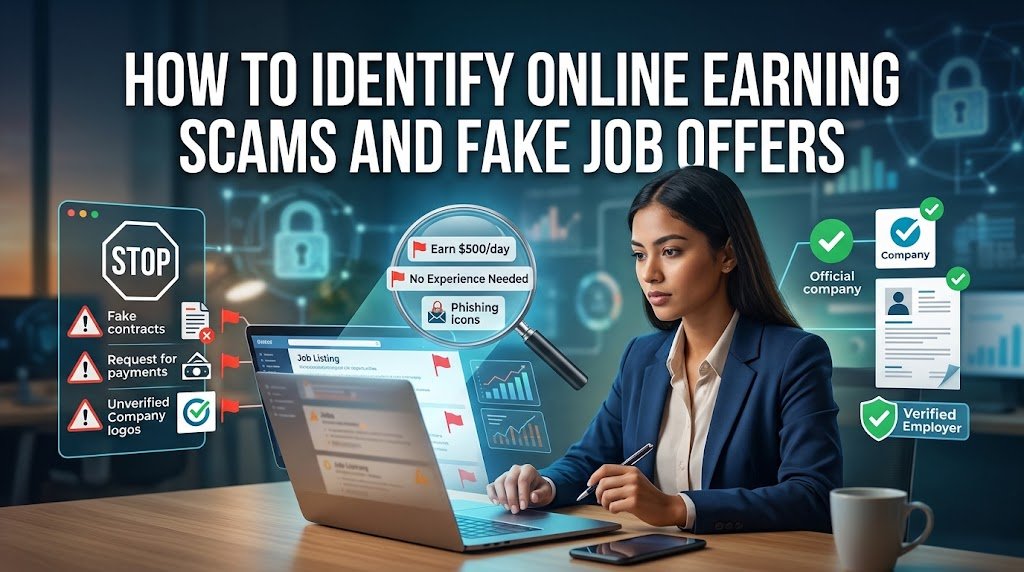
The easiest way to identify online earning scams and fake job offers is to stop and verify the opportunity before sending money, personal information, or documents. Be especially careful when a recruiter promises unusually high pay for little work, asks for an upfront fee, contacts you unexpectedly, requests sensitive financial information before hiring, or sends a check and asks you to return part of the money.
Online jobs can be genuine, but scammers often copy real companies, create convincing job descriptions, conduct fake interviews, and even send professional-looking offer letters. If you’re looking for legitimate ways to start earning online, learning about Beginner Jobs can help you understand what genuine entry-level opportunities normally look like.
What Are Online Earning Scams?
Online earning scams are schemes that pretend to offer a legitimate way to make money but are actually designed to take your money, personal information, or access to your accounts. They can appear as remote jobs, freelance projects, data entry work, virtual assistant positions, online tutoring, mystery shopping, reselling opportunities, or simple side gigs.
A scammer may advertise the opportunity on a job website, social media platform, email, WhatsApp, Telegram, or through a direct message. Some even impersonate recognizable companies or recruiters. This is why it’s important to understand the difference between genuine Earning Websites and websites that make unrealistic promises about income.
The goal is usually straightforward: convince you to send money or provide information that can be misused.
10 Warning Signs of a Fake Job Offer
A single warning sign doesn’t automatically prove that an opportunity is fraudulent. However, several warning signs appearing together should make you stop before proceeding. Take your time, verify the employer through independent sources, and don’t let a recruiter pressure you into making a quick decision.
Here are the most common signs to watch for:
- You have to pay to get hired: Registration fees, security deposits, training charges, starter kits, or payments for guaranteed employment are major warning signs.
- The income sounds unrealistic: Be cautious when someone promises thousands of dollars for a few hours of simple work.
- The recruiter contacts you unexpectedly: An unsolicited message offering an easy remote position deserves verification.
- You are pressured to act immediately: Scammers may claim that only a few positions remain or that you must pay today.
- Sensitive information is requested too early: Be careful if you’re asked for bank details or identity documents before a genuine hiring process.
- The recruiter uses a personal email: A personal email isn’t automatically proof of fraud, but it deserves extra checking.
- The company can’t be independently verified: Search for the employer yourself instead of relying only on information supplied by the recruiter.
- You receive a check and must send money back: This is a common fake-check scam.
- You’re asked to receive and reship packages: Reshipping schemes can involve stolen goods and aren’t legitimate work-from-home employment.
- The job requires you to recruit others or pay for access: Be cautious when earning depends mainly on bringing in new participants.
How to Check if an Online Job Is Legitimate
Before accepting an online job, verify the company independently. Don’t rely only on the recruiter because scammers can create convincing profiles and websites.
Start by searching for the company’s official website yourself. Look for the same vacancy on its careers page and check whether the job title, responsibilities, location, and application process match the message you received.
This is especially important when searching for Remote Jobs, because legitimate remote positions usually still have identifiable employers, clear responsibilities, and a defined hiring process. A remote position doesn’t mean you should skip basic checks.
You can also search the company name together with terms such as “scam,” “complaint,” or “review.” If the opportunity is genuine, you should be able to find enough independent information to understand who is hiring and what the work involves.
Be Careful With WhatsApp and Telegram Job Offers
Messaging apps can be useful for legitimate work, but an unexpected job message should never be accepted simply because the person sounds professional.
A common pattern is receiving a short message saying you can earn money by rating products, completing simple tasks, or working as an online assistant. After a few initial tasks, the person may ask you to deposit your own money to continue.
That changes the situation completely. If you’re being asked to pay money in order to receive supposed earnings, stop communicating and don’t send the payment.
Never Pay Money to Get a Job
One of the clearest rules for avoiding online earning scams is simple: don’t pay someone for the promise of employment.
Scammers may call the payment a registration fee, security deposit, processing charge, training fee, equipment cost, verification fee, or refundable deposit. The name doesn’t change the underlying issue.
If you’re exploring online work without a large starting budget, it’s useful to compare legitimate opportunities with genuine Earning Websites rather than responding to random job advertisements that promise guaranteed income.
Don’t Trust Fake Checks or Equipment Payments
Another common scam involves a fake employer sending you a check and telling you to use the money to purchase equipment or send part of it to another person.
The payment may appear in your account before the bank discovers that the check is fraudulent. If you’ve already sent your own money elsewhere, you could be left responsible for the loss.
The same principle applies to any unusual payment request. Before transferring money, sharing account information, or accepting an unfamiliar payment arrangement, review basic Payment Safety practices and make sure you understand where the money is coming from and where it is going.
Protect Your Personal and Financial Information
A fake job isn’t always designed to steal money immediately. Sometimes the main target is your personal information.
Avoid sending identity documents, bank details, payment information, passwords, verification codes, or other sensitive data until you’ve independently confirmed the employer and reached a legitimate stage of the hiring process.
This matters even when you’re selling products or services online. For example, someone contacting you about an Etsy order, freelance project, or remote position may try to move the conversation away from the normal payment system and ask for unusual information. If you’re using Etsy or another online marketplace, keep payments and account activity within the platform’s normal procedures whenever possible.
Also avoid sharing passwords or one-time verification codes with a recruiter. A genuine employer doesn’t need access to your personal accounts.
What to Do If You Already Responded to a Scam
If you’ve already sent money or personal information, act quickly. Stop communicating with the suspected scammer and save evidence such as messages, emails, payment receipts, usernames, phone numbers, websites, job descriptions, and offer letters.
If money was sent through a bank, card, payment service, or another financial provider, contact that provider immediately and ask what recovery or transaction-reversal options are available. Don’t send additional money because the scammer claims it is needed to release your previous payment.
If you’re in Pakistan, you can also seek guidance through the relevant FIA cybercrime reporting channels. Keeping screenshots and transaction records can make your report much more useful.
A Simple Checklist Before Accepting an Online Job
You don’t need to investigate every opportunity for hours. A short verification routine can prevent many avoidable losses. Before accepting an online job, pause and check the employer, recruiter, payment terms, job description, and information being requested.
Ask yourself:
- Is the company real and independently verifiable?
- Does the vacancy appear on the company’s official website?
- Did I receive the offer through a trustworthy hiring process?
- Is the salary reasonable for the work?
- Am I being asked to pay anything?
- Am I being asked for sensitive information too early?
- Is someone pressuring me to decide immediately?
- Have I checked the company name, recruiter, email address, and phone number?
- Am I being asked to deposit a check or send money elsewhere?
- Can I explain exactly what work I’ll perform and who will pay me?
If several answers raise concerns, don’t proceed until you’ve verified the opportunity.
Final Thoughts
Learning how to identify online earning scams and fake job offers comes down to verification and patience. A professional-looking website, company logo, interview, or offer letter doesn’t prove that a job is genuine.
Whether you’re searching for Beginner Jobs, applying for Remote Jobs, using Earning Websites, or selling through Etsy, the same basic rule applies: verify first and pay later—or don’t pay at all when a supposed employer demands money to hire you.
Protect your accounts, question unrealistic promises, keep records of suspicious conversations, and use safe payment practices. A few minutes of checking can help you avoid losing money or exposing personal information to a scammer.
FAQs
How can I tell if an online job is fake?
Check the employer independently, compare the vacancy with the company’s official careers page, and watch for upfront fees, unrealistic pay, pressure, fake checks, or early requests for sensitive information.
Should I pay a registration fee for an online job?
No. A request for money in exchange for a job is a major warning sign. Legitimate employers generally don’t require applicants to pay simply to receive employment.
Can a real company contact me through WhatsApp or Telegram?
It can happen, but an unexpected message should be verified independently. Don’t send money or sensitive information just because the person claims to represent a company.
What should I do if I send money to a fake employer?
Contact your bank or payment provider immediately, preserve all evidence, and report the fraud through the appropriate authority. Acting quickly may give you more options for addressing the transaction.