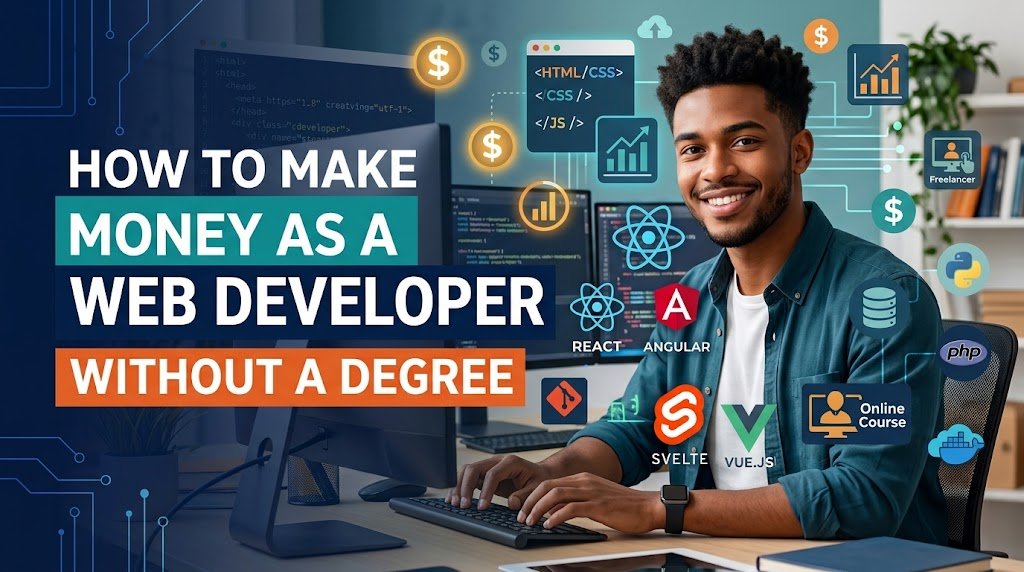
Yes, you can make money as a web developer without a degree. Employers and clients often care more about what you can build than whether you have a computer science qualification. If you learn practical skills such as HTML, CSS, JavaScript, responsive design, Git, and a modern framework, you can start earning through freelance projects, remote work, website development, or your own online services.
The key is to replace the traditional degree path with proof of skill. A useful Portfolio, real projects, good communication, and consistent practice can help you compete for paid work.
What Skills Do You Need to Become a Web Developer Without a Degree?
You don’t need to learn every programming language before looking for your first client. Start with the skills that businesses actually need and build from there.
For front-end development, HTML creates the structure of a page, CSS controls its appearance, and JavaScript adds interactive features. Once you’re comfortable with these basics, you can learn tools such as React to build more complex interfaces.
If you want to work on the server side as well, learn a back-end language and understand databases, APIs, authentication, and hosting. You can eventually become a full-stack developer, but there’s no need to learn everything at once.
A practical starting stack could include:
- HTML and CSS for website structure and design
- JavaScript for interactive features
- Git and GitHub for managing code
- React for modern front-end projects
- WordPress for client websites
- Basic databases, APIs, and hosting
Technical knowledge is only part of earning independently. If you plan to work with clients, communication, pricing, project management, and client handling are also important Freelance Skills.
Build a Portfolio Before Looking for Clients
Without a degree, your Portfolio becomes especially important because it gives potential clients or employers something concrete to evaluate. You don’t need ten projects. Three to five well-made projects can show far more than a long list of technologies you claim to know.
Build projects that resemble paid work. For example, create a restaurant website, a local service business website, an e-commerce product page, or a dashboard. Make each project responsive so it works properly on phones, tablets, and computers.
For every project, explain what you built, which technologies you used, what problem it solves, and what you personally contributed. Put the code on GitHub when appropriate and publish working websites so people can actually test them.
A strong Portfolio can also help when applying for jobs because it gives recruiters a quick way to see your actual development ability rather than relying only on your résumé.
Start Freelancing as a Web Developer
Freelancing is one of the most direct ways to make money as a web developer without a degree. Instead of waiting for a company to hire you, you can offer specific website services to businesses and individuals.
Don’t start by advertising yourself as someone who can “do everything.” A clear service is easier for a client to understand. You might offer landing page development, WordPress customization, website fixes, responsive design, website redesigns, or small JavaScript features.
Platforms such as Upwork and Fiverr can help you find initial projects, but you can also contact businesses directly. Local restaurants, consultants, real estate professionals, coaches, online stores, and service companies may need websites or improvements to existing sites.
Your first projects may be smaller than the work you eventually want. That’s normal. The goal is to gain real experience, collect useful testimonials where appropriate, and create stronger portfolio examples.
How Much Can a Beginner Web Developer Earn?
There isn’t one fixed income level for a web developer without a degree. Earnings depend on your skills, location, service, clients, experience, and whether you work as an employee or freelancer.
A beginner may start with smaller website projects and gradually charge more as their skills and results improve. A developer with experience can take on larger websites, custom applications, maintenance contracts, or specialized development work.
Instead of focusing only on an hourly rate, think about the value and scope of each project. A simple five-page business website is very different from a custom web application that requires user accounts, payments, databases, and an administrative system.
As your experience grows, recurring services can also create steadier income. Website maintenance, updates, performance improvements, security checks, and content changes can become monthly services for existing clients.
Find Web Development Jobs Without a College Degree
Freelancing isn’t your only option. Many companies hire developers based on practical ability, previous work, coding tests, and interviews rather than requiring a specific degree for every position.
Search for roles such as junior front-end developer, junior web developer, WordPress developer, JavaScript developer, or entry-level software developer. Read the actual requirements carefully because some companies do list degrees as a requirement while others focus more heavily on experience and technical skills.
Your application should make your abilities easy to verify. Include links to your Portfolio, GitHub projects, live websites, and any relevant freelance work. A short explanation of what you built can also give hiring managers more context than a list of technologies alone.
Get Your First Web Development Client
Getting the first client is often harder than completing the first project because you have little commercial experience to show. The solution is to make your offer specific and reduce uncertainty for the buyer.
Instead of saying, “I’m a web developer looking for work,” you could explain that you build responsive websites for small businesses or improve slow and outdated websites.
Research a potential client’s existing website before contacting them. If you notice broken layouts, poor mobile presentation, outdated information, or confusing navigation, you can mention the specific issue and explain how you could address it.
Don’t promise results you can’t guarantee. Be clear about the work, timeline, revisions, payment terms, and what the client will receive. Professional communication matters just as much as writing code when you’re working directly with customers.
If you’re using Upwork, the same principle applies to your proposals. Rather than sending the same generic message to every client, explain how your experience relates to that particular project and point them toward a relevant example from your portfolio.
Use WordPress and Website Builders to Start Earning
You don’t have to write every line of code from scratch to earn money from website development. WordPress can be a practical option for building websites for businesses that need content management, contact forms, blogs, service pages, or basic online stores.
The important part is understanding what you’re doing rather than simply installing themes and plugins. Learn how hosting works, how domains are connected, how themes and plugins interact, and how to make a site responsive and easy to maintain.
Once you’re comfortable, you can offer services such as WordPress setup, customization, speed improvements, troubleshooting, redesigns, and ongoing maintenance.
Create Multiple Income Sources With Web Development
Once you’ve built enough experience, you don’t have to depend on one type of client or one platform. Your coding skills can support several income streams.
You could combine freelance website projects with a remote development job, maintenance packages, website templates, technical tutorials, or small software products. Some developers also build niche websites or web applications that generate income independently.
The Freelance Skills you develop while working with clients can also help you move into other online services. For example, a developer who learns client communication, project pricing, and basic business management may eventually handle larger website projects or recurring client accounts.
The strongest approach is usually to build one reliable source first rather than trying five methods at the same time. Get good at delivering a service, then add another income stream when your workload and skills allow it.
A Simple Roadmap to Start Without a Degree
You don’t need to spend years preparing before trying to earn your first dollar. At the same time, rushing into paid work without basic skills can lead to poor results and unhappy clients.
A practical path is to spend the first stage learning HTML, CSS, and JavaScript, then build several complete websites. After that, choose a direction such as WordPress, front-end development, or full-stack development and learn the tools used in that area.
Your next stage should focus on real-world practice. Build portfolio projects, publish them online, create a professional profile, and apply for suitable jobs or freelance projects. Keep improving your skills while working rather than waiting until you feel completely ready.
Can You Become a Web Developer Without a Degree?
Absolutely. A degree can be useful for certain employers and career paths, but it isn’t the only route into web development. What matters is developing useful technical skills and being able to demonstrate them through working projects.
If your goal is to make money as a web developer without a degree, focus on three things: learn practical development skills, build proof of your ability, and consistently look for paid opportunities.
You may start with small websites or simple freelance jobs. With experience, you can move toward larger projects, higher-value services, remote positions, or specialized development work. Your Portfolio can grow alongside your career.
FAQs
Can I become a web developer without going to college?
Yes. You can learn web development through self-study, online courses, practice projects, and real client work. A Portfolio can demonstrate your abilities to employers and clients.
What is the easiest web development skill to monetize?
Building and maintaining business websites can be a practical starting point because many small businesses need websites, updates, redesigns, and technical support.
Can I get a remote web developer job without a degree?
Yes, some companies hire developers without requiring a degree. Requirements vary by employer, so check each job description and show relevant projects and technical skills.
How long does it take to make money from web development?
It varies widely. Someone who studies consistently and focuses on practical services may start pursuing small paid projects within months, while becoming ready for more advanced development roles generally takes longer.