Exchange-traded funds, commonly known as ETFs, are popular because they can provide investors with diversified exposure to stocks, bonds, commodities, or other assets through a single investment. Many ETFs are designed to track an index, such as a broad stock-market index or a bond index.
However, an ETF does not always produce exactly the same return as the index it follows.
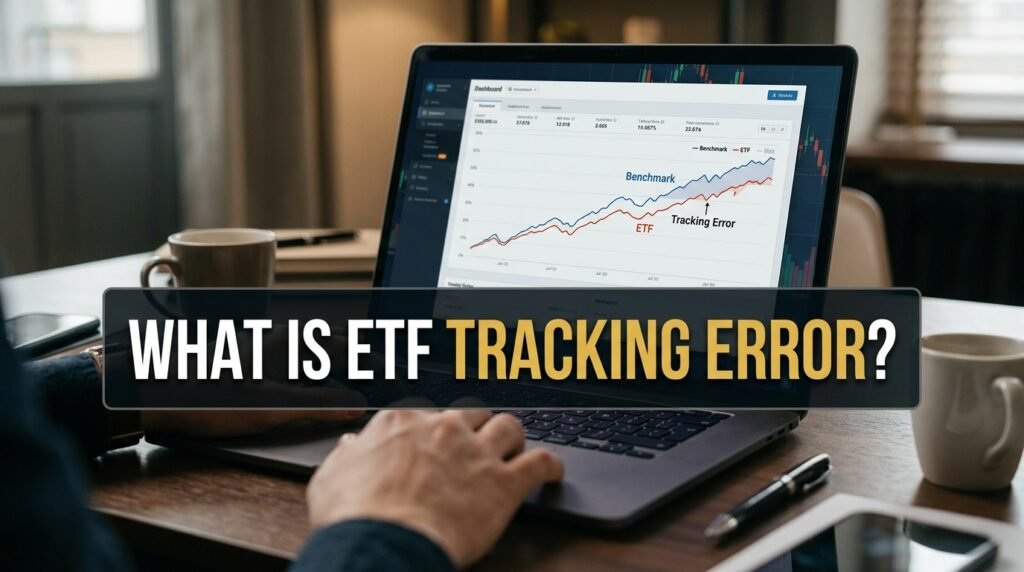
The difference between an ETF’s performance and the performance of its benchmark is known as tracking error. Understanding ETF tracking error can help investors evaluate how effectively an ETF follows its intended index and identify costs or other factors that may affect returns.
What Is ETF Tracking Error?
ETF tracking error measures how much an ETF’s returns differ from the returns of its benchmark index over time.
Suppose an ETF is designed to track an index that gains 10% during a particular period. If the ETF gains 9.7%, there is a difference between the ETF’s return and the index’s return.
That difference may be small, but it represents tracking difference.
Tracking error is often discussed statistically and can refer to the variability of the ETF’s differences from its benchmark over multiple periods. In everyday investing discussions, however, people sometimes use “tracking error” more broadly to describe the gap between ETF performance and index performance.
The important point is that an index-tracking ETF is designed to follow its benchmark, but it may not perfectly match the benchmark’s return.
Why Don’t ETFs Match Their Indexes Exactly?
Several factors can cause an ETF’s performance to differ from its benchmark.
The first is expenses.
An index does not charge an expense ratio, but an ETF has operating expenses. These expenses are deducted from the fund’s assets and can reduce the ETF’s return over time.
For example, imagine an index gains 8% over a year while an ETF tracking that index has a 0.20% expense ratio. Other factors being equal, the ETF would generally be expected to produce a return somewhat below the index.
However, expenses are only one part of the explanation.
Expense Ratios and Tracking Difference
The expense ratio is one of the easiest factors for investors to understand.
An ETF’s expense ratio represents the annual operating expenses charged by the fund, expressed as a percentage of assets.
If an ETF has a 0.10% expense ratio, that cost can reduce the fund’s return compared with the index it tracks.
However, investors should not assume that the ETF with the lowest expense ratio will always have the smallest tracking difference.
Other factors can offset or increase the impact of expenses.
For example, an ETF may earn additional income from securities lending or use an efficient portfolio-management process that helps reduce the gap between its return and the benchmark.
This is why investors should examine actual historical tracking performance rather than looking only at the expense ratio.
Trading Costs Can Affect ETF Performance
An index is a theoretical portfolio and does not experience the same trading costs as an actual ETF.
When an ETF buys or sells securities, it may incur transaction costs.
These costs can include brokerage expenses, bid-ask spreads, market impact, and other trading-related expenses.
Even when an ETF is designed to closely follow an index, buying and selling the underlying securities can create small differences between the fund and its benchmark.
This is especially relevant for indexes containing securities that are less liquid or more expensive to trade.
Rebalancing Can Create Tracking Differences
Indexes are not always static.
Index providers may periodically add or remove companies, change the weighting of securities, or make other adjustments.
When an index changes, the ETF tracking that index may need to adjust its portfolio.
This process can create trading costs and temporary differences between the ETF and its benchmark.
For a highly liquid index, the difference may be relatively small. For less liquid markets, however, implementation can be more complicated.
Investors should therefore understand that index investing does not mean the fund can automatically reproduce every index movement perfectly.
Full Replication vs Sampling
The way an ETF tracks its benchmark can also affect tracking performance.
Some ETFs use full replication. This means the fund attempts to hold all, or nearly all, of the securities in the index in approximately the same proportions.
Other ETFs use sampling.
With sampling, the fund holds a selection of securities designed to provide performance similar to the full index without necessarily owning every security.
Sampling can be useful when an index contains a very large number of securities or when some securities are difficult or expensive to trade.
However, because the ETF does not hold every security in exactly the same proportions, its performance can differ from the benchmark.
Currency Differences Can Create Tracking Differences
Currency can also affect ETF performance.
Suppose an investor buys an ETF that tracks companies listed in another country. The underlying securities may perform well in their local currencies, but the investor’s return can be affected by changes in exchange rates.
For example, a foreign stock index could rise 8% in its local currency while the investor’s home currency strengthens against that currency.
The ETF’s return measured in the investor’s home currency could therefore be lower than the headline index return.
Currency-hedged ETFs can work differently because they use strategies designed to reduce the impact of currency movements.
Dividends and Other Income
Dividends can also create differences between an ETF and its benchmark depending on how the index is calculated.
Some indexes are price indexes that do not include dividends in their reported performance. Others are total-return indexes that assume dividends are reinvested.
Investors should therefore make sure they are comparing the ETF with the correct version of its benchmark.
This distinction can prevent misleading conclusions about tracking performance.
An ETF that appears to outperform its index may simply be compared with a price index while the ETF receives dividends.
Taxes Can Affect Investor Returns
Taxes can also influence an investor’s actual return, although they are not necessarily part of the ETF’s tracking error itself.
The ETF may closely track its benchmark before taxes, while the investor’s after-tax return depends on the investor’s individual tax situation.
Different countries also have different rules regarding dividends, capital gains, and investment funds.
Therefore, investors should distinguish between the ETF’s performance relative to its benchmark and the personal return they ultimately receive after taxes and other costs.
Why Tracking Error Matters to Investors
Tracking error matters because investors who buy an index-tracking ETF generally expect it to behave similarly to its benchmark.
If an ETF consistently performs significantly differently from its index, investors may want to understand why.
A small difference may be completely normal.
For example, operating expenses alone can cause an ETF’s return to be slightly below its benchmark.
But a larger or inconsistent difference may require closer examination.
Investors can review the fund’s prospectus, performance history, benchmark methodology, expense ratio, portfolio holdings, and other fund information before making a decision.
Tracking Error vs Expense Ratio
Tracking error and expense ratio are related but different.
The expense ratio is a stated cost of operating the ETF.
Tracking error measures the difference between the ETF’s performance and its benchmark over time.
An ETF can have a low expense ratio but still experience tracking differences because of trading costs, sampling, taxes, liquidity, cash holdings, or other factors.
Likewise, an ETF with a slightly higher expense ratio may sometimes track its benchmark efficiently because of other portfolio-management advantages.
This is why investors should evaluate the complete picture rather than using one metric alone.
How Can Investors Compare ETF Tracking Performance?
When comparing ETFs that follow the same or similar indexes, investors can review several factors.
1. Expense Ratio
Check the fund’s annual operating expenses.
2. Historical Performance
Compare the ETF’s historical returns with the appropriate benchmark.
3. Tracking Difference
Look at how closely the fund’s actual returns have followed the index.
4. Fund Size
Larger funds may sometimes have operational advantages, although fund size alone does not guarantee better tracking.
5. Liquidity
Consider how actively the ETF trades and how wide its bid-ask spread tends to be.
6. Replication Method
Find out whether the ETF uses full replication, sampling, or another strategy.
7. Benchmark
Make sure you understand exactly which index the ETF is designed to track.
ETF Tracking Error and Long-Term Investing
Tracking differences may appear small over a single year, but they can become more meaningful over long periods.
For example, a difference of a few tenths of a percentage point each year can compound over decades.
This is one reason investors should pay attention to costs and fund efficiency when selecting long-term investments.
However, investors should also avoid focusing so heavily on tracking error that they ignore the bigger picture.
Asset allocation, diversification, risk tolerance, investment horizon, and consistency can have a much greater impact on long-term results.
Investors who want to understand how time can influence investment growth can also read why starting to invest early can matter more than investing larger amounts later.
ETF Tracking Error and Target-Date Funds
Not every fund is designed to track a single market index directly.
For example, target-date funds typically invest in a combination of underlying assets and gradually change their allocation as an investor approaches a target year.
That means the evaluation process is different from comparing a simple S&P 500-style index ETF.
If you want to understand how these retirement-focused funds work, What Is a Target-Date Fund and How Does It Work? provides an overview of their investment approach and glide paths.
This distinction is important because investors should compare a fund against the benchmark it is actually designed to follow.
How Automation Can Help ETF Investors
Tracking an ETF does not mean investors need to constantly monitor its price.
Long-term investors may benefit from a consistent investment process instead of making frequent decisions based on short-term market movements.
Automating contributions can make it easier to invest regularly according to a predetermined plan.
For investors interested in building financial systems that automatically handle saving and investing, Automating Your Finances explains how scheduled transfers and automated contributions can reduce the need to rely on willpower.
Automation does not remove investment risk, but it can help investors maintain consistency.
Is Low Tracking Error Always Better?
A low tracking error is generally desirable for an index-tracking ETF because it suggests the fund is closely following its benchmark.
However, investors should not treat low tracking error as the only measure of a good ETF.
A fund can track its index extremely closely while still being unsuitable for an investor because of its investment strategy, risk level, liquidity, geographic exposure, or tax considerations.
The right ETF depends on the investor’s objectives.
Someone seeking broad U.S. stock exposure may need a very different ETF from someone looking for international bonds, emerging-market stocks, or a specific sector.
Final Thoughts
ETF tracking error helps investors understand how closely an exchange-traded fund follows its benchmark index.
An ETF may differ from its index because of expenses, trading costs, portfolio sampling, rebalancing, taxes, cash holdings, currency movements, and other factors.
A small difference is often normal, but investors should investigate larger or persistent differences when comparing similar ETFs.
When evaluating an ETF, look beyond the expense ratio. Review its benchmark, historical tracking performance, liquidity, replication method, fund size, and overall investment strategy.
For long-term investors, even small differences in returns can compound over time. However, tracking error is only one part of ETF analysis.
A well-chosen ETF should fit the investor’s broader financial plan, risk tolerance, investment horizon, and diversification strategy.