When investors look at a bond, they often focus on its coupon rate or current price. However, these numbers do not always tell the complete story about the return an investor may receive. One of the most useful measures for evaluating a bond is yield to maturity, commonly called YTM.
Yield to maturity estimates the annualized return an investor could earn if they purchase a bond at its current market price and hold it until maturity, assuming the issuer makes all scheduled payments and interest payments are reinvested at the same rate.
Understanding YTM can help investors compare bonds with different prices, coupon rates, and maturity dates.
What Is Yield to Maturity?
Yield to maturity is the estimated annual return of a bond if an investor holds it until its maturity date.
Unlike the coupon rate, which tells you the fixed interest payment based on the bond’s face value, YTM considers several factors at the same time.
These include:
- The bond’s current market price
- Face value
- Coupon payments
- Time remaining until maturity
- The difference between the purchase price and maturity value
Because YTM considers both interest payments and the bond’s price, it can provide a more complete measure of potential return than the coupon rate alone.
How Does Yield to Maturity Work?
Imagine a bond has a face value of $1,000 and pays a 5% annual coupon.
The bond therefore pays $50 in annual interest.
If you purchase the bond for exactly $1,000 and hold it until maturity, its coupon rate and approximate YTM may both be around 5%, assuming the relevant assumptions are met.
But what happens if the bond’s market price changes?
Suppose the same bond is available for $950.
You would still receive $50 in annual coupon payments, but you would also potentially receive the $1,000 face value when the bond matures.
That additional $50 difference can increase your overall return. As a result, the bond’s YTM would be higher than its 5% coupon rate.
Now imagine the bond is trading for $1,050.
You would still receive the same $50 annual coupon, but you would potentially lose $50 relative to your purchase price when the bond matures at $1,000.
In this situation, the YTM would generally be lower than the 5% coupon rate.
Coupon Rate vs Yield to Maturity
Coupon rate and yield to maturity are often confused, but they measure different things.
The coupon rate is based on the bond’s face value.
For example, a $1,000 bond with a 5% coupon pays $50 per year.
YTM, on the other hand, considers the bond’s current purchase price, coupon payments, time to maturity, and the amount the investor expects to receive at maturity.
This means two bonds with the same coupon rate can have different YTMs if they trade at different market prices.
For investors comparing bonds, YTM can therefore be more useful than simply looking at the coupon rate.
Why Does Bond Price Affect YTM?
Bond prices and yields generally move in opposite directions.
When a bond’s market price falls, its yield generally rises. When its market price increases, its yield generally falls.
For example, suppose a bond pays $50 in annual interest and has a $1,000 face value.
If the bond trades below $1,000, an investor buying it at the lower price receives the same $50 coupon but pays less for the investment. If the bond is eventually redeemed at $1,000, the investor may also receive a capital gain.
That combination can increase the bond’s yield to maturity.
This relationship is one reason investors watch bond prices and yields closely when interest rates change.
YTM and Interest Rates
Market interest rates can have a major effect on bond prices and YTM.
When new bonds begin offering higher yields, older bonds with lower coupon rates may become less attractive. Their market prices can decline until their yields become more competitive.
When market interest rates fall, existing bonds with relatively higher coupon payments may become more attractive. Their prices can rise, which generally pushes their YTM lower.
This relationship is especially important in changing interest-rate environments. If you want to understand the wider impact of changing rates on savings, borrowing, and investments, see how higher interest rates can affect your money in 2026.
YTM and Bond Maturity
The amount of time remaining until a bond matures is another important part of YTM.
A bond with many years remaining until maturity may have a different YTM from a similar bond that matures soon.
The longer the time period, the more important future coupon payments and the eventual repayment of face value become in determining the estimated annual return.
Investors should therefore consider maturity alongside YTM instead of using YTM as the only measure.
Is a Higher YTM Always Better?
Not necessarily.
A higher YTM may look attractive, but it can sometimes reflect higher risk.
For example, a bond with a significantly higher yield may have greater credit risk. The issuer may have a weaker financial position, meaning investors demand a higher return for taking on additional risk.
Other factors can also matter, including:
- Credit quality
- Default risk
- Interest-rate risk
- Liquidity
- Inflation
- Call provisions
- Investment time horizon
Investors should therefore avoid choosing a bond simply because it has the highest YTM.
YTM and Inflation
Inflation is another important consideration when evaluating bond returns.
A bond may offer a particular YTM, but the purchasing power of that return can be reduced if inflation remains high.
For example, if a bond has a 6% YTM while inflation is running at 4%, the investor’s real return before taxes and other considerations is much lower than 6%.
This is why investors should consider both nominal returns and purchasing power when evaluating fixed-income investments.
For a broader explanation of how rising prices can affect savings and financial planning, see Inflation in Pakistan 2026 and what it means for your money.
YTM vs Current Yield
Current yield is another measure investors may see when researching bonds.
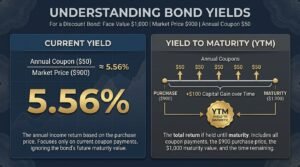
Current yield is generally calculated by dividing the bond’s annual coupon payment by its current market price.
For example, if a bond pays $50 per year and trades at $900, its current yield would be approximately 5.56%.
However, current yield does not account for the difference between the purchase price and the amount received at maturity.
YTM considers that difference along with coupon payments and the remaining time to maturity.
Therefore, YTM can provide a more comprehensive estimate of potential return when the bond is held until maturity.
Can YTM Change After You Buy a Bond?
Yes, the bond’s market yield can change after you purchase it.
Suppose you buy a bond at a certain price and its market value later changes because interest rates move.
The YTM calculated using the bond’s new market price will also change.
However, your original purchase price does not change.
This distinction is important. If you already own a bond, changes in its market YTM reflect what a new investor could potentially earn at the current market price. Your actual return depends on the price you paid, the payments you receive, and what happens if you sell before maturity.
YTM and Reinvestment Risk
YTM calculations generally assume that coupon payments can be reinvested at the same rate.
In real life, that may not happen.
Interest rates can change over time, meaning an investor may not be able to reinvest coupon payments at the same yield.
This is known as reinvestment risk.
For example, if you own a bond paying 6% but interest rates later decline, you may only be able to reinvest your coupon payments at a lower rate.
Therefore, YTM should be viewed as an estimate based on specific assumptions rather than a guaranteed annual return.
YTM for Bond Funds
YTM can also be useful when evaluating bond funds, although the analysis is different from owning a single bond.
A bond fund owns a portfolio of bonds with different maturities, coupons, credit qualities, and prices.
The fund may report a portfolio-level yield measure that helps investors understand the income characteristics of its holdings.
However, a bond fund does not have one single maturity date in the same way an individual bond does.
This means investors should not interpret a bond fund’s yield exactly like the YTM of an individual bond.
YTM and Gold or Other Investments
Investors often compare bonds with other asset classes when deciding where to place their money.
Gold, for example, does not provide a fixed coupon payment or a maturity value like a traditional bond. Its potential return primarily depends on changes in its market price.
If you are comparing fixed-income investments with other assets, Gold Investment in Pakistan: Beginner’s Guide for 2026 explains some of the factors that can influence gold investment decisions.
What Should Investors Check Besides YTM?
Before purchasing a bond, investors should review more than its yield to maturity.
Important factors include:
- Credit rating
- Issuer financial strength
- Maturity date
- Coupon rate
- Current market price
- Duration
- Liquidity
- Call provisions
- Tax treatment
- Inflation expectations
- Investment goals
A bond with a lower YTM may sometimes be more appropriate if it offers better credit quality or matches the investor’s risk tolerance and time horizon.
Final Thoughts
Yield to maturity is one of the most useful measures for evaluating bonds because it considers the bond’s current price, coupon payments, maturity value, and remaining time until maturity.
Unlike the coupon rate, YTM provides an estimate of the annualized return an investor could receive if the bond is held until maturity under certain assumptions.
However, YTM is not a guaranteed return. Reinvestment rates can change, issuers can face financial problems, and investors who sell before maturity may receive more or less than they originally paid.
For that reason, YTM should be considered alongside credit quality, maturity, duration, liquidity, inflation, and overall investment goals.
Understanding these factors can help investors compare bonds more effectively and make better-informed fixed-income decisions.