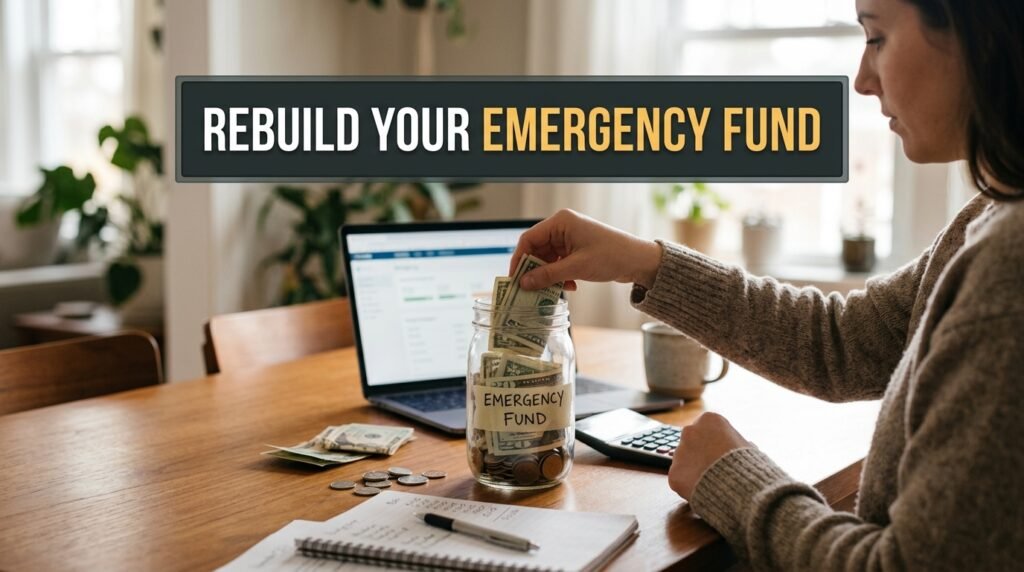
Using your emergency fund for a genuine financial emergency is exactly what the money is there for. Whether you paid for an unexpected car repair, medical bill, home repair, or temporary loss of income, using your savings does not mean you failed at managing your money.
The challenge begins after the emergency is over.
Your savings account may now be much lower than before, and rebuilding the money can feel difficult, especially if the unexpected expense was large. The good news is that you do not necessarily need to rebuild the entire fund immediately. A practical plan can help you restore your financial cushion gradually while keeping up with normal expenses.
Start by Calculating How Much You Used
The first step is to determine exactly how much your emergency fund has decreased.
Suppose you previously had $5,000 saved and used $2,000 to pay for an unexpected home repair. You now have $3,000 remaining.
Your immediate goal is not necessarily to replace the entire $2,000 in one month. Instead, identify the amount you can realistically contribute while continuing to pay your normal bills.
Write down:
- Your current emergency fund balance
- The amount you used
- Your original savings target
- Your essential monthly expenses
- The amount you can save each month
Having these numbers in front of you makes the rebuilding process more manageable.
Reassess Your Emergency Fund Target
Your original emergency fund target may have been based on your financial situation at the time you created it.
But your circumstances may have changed.
Your rent could be higher, your income could have changed, or you may now have additional financial responsibilities.
Review your essential monthly expenses and decide whether your previous emergency fund target still makes sense.
For example, if your essential expenses are $3,000 per month, having $1,000 saved may provide some protection, but it may not be enough to cover a prolonged income interruption.
The goal is to create a target that reflects your current situation rather than automatically returning to an old number.
If you need to revisit the basics, the Complete Beginner’s Guide to Building an Emergency Fund explains how to calculate essential expenses, choose a savings target, and build emergency savings gradually.
Rebuild a Small Cushion First
If you used most of your emergency fund, consider rebuilding a smaller cushion before focusing on your full long-term target.
For example, if you had $5,000 saved but used $4,000, you may want to prioritize rebuilding the first $500 or $1,000.
This creates an initial layer of protection while you continue working toward the larger goal.
A small emergency reserve can help prevent a second unexpected expense from immediately turning into credit card debt or another type of borrowing.
Once the starter cushion is restored, you can continue increasing the balance over time.
Create a Specific Monthly Rebuilding Goal
Instead of simply saying, “I need to save more,” choose a specific monthly amount.
Suppose you need to rebuild $2,000.
If you save:
- $100 per month, it takes 20 months
- $200 per month, it takes 10 months
- $250 per month, it takes 8 months
- $400 per month, it takes 5 months
You do not necessarily need to choose the largest amount.
A contribution you can maintain consistently is often better than an aggressive savings goal that causes you to fall behind on other essential expenses.
Your goal should fit comfortably into your monthly cash flow.
Review Your Monthly Budget
Rebuilding an emergency fund becomes easier when you know exactly where your money is going.
Review your income and expenses and look for areas where you can temporarily redirect money toward savings.
You do not have to eliminate every enjoyable expense.
Instead, look for spending that provides less value than rebuilding your financial cushion.
For example, you might reduce:
- Restaurant spending
- Unused subscriptions
- Impulse shopping
- Entertainment expenses
- Unnecessary delivery fees
- Nonessential upgrades
You can use the Beginner’s Guide to Creating a Monthly Budget to organize income, fixed expenses, variable spending, debt payments, and savings goals.
The purpose is not to create a painfully restrictive budget. It is to find realistic room for rebuilding your emergency savings.
Automate Your Emergency Fund Contributions
One of the easiest ways to rebuild savings is to automate the process.
Instead of waiting until the end of the month to see what money remains, schedule an automatic transfer after your paycheck arrives.
For example, you could automatically transfer $100 every payday into a separate savings account.
If you are paid twice a month, that would equal approximately $200 per month.
Automation removes the need to make the same savings decision repeatedly.
You can learn more about creating automatic transfers and other financial systems in the CoreFoxes guide on automating your finances.
Even a relatively small automatic contribution can become meaningful when maintained for several months.
Use Extra Money to Speed Up the Process
Your regular monthly contribution does not have to be the only money going toward your emergency fund.
Whenever you receive unexpected or additional income, consider directing part of it toward your savings.
Possible sources include:
- Work bonuses
- Tax refunds
- Side income
- Cash gifts
- Freelance income
- Money from selling unused items
- Temporary spending reductions
For example, suppose you normally save $200 per month and receive a $500 bonus.
You could put $300 of that bonus into your emergency fund while keeping the remaining $200 for another financial goal.
The exact amount depends on your circumstances, but occasional extra contributions can shorten the rebuilding period.
Keep Your Emergency Fund Separate

Once you begin rebuilding, keeping the money in a dedicated account can make it easier to protect.
If your emergency savings are mixed with your everyday spending money, you may be more likely to use the funds for nonessential purchases.
A separate savings account creates a clearer boundary between money available for normal spending and money reserved for genuine emergencies.
However, accessibility still matters.
Your emergency fund should be somewhere you can reasonably access when an unexpected expense occurs.
Check Your Savings Account Rules
The account you use for emergency savings should match your need for access.
Before rebuilding a large balance, review the account’s:
- Withdrawal rules
- Transfer limits
- Fees
- APY
- Minimum balance requirements
- Transfer processing times
- Deposit insurance
A recently published CoreFoxes guide on savings account withdrawal limits explains why transaction and transfer restrictions can matter when choosing where to keep emergency savings.
An account offering a competitive interest rate may not be ideal if accessing your money during an emergency is unnecessarily difficult or expensive.
Avoid Draining the Fund Again for Predictable Expenses
One of the best ways to protect your rebuilt emergency fund is to separate emergencies from expenses you already know are coming.
For example, annual insurance payments, holiday spending, property taxes, school expenses, and planned vehicle maintenance may be predictable.
These expenses can be handled through separate savings categories or sinking funds.
If you use your emergency fund for predictable expenses, you may repeatedly rebuild the same money only to spend it again.
Creating separate savings categories can help keep your emergency fund reserved for genuine financial surprises.
Balance Emergency Savings With Debt Payments
After using your emergency fund, you may be tempted to stop all debt payments beyond the minimum and send every extra dollar toward savings.
That may make sense in some situations, but the right balance depends on the type and cost of your debt.
High-interest credit card debt can become expensive quickly, while having no emergency savings can force you to borrow again when another unexpected expense appears.
Consider maintaining a basic emergency cushion while also making required debt payments.
Once your starter emergency fund is restored, you can decide how aggressively to increase savings or reduce high-interest debt.
Do Not Try to Rebuild Everything Immediately
One common mistake is setting an unrealistic deadline.
If you used $3,000 from your emergency fund, you may feel like you need to replace the entire amount as quickly as possible.
But if rebuilding that money requires cutting essential spending, missing debt payments, or relying on credit cards for normal expenses, the strategy can backfire.
Instead, focus on consistent progress.
Saving $150 every month may seem slow, but after one year you will have added $1,800.
If you later increase the contribution to $250 per month, your progress will accelerate.
The important thing is to create a sustainable system.
Increase Your Savings Rate When Your Situation Improves
Your rebuilding plan does not have to remain the same forever.
If you receive a raise, finish paying off a loan, reduce a monthly bill, or increase your income, consider directing some of the additional money toward your emergency fund.
For example, if you receive an extra $300 per month after a raise, you could put $150 toward emergency savings and use the other $150 for another goal.
Small increases can significantly shorten the time required to rebuild your financial cushion.
Final Thoughts
Using your emergency fund for a genuine emergency is not a financial failure. The purpose of the fund is to protect you when unexpected expenses happen.
The important step is what you do afterward.
Calculate how much you used, reassess your savings target, create a realistic monthly contribution, and automate your transfers. Start with a smaller cushion if necessary and gradually work toward your larger goal.
You can also use additional income, temporary spending reductions, and budget adjustments to speed up the process.
Most importantly, avoid putting unnecessary pressure on yourself to rebuild everything immediately. Consistent progress is more valuable than an unrealistic savings plan.
Once your emergency fund is restored, continue reviewing your expenses and savings target as your financial situation changes. A rebuilt emergency fund can give you greater flexibility and reduce the chance that the next unexpected expense turns into expensive debt.