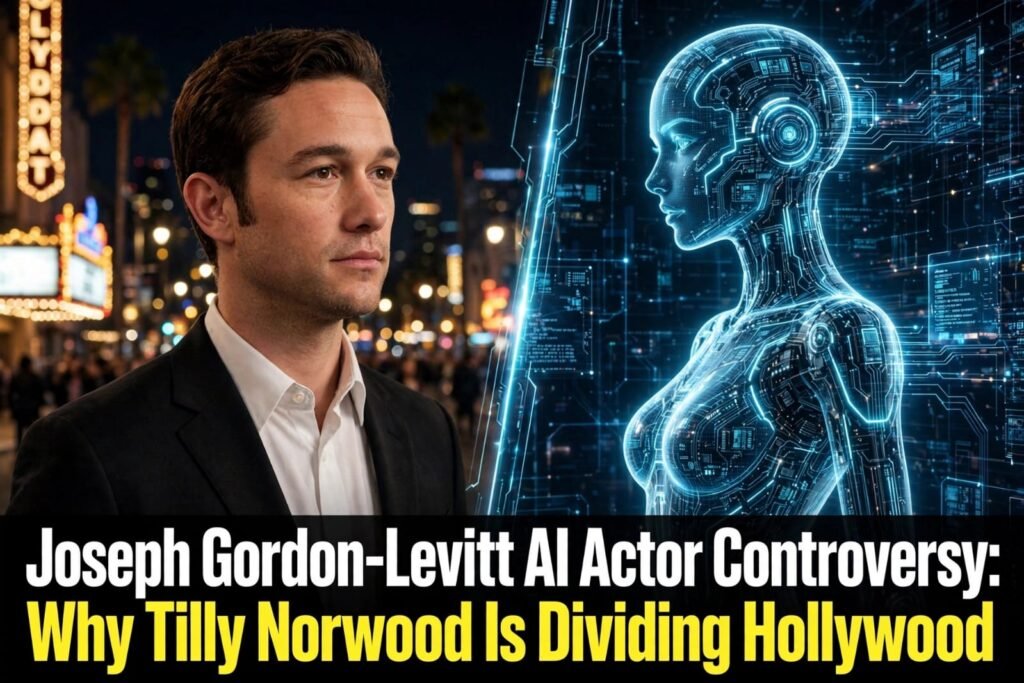
Joseph Gordon-Levitt AI Actor Controversy: Why Tilly Norwood Is Dividing Hollywood
Hollywood is facing a new debate over artificial intelligence after actor Joseph Gordon-Levitt spoke out about Tilly Norwood, an AI-generated character being promoted as an actress. The Joseph Gordon-Levitt AI actor debate has quickly attracted attention because it raises a much bigger question: can an artificial intelligence creation really be called an actor?
Gordon-Levitt has strongly rejected that idea. In a video shared on Instagram, the actor described Tilly Norwood as a piece of software being branded as an actress and argued that AI is not a person. He also said creativity is fundamentally connected to human beings and their experiences.
The comments have added fresh energy to an already heated Hollywood discussion about AI, human performers, creativity and the future of entertainment.
Who Is Tilly Norwood?
Tilly Norwood is an AI-generated entertainment character created by Particle6, an AI-focused entertainment company led by Eline van der Velden, a former actor and filmmaker.
Unlike a traditional Hollywood performer, Tilly is not a human being. She exists digitally and is created through artificial intelligence and other production technologies.
Her creators have promoted her as an AI performer who could appear in different types of entertainment projects. The concept has attracted significant attention because it challenges the traditional idea of what an actor is.
The controversy became even bigger after Tilly was connected with the planned feature film “Misaligned.” The project is described as a hybrid production involving human filmmakers and AI-generated elements.
That development has forced Hollywood to confront a difficult question: if an AI-generated character appears in a film and delivers dialogue and expressions, should the creation itself receive the title of actor?
What Did Joseph Gordon-Levitt Say?
The Joseph Gordon-Levitt AI actor discussion began gaining renewed attention after the actor shared his views on AI and Tilly Norwood.
Gordon-Levitt argued that AI should not be treated as a person. According to his comments, artificial intelligence works by processing and recombining human-created material rather than having its own lived experience.
He explained that AI systems can draw from enormous amounts of human-created content, including films, music, writing and other material available online.
For Gordon-Levitt, that distinction is extremely important.
A human actor has personal experiences, emotions, memories and relationships that can influence a performance. An AI system does not have those human experiences.
That is why Gordon-Levitt does not believe Tilly should be considered an actor in the traditional sense.
Why the AI Actor Debate Is Becoming So Important
The Joseph Gordon-Levitt AI actor controversy is part of a much larger discussion happening across Hollywood.
Artificial intelligence can now generate realistic faces, voices, dialogue, environments and performances. This technology is developing quickly enough that audiences sometimes have difficulty determining whether something was created by a human performer or an AI system.
That creates opportunities for filmmakers, but it also creates serious concerns for actors.
If studios can generate digital performers without hiring traditional actors, some performers fear that jobs could eventually disappear.
The issue is particularly sensitive for background performers, commercials and other roles where digital replicas or synthetic characters could potentially be used.
Hollywood unions have therefore been watching developments involving AI-generated performers very closely.
SAG-AFTRA Raises Concerns
The debate is not limited to Joseph Gordon-Levitt.
SAG-AFTRA, the major US performers’ union, has also criticized the idea of treating AI-generated characters as human actors.
The union has argued that Tilly Norwood is a synthetic creation generated through software and has raised concerns about AI systems being developed using the work of professional performers without appropriate permission, credit or compensation.
This is one of the biggest disagreements between AI companies and traditional performers.
AI developers and supporters often argue that the technology can create new forms of entertainment and new jobs.
Actors and their representatives worry that the same technology could be used to replace human performers or imitate their work without giving them proper control.
The disagreement is therefore not simply about whether AI can produce realistic images.
It is also about ownership, consent, employment and artistic identity.
Can AI Really Be Creative?
One of Gordon-Levitt’s strongest arguments concerns creativity.
The actor has said that creativity is a human trait and that AI works through algorithmic recombination of human-created material.
This raises a difficult philosophical question.
If an AI system creates something that looks completely new, is the AI itself creative?
Or is the creativity actually coming from the humans who developed the technology, supplied the prompts, selected the results and built the system?
There is no universally accepted answer.
Modern AI systems can generate scripts, images, music, voices and videos within seconds. However, the debate continues over whether producing an output is the same thing as experiencing creativity.
For actors, this distinction is particularly important because acting is traditionally connected to human emotion and lived experience.
Tilly Norwood’s Viral Interview
The controversy surrounding Tilly Norwood became even more visible after an unusual interview earlier in September.
During an appearance involving Piers Morgan and actor Tom Conti, Tilly reportedly experienced a strange glitch while discussing her planned film.
When asked questions about the other actors in the project, the AI character unexpectedly switched into Cantonese.
The unexpected moment quickly went viral, with reports saying the clip received more than 14 million views on X.
The incident became another example of the challenges surrounding AI-generated performers.
Supporters can argue that such glitches are simply technological imperfections that will improve over time.
Critics, however, see moments like this as evidence that AI-generated performers still lack the natural understanding and flexibility of human actors.
Hollywood Is Already Experimenting With AI
The Joseph Gordon-Levitt AI actor controversy would not have become so significant if AI were still a distant technology.
Hollywood studios, filmmakers and entertainment companies are already experimenting with artificial intelligence in areas such as visual effects, digital characters, dubbing, editing and production.
Some filmmakers see AI as another creative tool.
The technology can potentially reduce production costs, create impossible environments and help small teams produce sophisticated visual content.
But the use of AI also raises questions about what happens to human jobs.
If AI becomes capable of producing convincing performances, studios could be tempted to reduce the number of human performers required for certain productions.
That is why the current debate is about more than one fictional character.
The Human Performance Argument
Traditional actors argue that acting is not simply about producing facial expressions or saying lines.
A human performer brings personal experience to a character.
An actor may understand grief because they have experienced loss. They may understand fear, happiness, love or disappointment because these emotions are part of human life.
That lived experience can influence subtle elements of a performance.
An AI system can reproduce patterns associated with those emotions, but it does not experience them in the same way.
This is at the center of the Joseph Gordon-Levitt AI actor argument.
Gordon-Levitt’s position is that audiences should distinguish between a human performer and a computer-generated character, even if the technology becomes extremely convincing.
What Tilly’s Creators Say
The creators of Tilly Norwood have offered a very different perspective.
Eline van der Velden has argued that the project is not necessarily designed to eliminate human actors.
According to reporting by the Los Angeles Times, the production process behind Tilly involves human creative decisions, including character development, prompting, performance choices and filmmaking.
Van der Velden has also argued that the project can create jobs for filmmakers and actors who help develop characters and stories.
This creates an important distinction.
AI could potentially become a tool used by human filmmakers rather than a complete replacement for them.
The disagreement is about how that tool will ultimately be used.
Could AI Actors Replace Hollywood Stars?
It is unlikely that AI will immediately replace major Hollywood stars.
Audiences develop emotional connections with real performers because they recognize them across films and public appearances.
Actors such as Joseph Gordon-Levitt have careers built on years of performances, interviews, relationships with audiences and personal identities.
A completely artificial character does not have the same history.
However, AI could have a larger impact on certain parts of the entertainment industry.
Background characters, advertising, short online videos and low-budget productions may be areas where synthetic performers become increasingly common.
This could create a new entertainment market while simultaneously reducing demand for some traditional jobs.
Why Actors Are Worried About Digital Replicas
Another major concern is the use of an actor’s likeness.
Imagine a studio creates a digital version of a performer and uses that digital version in a film without requiring the actor to be physically present.
That technology could be useful when properly licensed.
But without strong protections, performers could lose control over how their face, voice or image is used.
This is why AI contracts and performer protections have become increasingly important in Hollywood.
The future may depend on clear rules explaining when a digital replica can be created, who owns it and how long it can be used.
The Difference Between an AI Character and an AI Actor
The Joseph Gordon-Levitt AI actor debate also raises an important language issue.
Hollywood already has many fictional characters that are not human actors.
Animated characters can be voiced by humans. Computer-generated characters can be created by large teams of artists. Digital effects can create creatures that do not exist in reality.
Nobody normally argues that an animated character is literally a human performer.
The controversy surrounding Tilly is different because she is being promoted specifically as an AI-generated performer.
That wording changes the debate.
If Tilly is described as a character, audiences may understand the concept differently.
If she is described as an actress, it creates a question about whether software should receive the same professional label as a human performer.
What Could Happen Next?
The entertainment industry is unlikely to stop experimenting with AI.
Technology companies are investing heavily in AI-generated video and digital characters, while filmmakers are exploring new ways to use these tools.
At the same time, actors and unions are likely to continue demanding stronger protections.
The future could eventually involve a mixture of human and artificial performers.
Some productions may use traditional actors.
Others may use AI-generated characters.
Some may combine human performances with digital modifications.
The key issue will be whether audiences accept these new forms of entertainment and whether performers are protected from unwanted replacement or imitation.
Will Audiences Accept AI Actors?
That remains one of the biggest unanswered questions.
Technology may become capable of producing extremely realistic digital performers, but realism alone does not guarantee audience acceptance.
People watch actors because they care about stories and characters.
They also develop connections with performers outside films through interviews, social media and public appearances.
An AI character could potentially develop its own digital following, but whether audiences will form the same emotional connection remains uncertain.
Tilly Norwood’s growing online attention suggests there is curiosity about AI performers.
However, controversy surrounding her also shows that many people remain uncomfortable with the concept.
Why This Story Matters Beyond Hollywood
The Joseph Gordon-Levitt AI actor debate is not only about movies.
It represents a much larger question about artificial
Ronaldo Goodbye to Portugal: Is the Portugal Legend Really Leaving the National Team?