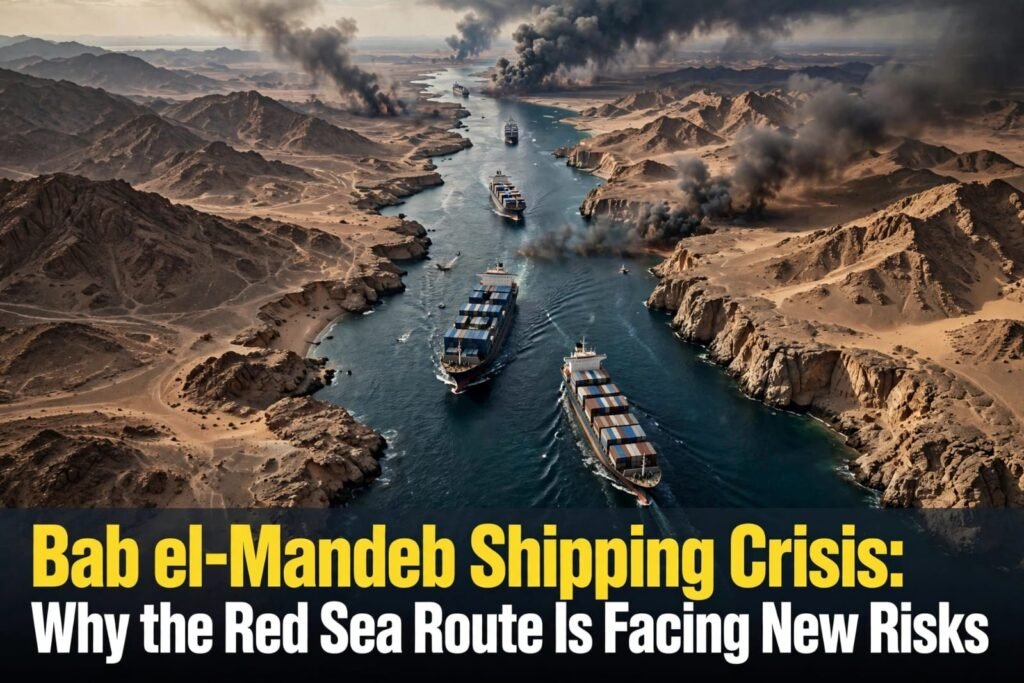
Bab el-Mandeb Shipping Crisis: Why the Red Sea Route Is Facing New Risks
The Bab el-Mandeb shipping crisis has become one of the most closely watched developments in global trade and energy markets as fighting in Yemen threatens a major maritime route connecting the Red Sea with the Gulf of Aden and the Indian Ocean. Recent military developments around the narrow strait have raised fresh concerns for cargo ships, oil tankers and international supply chains.
The situation has changed rapidly in recent days. Saudi-backed Yemeni government forces have claimed effective control of key positions around the Bab el-Mandeb Strait after advancing along Yemen’s western coast with Saudi air support. However, fighting with Houthi forces has continued, and the threat to commercial shipping has not completely disappeared.
The Bab el-Mandeb shipping crisis matters far beyond Yemen. The waterway is an important connection between the Red Sea and the Gulf of Aden. Ships using the route can continue toward the Suez Canal, making it an important shortcut between Europe and Asia.
What Is the Bab el-Mandeb Strait?
Bab el-Mandeb is a narrow maritime passage between Yemen on the Arabian Peninsula and the Horn of Africa. It connects the Red Sea with the Gulf of Aden.
Its geographic position gives it enormous importance for international commerce. Ships traveling between Europe and Asia can use the Red Sea and Suez Canal instead of taking the much longer route around Africa’s Cape of Good Hope.
That means instability around the strait can affect shipping schedules, fuel costs, insurance prices and eventually consumer prices.
The current Bab el-Mandeb shipping crisis is therefore not simply a local military dispute. It has the potential to influence international energy markets and global supply chains.
Why Is the Shipping Route Under Threat?
The latest crisis is connected to the wider conflict in Yemen and the growing confrontation involving the Houthis, Saudi Arabia and other regional powers.
Houthi forces have sought to establish influence over the coastal area and have threatened shipping connected to their regional enemies. Their ability to use missiles, drones and other weapons creates a security concern even when commercial vessels are not directly involved in the fighting.
Recent fighting has been particularly significant because Bab el-Mandeb is already under increased international attention following disruptions elsewhere in the Middle East.
Reuters reported that Saudi-backed Yemeni government forces advanced toward the strait and captured key positions around Dhubab, while Saudi Arabia provided air support. The Yemeni government said the operation was intended to restore control and protect movement through the Red Sea.
Latest Development Around Bab el-Mandeb
One of the biggest developments came in early October 2026.
Yemeni government forces said they had secured effective control of the Bab el-Mandeb area after advancing along the coast. They also reported taking the Dhubab airstrip and isolating remaining Houthi forces in the area.
However, the situation remains contested.
Houthi forces rejected the government’s claims, while other Yemeni sources said fighting was still taking place near military positions close to the strait. This means the situation cannot yet be described as completely stable.
Even if government forces maintain control of the coastline, Houthi forces could potentially use drones or missiles from positions farther inland or along other parts of the coast.
This is one reason the Bab el-Mandeb shipping crisis remains an international concern.
How Does This Affect Global Shipping?
The biggest concern is uncertainty.
Shipping companies need predictable routes. When a maritime corridor becomes dangerous, operators may decide to reroute vessels even if the waterway remains technically open.
A ship traveling from Asia to Europe through the Red Sea and Suez Canal can save significant time compared with sailing around Africa.
But if security risks increase, companies may choose the longer Cape of Good Hope route.
That creates several additional costs:
– Longer voyages
– Higher fuel consumption
– Increased insurance premiums
– Higher crew and security costs
– Delayed deliveries
– More expensive freight rates
– Pressure on global supply chains
The Bab el-Mandeb shipping crisis can therefore affect businesses that are thousands of kilometers away from Yemen.
Why Oil Markets Are Watching Closely
Energy markets are particularly sensitive to developments around Bab el-Mandeb.
The Red Sea route provides an important pathway for oil and petroleum products moving between the Middle East, Europe and Asia.
The latest crisis is especially significant because the Middle East is already experiencing major disruption to energy exports.
Reuters reported on October 6 that global energy markets were facing a combination of crude, refined-product and shipping disruptions. Vitol CEO Russell Hardy said shipping costs had risen sharply, creating significant uncertainty for energy traders and consumers.
Oil executives have also warned that the recent disruptions are forcing the industry to rethink its dependence on a small number of major maritime routes.
According to Reuters, attacks and threats around both the Strait of Hormuz and Bab el-Mandeb have disrupted energy exports and contributed to higher prices and inflation.
What Happens If Ships Avoid Bab el-Mandeb?
If shipping companies significantly reduce their use of Bab el-Mandeb, vessels traveling between Asia and Europe may have to go around the southern tip of Africa.
That journey is considerably longer.
For shipping companies, distance matters because every additional day at sea can increase fuel consumption, crew costs and vessel operating expenses.
Longer routes can also reduce the number of trips a vessel can complete during a particular period.
That means a relatively small security problem at one maritime chokepoint can eventually reduce effective global shipping capacity.
The Bab el-Mandeb shipping crisis could therefore create a chain reaction across international trade if disruptions become prolonged.
Are Ships Still Using the Route?
Yes. The situation is not as simple as saying that all shipping has stopped.
Shipping data cited by Lloyd’s List showed that hundreds of vessels continued transiting the Bab el-Mandeb during late September. The publication reported 290 preliminary transits during the week of September 21–27, compared with 264 the previous week.
This shows that the route remains active despite security concerns.
However, continued traffic does not mean that the crisis has disappeared.
Shipping companies can change their strategies quickly if attacks increase or if insurance and security costs become too high.
Why the Suez Canal Is Also Important
Bab el-Mandeb and the Suez Canal are closely connected in global shipping.
A vessel coming from Asia through the Indian Ocean can pass Bab el-Mandeb, enter the Red Sea and then continue north through the Suez Canal before reaching the Mediterranean.
This route is one of the world’s most important maritime connections.
If ships avoid Bab el-Mandeb, they may also avoid the Suez Canal because they cannot reach it from the south without passing through the Red Sea.
That means a prolonged Bab el-Mandeb shipping crisis could reduce traffic through the Suez Canal as well.
What Does This Mean for Europe and Asia?
European importers are particularly sensitive to disruptions because many products arrive from Asia through maritime routes.
Electronics, machinery, clothing, household products and industrial components can all be transported through these corridors.
Asian economies can also be affected because energy shipments and other commodities move through the Red Sea region.
If transportation becomes more expensive, companies may eventually pass part of those costs to consumers.
That can contribute to inflation.
For businesses, the problem is not only higher shipping prices. Delays can also make inventory planning more difficult.
A company that normally receives goods within a predictable period may have to hold additional stock if vessels are taking longer routes.
The Humanitarian Dimension
The military confrontation also has a serious humanitarian impact.
Yemen has already experienced years of conflict and economic hardship. Renewed fighting could increase displacement and put additional pressure on civilians.
Recent reporting indicated that the renewed war has already displaced large numbers of people.
The latest military campaign is therefore not simply about controlling a shipping route. It is also part of a broader conflict affecting communities across Yemen.
Any escalation around Bab el-Mandeb could make humanitarian access and civilian security more difficult.
Could the Crisis Get Worse?
The future remains uncertain.
The recapture of positions near Bab el-Mandeb by Yemeni government forces could reduce the Houthis’ ability to directly control the narrowest coastal areas of the strait.
However, the military situation remains fluid.
Houthi forces could continue using missiles and drones from other locations. Reuters has also reported that even if coastal territory is recaptured, the group could still potentially threaten vessels from positions farther inland or along the coast.
This means military control of a particular coastal position does not automatically eliminate the wider maritime threat.
For shipping companies, the key question will be whether the security situation remains stable for a sustained period.
What Could Stabilize the Shipping Route?
Several developments could improve the situation.
First, a sustained reduction in fighting around Yemen would lower the immediate security risk.
Second, stronger maritime protection could reassure commercial operators.
Third, diplomatic efforts could reduce the wider regional confrontation that is contributing to the crisis.
Finally, shipping companies will need reliable evidence that vessels can safely travel through the Red Sea before fully restoring normal schedules.
Some major carriers have already explored returning to the Suez route as security conditions changed earlier in 2026.
But companies are likely to remain cautious while military tensions continue.
What Should Consumers Expect?
Consumers should not automatically expect shortages simply because the Bab el-Mandeb route is under pressure.
Global shipping networks are flexible, and companies can reroute vessels when necessary.
However, prolonged disruptions can increase transportation costs.
Those costs can eventually influence the prices of imported goods, fuel and other products.
The effect will depend on how long the disruption lasts and whether other maritime routes remain available.
The biggest risk is a combination of several shipping disruptions at the same time.
That is particularly important because the Middle East is currently experiencing problems involving multiple strategic waterways.
The Bigger Global Trade Risk
The Bab el-Mandeb shipping crisis highlights a major weakness in modern global trade: enormous amounts of commerce depend on a limited number of maritime chokepoints.
When one route becomes dangerous, ships can sometimes find alternatives.
But alternative routes are usually longer and more expensive.
When several routes face problems at the same time, the global economy has fewer options.
That is why governments and energy companies are increasingly discussing alternative pipelines, ports and export routes.
Reuters reported that energy executives are calling for greater investment in alternative routes so global supply chains are less dependent on strategic maritime chokepoints.
What Happens Next?
The next phase of the Bab el-Mandeb shipping crisis will depend heavily on developments in Yemen.
If Saudi-backed government forces maintain control around the strait and fighting decreases, commercial shipping could gradually become more confident.
If Houthi attacks continue or the conflict spreads to other parts of Yemen, shipping companies could once again increase diversions.
The situation will also depend on wider regional tensions.
For now, the most accurate picture is that Bab el-Mandeb remains open to commercial traffic but faces serious security risks.
The latest military developments may have changed who controls important positions near the strait, but they have not completely removed the threat to shipping.
Conclusion
The Bab el-Mandeb shipping crisis has become an important global economic and security story because the narrow waterway connects the Red Sea with a major international trade corridor.
Recent advances by Saudi-backed Yemeni government forces have changed the military picture around the strait, but fighting with Houthi forces continues and the possibility of missile or drone attacks remains a concern.
For international businesses, the main issue is uncertainty. Ships may continue using the route, but companies must constantly evaluate security, insurance and transportation costs.
If stability returns, the Red Sea and Suez route could gradually regain confidence. If fighting intensifies, longer routes around Africa could become increasingly important.
For now, the world is watching Bab el-Mandeb closely because events in this narrow waterway can have consequences far beyond Yemen, affecting shipping, energy markets, inflation and international trade.
Frequently Asked Questions
1. What is the Bab el-Mandeb shipping crisis?
The Bab el-Mandeb shipping crisis refers to growing security risks affecting commercial vessels around the Bab el-Mandeb Strait because of fighting and threats involving Houthi forces and other parties in Yemen.
2. Why is Bab el-Mandeb important?
Bab el-Mandeb connects the Red Sea with the Gulf of Aden and provides an important maritime route between Europe and Asia through the Suez Canal.
3. Are ships still using Bab el-Mandeb?
Yes. Shipping data shows that commercial vessels continue to transit the strait, although operators remain concerned about security risks.
4. Could the crisis increase oil prices?
Yes. Any prolonged disruption to important energy shipping routes can increase transportation costs and place additional pressure on global oil markets.
5. Who is fighting around Bab el-Mandeb?
The conflict involves Houthi forces and Saudi-backed Yemeni government forces, with Saudi Arabia providing military support to the Yemeni government campaign.
6. Will ships stop using the Red Sea?
Not necessarily. Shipping companies are likely to make decisions based on security conditions, insurance costs and the risk of attacks. Some vessels continue using the route while others may choose longer alternatives.
7. What happens if ships avoid Bab el-Mandeb?
Ships traveling between Asia and Europe may need to sail around the Cape of Good Hope in southern Africa, increasing journey times and operating costs.
8. Is Bab el-Mandeb completely closed?
No. Commercial shipping continues through the area. However, the military situation remains unstable and security risks remain.
9. Could this affect global prices?
A prolonged disruption could increase shipping and energy costs, potentially putting pressure on prices for fuel and imported goods.
10. What should happen next?
The key developments to watch are fighting around the strait, the security of commercial vessels, Houthi capabilities and whether Saudi-backed Yemeni forces can maintain control of important coastal positions.
Pakistan, Turkey and Saudi Arabia Yemen War: Defence Pact Activates Amid Houthi Escalation