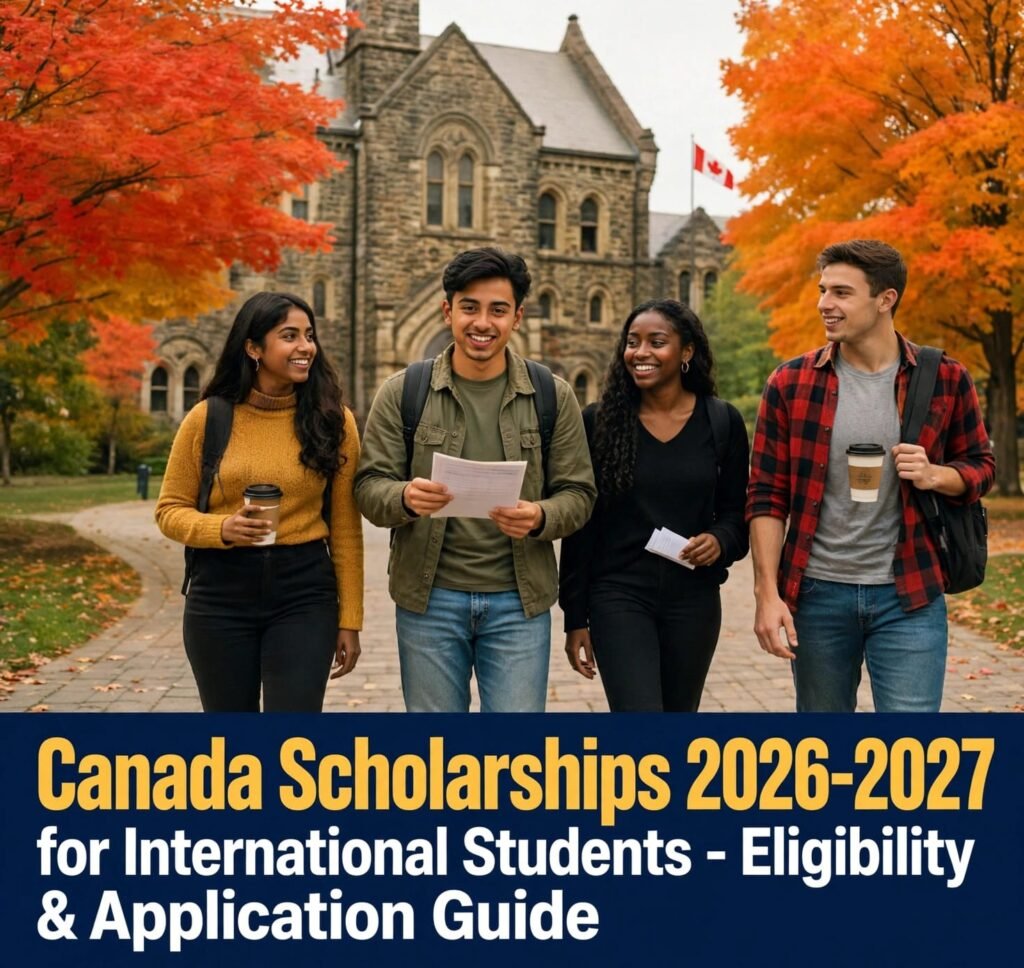
Canada Scholarships 2026–2027 for International Students: Eligibility and Application Guide
Canada Scholarships 2026–2027 for International Students can help eligible students explore opportunities to study at Canadian universities and colleges. Students planning to study in Canada should research university scholarships, academic awards, postgraduate funding, and eligible exchange programmes before choosing where to apply. The right opportunity depends on the student’s nationality, academic qualifications, chosen subject, and intended level of education.
Canada offers different types of financial support, but there is no single scholarship that guarantees funding for every international student. Some awards reduce tuition costs, while others provide financial assistance for specific research or exchange programmes. Students from Pakistan and other countries should carefully check the official eligibility rules, application deadlines, and benefits before submitting an application.
Why Consider Studying in Canada in 2026–2027?
Canada attracts international students because its educational institutions offer programmes in a wide range of academic and professional fields. Students can explore subjects such as business administration, computer science, engineering, healthcare, finance, environmental science, and social sciences.
However, choosing a university involves more than finding a scholarship. Applicants should compare tuition fees, living costs, course requirements, location, and career opportunities related to their chosen qualification.
A scholarship can make education more affordable, but students should calculate their expected expenses before accepting an offer. Accommodation, food, transportation, books, insurance, and other personal costs may not be covered by the award.
Types of Canadian Scholarships for International Students
Students researching Canada Scholarships 2026–2027 for International Students should understand that scholarship programmes differ in their funding, eligibility conditions, and application procedures.
1. University Entrance Scholarships
University entrance scholarships are designed for eligible students beginning a new academic programme. Some institutions consider students automatically during the admission process, while others require a separate scholarship application.
Selection may depend on academic grades, leadership, extracurricular activities, community involvement, or other achievements.
For example, the University of Toronto offers the Lester B. Pearson International Scholarship for eligible international secondary-school students entering undergraduate study. The award has specific eligibility requirements and a school nomination process, so students should read the official instructions carefully.
2. Academic and Merit-Based Awards
Merit-based awards recognize students who meet particular academic or achievement standards. Some focus mainly on grades, while others consider leadership, community service, artistic ability, or other accomplishments.
The award amount and selection criteria vary between institutions. Applicants should check whether the scholarship is renewable, whether they must maintain a minimum grade average, and whether additional applications are required.
Students with strong academic records may find these awards worth investigating, but high grades do not guarantee selection.
3. Master’s Degree Funding
Students planning to pursue a master’s degree can investigate university awards, departmental scholarships, research funding, and other postgraduate opportunities.
Some awards are available to international students, while others are restricted by citizenship, residency, subject, or funding source.
Research-based programmes may offer different funding arrangements from course-based degrees. Applicants should contact the relevant graduate department to understand tuition costs, available funding, and any supervisor requirements.
4. PhD and Research Scholarships
Doctoral students may find funding through university scholarships, research projects, departmental awards, or other eligible programmes.
Applications can require academic transcripts, recommendation letters, a research proposal, and evidence of previous research experience. Some departments also expect applicants to contact a potential supervisor before applying.
Students should confirm whether an award covers tuition, living expenses, research costs, or only a portion of their overall expenses.
5. Government-Supported Exchange Programmes
The Government of Canada also supports selected international study and research exchanges through programmes listed on EduCanada.
For example, the Study in Canada Scholarships programme supports eligible students from specified countries who participate in short-term study or research exchanges. The current programme is not a general, direct-application scholarship for every international student. Canadian postsecondary institutions apply and select eligible participants under the programme rules.
The published 2026–2027 eligibility list includes selected countries and territories in Asia, Europe, the Middle East and North Africa, and Sub-Saharan Africa. Pakistan is not included in that current list.
Official information: https://www.educanada.ca/scholarships-bourses/can/institutions/study-in-canada-sep-etudes-au-canada-pct.aspx?lang=eng
Pakistani students should therefore look for university-specific scholarships and other programmes that explicitly accept applicants from Pakistan instead of assuming that every government scholarship is available to them.
Who Can Apply for Canada Scholarships 2026–2027?
Eligibility for Canada Scholarships 2026–2027 for International Students depends on the award and the institution offering it. Common requirements may include:
– A suitable previous academic qualification.
– The minimum grades or academic average specified by the programme.
– Admission to an eligible university or college programme.
– Proof of nationality or residency, where required.
– English or French language results, if applicable.
– Recommendation letters or a statement of purpose.
– Research experience or a proposal for certain postgraduate awards.
Some scholarships are open to students from many countries, while others accept applications only from selected nationalities.
Before preparing documents, applicants should read the full scholarship guidelines. They should also confirm whether they need an admission offer before applying or whether the scholarship application must be submitted separately.
Documents You May Need
The required documents vary, so students should follow the official checklist for each scholarship.
Academic Transcripts and Certificates
Applicants commonly need academic transcripts and certificates from their previous schools, colleges, or universities. Documents should clearly show the qualifications completed and grades achieved.
Passport
A valid passport is generally important for international admission and subsequent travel or immigration procedures. Check the university’s requirements for passport validity and identification documents.
Language Test Results
Some institutions require an accepted English or French language test. Others may provide exemptions to applicants who meet particular conditions. Check the programme’s official language requirements rather than assuming a test is always compulsory.
Statement of Purpose
A statement of purpose may explain your educational background, career goals, reasons for selecting the programme, and plans for using the qualification.
Keep the statement specific to the university and scholarship. Avoid submitting generic content that does not explain why you are a suitable applicant.
Recommendation Letters
Certain scholarships require references from teachers, professors, academic advisers, or employers. Ask suitable referees well before the deadline and provide them with the relevant application information.
CV or Research Proposal
A CV may be required for postgraduate applications. Research-based programmes may request a proposal describing the subject, research questions, objectives, and proposed approach.
Only submit documents that the scholarship or institution requests, and ensure all information is accurate.
How to Apply for Canadian Scholarships
Students searching for Canada Scholarships 2026–2027 for International Students can use the following process to organize their applications.
Step 1: Decide Your Study Level
First, decide whether you want to pursue an undergraduate degree, master’s qualification, PhD, or short-term exchange programme.
Your education level will help narrow down the scholarships that may be suitable for you.
Step 2: Choose a Subject and Institution
Identify Canadian universities or colleges offering your preferred subject. Compare entry requirements, tuition fees, location, and scholarship opportunities.
Step 3: Check Scholarship Eligibility
Read each scholarship’s rules carefully. Confirm the eligible nationalities, academic requirements, degree levels, and funding conditions.
Pay particular attention to whether the award accepts international students and whether Pakistani applicants are eligible.
Step 4: Prepare Your Documents
Gather transcripts, certificates, identification documents, language test results, references, and any other required materials.
If documents must be translated or officially verified, allow enough time to complete those steps.
Step 5: Apply for Admission
Submit your university application through the institution’s official admission system if required.
Some entrance awards are linked to admission applications. Other scholarships have separate forms or nomination procedures.
Step 6: Submit the Scholarship Application
Complete the required application carefully and submit all supporting documents before the stated deadline.
Save copies of your application and any confirmation messages. If a university or scholarship provider requests additional information, respond within the specified time.
Step 7: Review the Funding Offer
If you receive an award, read the conditions before accepting it. Check the amount, payment schedule, covered expenses, renewal conditions, and any academic requirements.
Do not assume that the scholarship covers every expense unless the official award letter clearly confirms it.
Step 8: Check Study Permit Requirements
Students who plan to study in Canada must review the applicable immigration requirements separately. University admission and scholarship selection do not automatically guarantee study permit approval.
Not every scholarship in Canada is fully funded. Some provide a partial tuition reduction, while others offer a fixed amount or support for a specific period of study or research.
Before applying, check what the award actually covers. Tuition, accommodation, meals, transportation, health insurance, and travel expenses may be treated differently by different programmes.
If an award does not cover all your expenses, calculate how much additional money you would need. Students should also review the applicable study permit financial requirements through official Canadian immigration resources.
Tips for Pakistani Students Applying in 2026–2027
Pakistani students should search for scholarships that explicitly accept applicants from Pakistan. University-specific international entrance awards and eligible postgraduate funding opportunities may be worth exploring, depending on the subject and level of study.
Keep these practical points in mind:
– Start researching before university application deadlines.
– Check whether the scholarship is open to Pakistani citizens.
– Confirm that your chosen degree and institution qualify.
– Prepare genuine academic documents and accurate application details.
– Check whether admission and scholarship applications have separate deadlines.
– Contact the university’s international admissions or funding office if the rules are unclear.
– Avoid agents or websites promising guaranteed scholarships or visas.
The official EduCanada website provides information about scholarship opportunities for international applicants: https://www.educanada.ca/scholarships-bourses/non_can/index.aspx?lang=eng
How to Avoid Scholarship Scams
Students searching for overseas education opportunities may encounter misleading advertisements. Be careful with claims that promise guaranteed admission, a guaranteed full scholarship, or guaranteed visa approval.
Verify the award directly through the university or official government website. Do not send money to an unknown person simply because they claim to reserve a scholarship for you.
Never submit fake certificates, altered transcripts, or false financial information. These actions can lead to serious problems with admission and immigration applications.
A genuine opportunity should have clear eligibility rules, application instructions, and information about the organization responsible for the award.
Canada Scholarships 2026–2027 for International Students provide a useful starting point for students researching financial support for higher education in Canada. However, the best opportunity depends on academic qualifications, nationality, chosen subject, study level, and the funding available at each institution.
Students from Pakistan should carefully distinguish between university scholarships, postgraduate funding, and government-supported exchange programmes. These opportunities do not all follow the same rules, and some are restricted to specific countries.
Begin with official university websites, prepare your documents early, and keep track of admission and scholarship deadlines. Most importantly, check the award’s conditions before relying on it to finance your education.
Frequently Asked Questions
1. Can international students apply for Canadian scholarships in 2026–2027?
Yes. International students can apply for scholarships that accept their nationality and academic level. Eligibility and application procedures vary by award.
2. Can Pakistani students apply for scholarships in Canada?
Yes. Pakistani students can apply for university scholarships and other awards that explicitly accept Pakistani applicants. They must check the rules of each programme.
3. Are all Canadian scholarships fully funded?
No. Some awards provide partial tuition assistance or a fixed amount. Students should check the official funding details to understand what is covered.
4. Is IELTS compulsory for Canadian scholarships?
Not in every case. Language requirements depend on the university, programme, and scholarship. Some institutions may allow exemptions under specific conditions.
5. What documents are commonly required?
Applicants may need transcripts, certificates, a passport, language test results, recommendation letters, a statement of purpose, a CV, or a research proposal.
6. Where can I find official scholarship information?
Start with EduCanada’s official scholarship pages and the websites of Canadian universities. Confirm eligibility and deadlines directly with the relevant provider.
7. Do I need university admission before applying for a scholarship?
It depends on the award. Some scholarships are linked to the admission process, while others require a separate application or institutional nomination.
8. Does receiving a scholarship guarantee a Canadian study permit?
No. Scholarship selection and study permit decisions are separate. Applicants must meet the applicable Canadian immigration requirements.
9. When should I apply for the 2026–2027 academic year?
Check official university and scholarship websites as early as possible. Deadlines differ, and some opportunities may have closed before the academic year begins.
10. Can I apply for more than one scholarship?
Often, yes, provided you meet each award’s eligibility rules. However, some programmes restrict combining awards, so check the conditions before accepting multiple offers.
How to Study in Dubai 2027: University Admission, Student Visa and Part-Time Jobs