
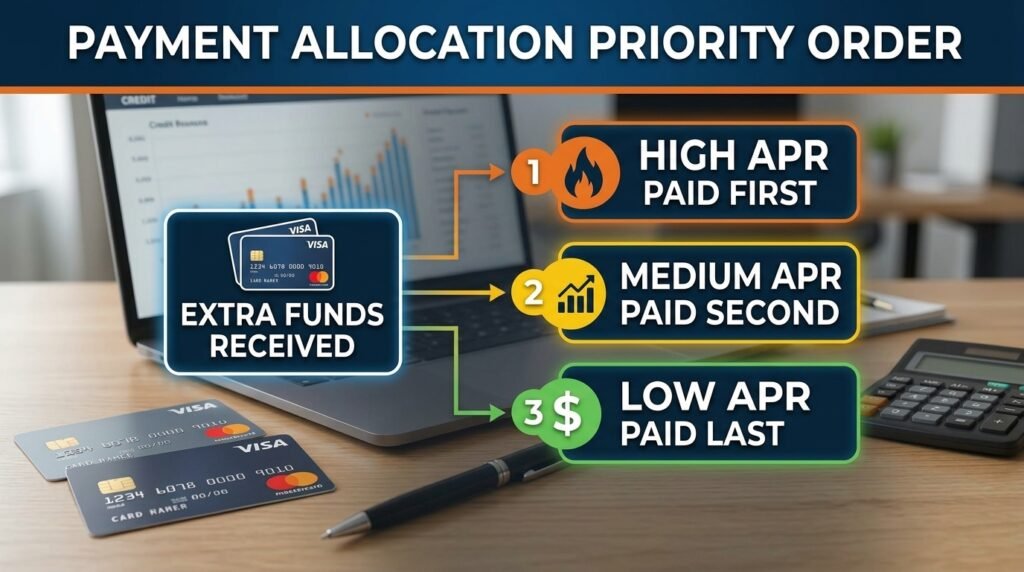
If you have a credit card with different types of balances, you may assume that every payment simply reduces the total amount you owe. In reality, credit card issuers can apply your payment to different portions of your balance according to specific rules and the terms of your card agreement.
This is known as the credit card payment allocation order.
Understanding payment allocation becomes especially important when you have purchases, balance transfers, cash advances, promotional APR balances, or balances carrying different interest rates on the same credit card. Knowing which balance gets paid first can help you understand your interest charges and avoid surprises.
What Is Credit Card Payment Allocation?
Credit card payment allocation is the process a card issuer uses to decide which part of your outstanding balance receives your payment.
A single credit card can contain several balance categories, such as:
- Regular purchases
- Cash advances
- Balance transfers
- Promotional APR balances
- Deferred-interest balances
- Fees and interest
These balances may have different APRs and different repayment terms.
For example, imagine your card has:
- $2,000 in regular purchases at 24% APR
- $1,000 balance transfer at 0% promotional APR
- $500 cash advance at 29% APR
You owe $3,500 in total, but the three balances do not necessarily receive your payment equally.
Which Credit Card Balance Gets Paid First?
The answer depends partly on whether you are paying only the required minimum or paying more than the minimum.
Under U.S. federal credit card payment allocation rules, payments generally must first satisfy the minimum payment due. For amounts paid above the minimum, the portion generally must be applied to the balance with the highest APR first.
This distinction matters because your minimum payment and additional payment can be treated differently.
For example, suppose you owe:
- $1,500 at 25% APR
- $1,000 at 18% APR
- $500 at 0% promotional APR
If your required minimum payment is $100 and you pay $300, the issuer can allocate the minimum portion according to the terms of the account. The amount above the minimum, however, generally goes toward the highest-APR balance first.
That means the extra $200 would generally be directed toward the 25% APR balance.
Why the Minimum Payment Can Be Different
Many cardholders assume the entire payment automatically goes toward the highest-interest balance.
That is not necessarily how it works.
The minimum payment can be allocated according to the credit card agreement and applicable rules. The rules governing amounts above the minimum are more specific.
This is one reason it is important to read your card’s terms if you are carrying multiple balance types.
For example, a card might have a 0% balance transfer promotion alongside regular purchases at a much higher APR. Your payment allocation can affect how quickly the high-interest balance decreases.
What Happens When You Pay More Than the Minimum?
Paying more than the minimum can make a meaningful difference when you carry multiple balances.
The amount above your required minimum generally goes toward the balance with the highest APR first.
Suppose your card has:
- $2,000 at 26% APR
- $1,500 at 20% APR
- $1,000 at 0% APR
If you make a payment substantially larger than your minimum, the additional amount generally goes toward the 26% balance first.
Once that balance is eliminated, additional payments can then be directed toward the next applicable balance.
This can help reduce the amount of interest accumulating on higher-rate debt.
For a broader explanation of why different payment amounts can dramatically affect repayment costs, see our recent guide on Credit Card Minimum Payment vs Full Payment.
How Different APRs Affect Payment Allocation
The interest rate attached to each balance is important because a higher APR generally means that balance becomes more expensive to carry.
For example:
| Balance Type | Balance | APR |
| Cash advance | $500 | 29% |
| Regular purchases | $2,000 | 24% |
| Balance transfer | $1,500 | 0% |
If you pay more than the required minimum, the additional amount would generally be applied to the highest-APR balance first.
In this example, the cash advance has the highest APR.
However, your card agreement can contain specific provisions, so always check the terms associated with your account.
Why Cash Advances Can Be Important
Cash advances often have higher APRs than regular purchases and may begin accruing interest immediately rather than receiving the same grace-period treatment as ordinary purchases.
That makes payment allocation particularly important.
If you have a cash advance and regular purchase balance on the same card, you should understand how payments are being applied and what interest rate applies to each balance.
The sooner a high-cost balance is reduced, the less interest it may generate over time.
What About Balance Transfers?
Balance transfers can create another layer of complexity.
Suppose you transfer $5,000 to a card offering a promotional 0% APR while continuing to use the same card for new purchases at a regular APR.
You could then have:
- Promotional balance at 0%
- New purchases at a higher APR
Your payment allocation becomes important because you may want to understand how much of each payment is reducing the promotional balance versus the higher-interest purchases.
You should also remember that promotional rates usually expire after a specified period. Once the promotional period ends, the remaining balance may become subject to the applicable regular APR.
Our guide on What Is a Balance Transfer Credit Card and How Does It Work? explains how balance transfers work and what costs borrowers should consider.
How Credit Card Interest Is Calculated

Payment allocation and interest calculation are closely connected.
When a balance remains outstanding, the applicable APR determines the cost of carrying that balance. Credit card issuers commonly calculate interest using a daily periodic rate and an average daily balance method, although specific terms can vary.
This means reducing a high-interest balance can reduce the amount of interest that accumulates.
If you want to understand the mathematics behind these charges, our recently published guide on Credit Card Interest Calculation Explained breaks down how APR becomes an actual interest charge.
Does Paying Before the Statement Date Change Allocation?
Making a payment before your statement closes can reduce the balance that appears on your statement, but it does not necessarily change the issuer’s payment allocation rules.
The timing of your payment can still matter for credit reporting.
For example, the balance reported to credit bureaus can be based on information reported around the statement closing date. Our Statement Date Trick guide explains why the statement date and payment due date are different and how payment timing can affect the balance reported to credit bureaus.
However, reducing your reported balance is different from changing how the issuer allocates your payment among different balance categories.
What If You Have a Promotional Balance?
Promotional balances require extra attention.
A credit card may offer:
- 0% APR for balance transfers
- 0% APR for purchases
- Deferred-interest financing
- Reduced APR for a limited period
The terms can differ significantly.
With deferred-interest promotions, for example, failing to pay the promotional balance in full by the deadline can potentially result in interest being charged according to the promotion’s terms.
Do not assume that every “0% offer” works the same way. Check the promotional disclosure and account agreement.
Can You Tell How Your Payment Was Applied?
Usually, yes.
Your credit card statement should provide information about your balances, payments, interest charges, and other account activity.
If you have multiple balance types, review the statement carefully to understand how your payment affected each balance.
You can also contact the card issuer if the allocation is unclear.
Keep copies of your statements and promotional terms, especially if you are using a balance transfer or another special financing offer.
Common Payment Allocation Mistakes
Assuming Every Balance Gets Paid Equally
Payments are not necessarily divided evenly among your different balances.
Ignoring APR Differences
A small balance with a very high APR may cost more over time than a larger balance with a lower APR.
Focusing Only on the Minimum Payment
The minimum payment keeps the account current when paid on time, but paying only the minimum can result in a much longer repayment period and greater interest costs.
Forgetting Promotional Expiration Dates
A 0% promotional APR does not necessarily last indefinitely. Record the expiration date and understand what APR may apply afterward.
Continuing to Use the Card While Paying It Down
New purchases can make it harder to reduce your overall balance and may create additional balance categories.
How to Manage Multiple Credit Card Balances
If your card has multiple balances, start by identifying:
- The balance amount
- The APR for each balance
- The promotional expiration date
- The minimum payment
- How payments are allocated
- Whether new purchases receive a grace period
- Any applicable fees
Then review your statement each month.
If you have extra money available for repayment, understanding which balance carries the highest APR can help you see where additional payments are being directed.
Frequently Asked Questions
Does my credit card payment always go to the highest-interest balance first?
Not necessarily for the entire payment. The minimum payment can be allocated according to applicable rules and your card agreement. Generally, amounts paid above the minimum must be applied to the balance with the highest APR first.
What happens if two balances have the same APR?
If two balances have the same APR, the issuer’s terms and applicable payment allocation rules determine how the payment is applied.
Do balance transfers affect payment allocation?
Yes. A balance transfer can create a separate balance with different pricing or promotional terms, so understanding how payments are allocated becomes particularly important.
Are cash advances usually paid first?
Not automatically. Although cash advances can have high APRs, the exact allocation depends on the applicable payment rules and account terms.
Can payment allocation affect how much interest I pay?
Yes. Which balance is reduced first can affect how much high-interest debt remains outstanding and therefore how much interest can accumulate.
Final Thoughts
Credit card payment allocation determines how your payments are distributed among different balances on your account. This becomes especially important when a card contains regular purchases, cash advances, balance transfers, or promotional APR balances.
In general, the minimum payment can be allocated under the card’s applicable terms, while amounts paid above the minimum generally go toward the highest-APR balance first under U.S. federal rules.
Understanding your payment allocation order can help you read your credit card statement more accurately, anticipate interest charges, and make more informed repayment decisions. Always review your card agreement and promotional terms because the details can vary by account.