
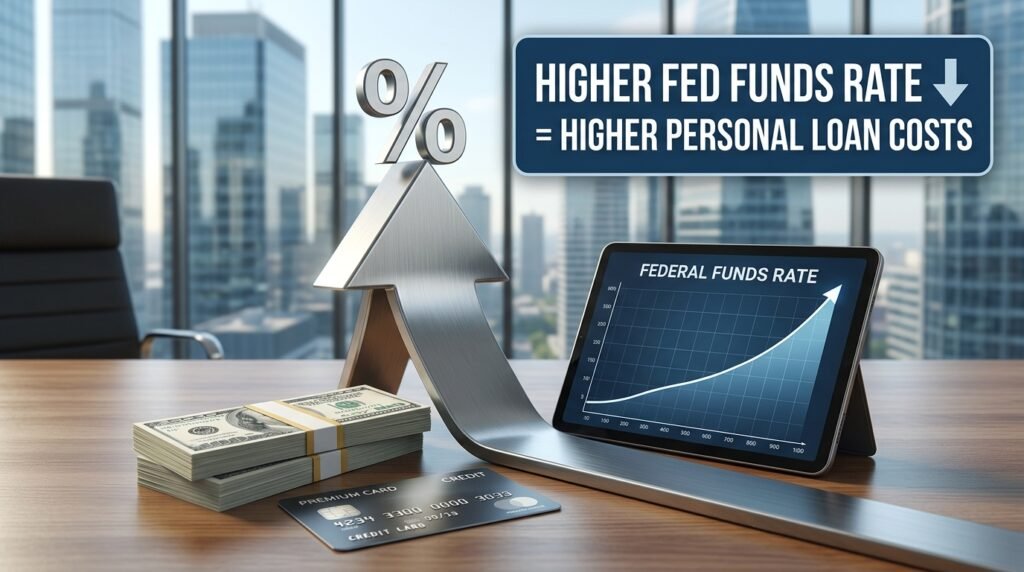
When the Federal Reserve changes its benchmark interest rate, borrowers may wonder how the decision could affect personal loans. The federal funds rate does not directly determine the interest rate on a personal loan, but changes in monetary policy can influence broader borrowing costs.
On September 16, 2026, the Federal Reserve raised the target range for the federal funds rate by 0.25 percentage point to 3.75% to 4.00%. The Fed said the decision was made as inflation remained elevated and the central bank continued working toward its 2% inflation goal.
For people considering a personal loan, a higher-rate environment can affect the interest rate offered by lenders, monthly payments, and the total cost of borrowing. However, the impact varies depending on the lender, loan type, credit profile, loan term, and broader market conditions.
What Is the Federal Funds Rate?
The federal funds rate is the interest rate banks charge each other for overnight borrowing of reserve balances. The Federal Reserve uses this rate as an important tool for influencing monetary conditions in the economy.
When the Fed raises the federal funds rate, borrowing costs across parts of the financial system can increase. When the Fed lowers the rate, some borrowing costs may move lower over time.
The federal funds rate is not the same as the interest rate you receive on a personal loan. Instead, it is one factor that can influence the broader interest-rate environment in which banks and other lenders operate.
How Does a Higher Federal Funds Rate Affect Personal Loans?
Personal loan rates are determined by individual lenders based on several factors.
These can include:
- Your credit history and credit score
- Income and employment information
- Existing debt
- Loan amount
- Loan term
- Lender policies
- Market interest rates
- Whether the loan has a fixed or variable rate
A higher federal funds rate can contribute to a higher overall cost of borrowing. Lenders may adjust pricing based on their own funding costs, market conditions, and risk assessments.
However, the change is not necessarily one-for-one.
For example, a 0.25 percentage point Fed increase does not automatically mean that your personal loan APR will increase by exactly 0.25 percentage point.
Do Personal Loan Rates Always Rise After a Fed Rate Hike?
No.
The relationship between the federal funds rate and personal loan rates is not automatic.
Many personal loans have fixed interest rates, meaning the rate is established when the loan is originated and generally remains unchanged throughout the repayment period, subject to the loan agreement.
This means an existing fixed-rate personal loan generally does not become more expensive simply because the Fed raises its benchmark rate.
However, borrowers applying for a new personal loan may encounter different rates because lenders can adjust their pricing as market conditions change.
Fixed-Rate Personal Loans and Higher Interest Rates
A fixed-rate personal loan provides a set interest rate for the agreed repayment period.
For example, suppose you take out a $10,000 personal loan with a fixed APR. If the Federal Reserve later raises its benchmark rate, the interest rate on that existing loan generally does not change simply because of the Fed’s decision.
This can make the monthly principal-and-interest payment more predictable.
The situation is different when you are shopping for a new loan. A lender may offer a different APR based on current market conditions and your financial profile.
This is why borrowers should compare loan offers instead of assuming that one lender’s rate represents the entire market.
How a Higher Rate Can Increase Your Monthly Payment
Interest rates can have a noticeable effect on monthly loan payments.
Consider a hypothetical $10,000 personal loan with a five-year repayment period.
If the APR is relatively low, the monthly payment will generally be lower than it would be for the same loan amount and term at a higher APR.
The difference can also affect the total interest paid over the life of the loan.
For example, using an illustrative calculation:
- Loan amount: $10,000
- Term: 60 months
- APR: 10%
The monthly principal-and-interest payment would be approximately $212.
At a 15% APR for the same amount and term, the monthly payment would be approximately $238.
That difference is around $26 per month, but the total interest difference becomes more significant over five years.
Actual loan payments can vary because lenders may charge origination fees or other costs.
Why Your Credit Profile Still Matters
The federal funds rate is only one part of the personal loan pricing picture.
Your individual credit profile can have a major effect on the APR you are offered.
A lender may consider factors such as:
- Credit history
- Credit score
- Income
- Employment
- Existing debt
- Debt-to-income ratio
- Loan amount
- Loan purpose
- Repayment history
For example, two borrowers applying for the same loan amount may receive different APRs because their credit profiles and financial circumstances are different.
Your debt-to-income ratio can also be relevant when lenders evaluate your ability to handle additional monthly payments. Our published guide on Debt-to-Income Ratio Explained explains how DTI is calculated and how lenders may use it when reviewing applications.
What Does a Higher Fed Rate Mean for Existing Personal Loans?
If you already have a fixed-rate personal loan, a Fed rate increase generally does not change your scheduled interest rate.
Your existing loan follows the terms you agreed to when you borrowed the money.
However, borrowers with variable-rate loans may have different experiences. If the loan’s terms allow the interest rate to adjust based on an underlying index, changes in market rates could affect future borrowing costs.
You should check your loan agreement to determine whether your rate is fixed or variable and understand when adjustments can occur.
What Does a Higher Fed Rate Mean for New Personal Loans?
For someone planning to apply for a personal loan, a higher-rate environment can make comparing offers more important.
A higher APR can increase both your monthly payment and the total amount of interest paid over the repayment period.
For example, if you are considering a $15,000 loan, extending the repayment period may lower your monthly payment but increase the total interest paid.
This is why borrowers should look at more than the monthly payment.
Compare:
- APR
- Interest rate
- Loan term
- Monthly payment
- Origination fees
- Prepayment terms
- Total repayment amount
- Late-payment fees
How Debt Consolidation Can Be Affected
Some borrowers use personal loans to consolidate credit card debt.
If a personal loan offers a lower APR than the credit cards being consolidated, the borrower may potentially reduce interest costs or simplify repayment.
However, the value of consolidation depends on the actual loan terms.
A higher personal loan APR may reduce the potential savings compared with consolidating when rates are lower.
Our published guide on Debt Consolidation vs. Debt Settlement explains how debt consolidation works and why borrowers should consider interest rates, fees, loan terms, and total repayment costs.
Should You Wait to Apply for a Personal Loan?
A Fed rate increase does not automatically mean that you should wait or apply immediately.
The right timing depends on your financial circumstances, borrowing need, credit profile, and the offers available to you.
If you need a personal loan for a necessary expense, waiting may not be practical.
If the loan is optional, you may have more flexibility to improve your credit, reduce existing debt, increase savings, or compare more lenders before borrowing.
Instead of focusing only on the Fed’s latest decision, look at the actual APRs available to you.
How to Reduce the Cost of a Personal Loan

There are several steps that may help you reduce borrowing costs.
Improve Your Credit Before Applying
If possible, review your credit reports and address errors or outstanding issues before applying.
A stronger credit profile may help you qualify for more competitive loan offers, although approval and pricing vary by lender.
Compare Multiple Lenders
Different lenders can offer different APRs, fees, loan amounts, and repayment terms.
Comparing multiple offers can help you understand the range of costs available to you.
Choose a Reasonable Loan Term
A longer term may reduce your monthly payment, but it can increase the total interest paid.
A shorter term may increase your monthly payment while reducing the amount of time interest accrues.
Consider both numbers before selecting a repayment period.
Borrow Only What You Need
A higher loan amount generally means more money to repay and potentially more interest.
Before applying, calculate how much you actually need and whether the monthly payment fits comfortably within your budget.
Personal Loans vs. Other Borrowing Options
A personal loan is not the only way to borrow money.
Depending on your situation, you may also consider a credit card, balance transfer, home-related borrowing, or other financial products.
For example, a balance transfer credit card may offer a promotional APR for eligible transferred debt. However, fees, promotional periods, eligibility requirements, and the regular APR after the promotional period should all be considered.
Our guide on What Is a Balance Transfer Credit Card and How Does It Work? explains the costs and repayment considerations involved with balance transfers.
The important point is to compare the total cost rather than choosing an option based only on the advertised monthly payment.
What Should Borrowers Watch in 2026?
The Federal Reserve’s September 2026 decision brought the federal funds target range to 3.75% to 4.00%. The Fed’s projections also show that policymakers have different expectations for future interest rates, so borrowers should not assume that rates will move in only one direction.
For personal-loan borrowers, it makes sense to monitor:
- Personal loan APRs
- Federal Reserve decisions
- Your credit profile
- Existing debt
- Monthly budget
- Loan fees
- Total repayment cost
Current personal loan offers can vary substantially by borrower and lender. For example, Bankrate’s September 2026 data shows a broad range of personal-loan APRs, illustrating why comparing actual offers is important rather than relying on a single market average.
Final Thoughts
A higher federal funds rate can contribute to a higher borrowing-cost environment, but it does not directly determine the APR on an individual personal loan.
For existing fixed-rate personal loans, the scheduled interest rate generally remains unchanged under the original loan terms. For new borrowers, however, market conditions can influence the rates lenders offer.
If you are considering a personal loan in 2026, compare APRs, fees, repayment terms, and total borrowing costs. Your credit history, income, existing debt, and loan amount can also affect the offer you receive.
Understanding the relationship between Federal Reserve policy and personal loan rates can help you evaluate borrowing costs without focusing on the Fed rate alone.
Frequently Asked Questions
Does the federal funds rate directly control personal loan rates?
No. The federal funds rate is a benchmark used in monetary policy. Personal loan rates are set by individual lenders and can be influenced by market conditions, funding costs, borrower risk, and other factors.
Will my existing personal loan rate increase after a Fed rate hike?
If your personal loan has a fixed rate, a Fed rate increase generally does not change the interest rate on your existing loan. Variable-rate loans can have different terms, so check your agreement.
Can a higher Fed rate make personal loans more expensive?
It can contribute to a higher borrowing-cost environment. However, the actual APR offered to a borrower depends on the lender, credit profile, loan term, and other factors.
Does my credit score affect my personal loan APR?
Yes. Lenders commonly consider credit history and other financial information when determining eligibility and pricing. The specific factors and their importance vary by lender.
Should I compare personal loan APRs?
Yes. Comparing APRs can help you evaluate the cost of different loan offers because APR can incorporate interest and certain fees associated with borrowing.
Can a personal loan be used to consolidate credit card debt?
Yes. Some borrowers use personal loans to consolidate credit card balances. However, you should compare the personal loan APR, fees, repayment term, and total cost with your existing credit card debt before proceeding.