
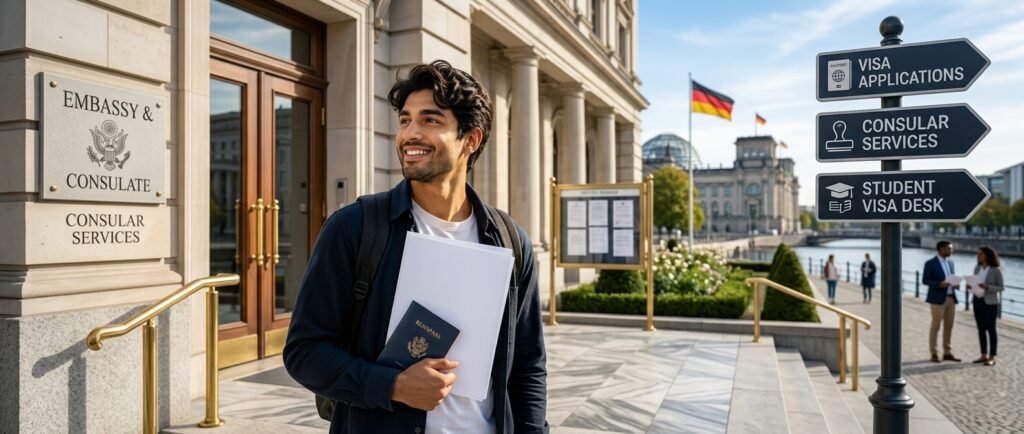
The admission letter arrives, and for a day or two everything feels settled. Then you realize that to get a US student visa, you still need an I-20, fees, a form, an interview slot, and no idea how long any of it takes.
Nobody can promise a delay-free visa, because consular officers make the final call and rules change. What you can do is remove the avoidable delays. This guide walks through the F-1 process, the recent rule changes that catch people off guard, and a timeline for a 2027 start.
What You Need to Get a US Student Visa
Most full-time international students in the U.S. apply for an F-1 visa. The process starts with your school, not the embassy. Once a school approved to enroll international students admits you, it issues a Form I-20, and that document unlocks everything else.
For a broader look at planning your move abroad, see our guide on how to study abroad.
Step-by-Step: The F-1 Process
- Get your Form I-20. Your school issues it after admission, usually once you confirm enrollment and show proof of funds. Check that your name, program, and dates are correct.
- Pay the SEVIS I-901 fee. ICE lists the fee at $350 for F-1 students. Pay it online before your interview and keep the receipt.
- Complete the DS-160. This is the online nonimmigrant visa application. The State Department’s DS-160 page explains that you should print the barcode confirmation page, schedule your own interview, and pay the processing fee.
- Pay the visa application fee and book your interview. The embassy doesn’t schedule it for you. The standard application fee is $185, though your embassy’s instructions are the final word.
- Gather your documents. Bring your passport, I-20, DS-160 confirmation, fee receipts, financial evidence, and academic records.
- Attend the interview. Answer clearly, briefly, and honestly.
Rules That Can Slow You Down When You Get a US Student Visa in 2027
Several recent changes affect timing, so read this section carefully.
Interviews Are Now Standard
The State Department sharply narrowed interview waivers in 2025. Legal advisories say that since October 1, 2025, most nonimmigrant visa applicants, including many renewals, need an in-person interview. For a first-time F-1 applicant, plan on attending one.
Apply in Your Home Country
Since September 2025, applicants are directed to interview at a U.S. embassy or consulate in their country of nationality or residence. University advisories warn that applying in a third country may bring longer waits and extra scrutiny and that fees generally aren’t refundable if you have to change plans.
Social Media Review
For F, M, and J applicants, the State Department asks that social media accounts be set to public so officers can review them. The DS-160 also requires you to list the social media handles you’ve used in the last five years. The U.S. Embassy in Mexico’s guidance explains this process. Whatever you do, list your accounts accurately. Omissions cause more problems than a casual post ever will.
New and Changing Fees
Congress created a $250 Visa Integrity Fee for most nonimmigrant visas. Boston University’s international office reports that some posts have begun collecting it at visa issuance, on top of the application and SEVIS fees. Implementation details have been unclear, so follow your embassy’s instructions and never pay an unofficial website or agent claiming to collect it.
A Realistic 2027 Timeline
To get a US student visa for a fall 2027 start, a workable plan looks like this:
- As soon as you’re admitted: Confirm enrollment and submit financial documents so your school can issue the I-20.
- Right after the I-20: Pay the SEVIS fee and finish the DS-160.
- Immediately after: Check appointment availability, since wait times vary by location, and book the earliest slot that works.
- Before the interview: Prepare documents and review your online presence.
Universities generally note that you can apply up to 365 days before your program start date, but you can’t enter the U.S. more than 30 days before it. Applying early gives you a buffer if something goes wrong.
The Interview: The Final Step to Get a US Student Visa
The interview is short, and the officer mainly wants to understand three things before you get a US student visa:
- Why you chose this school and program
- How you’ll pay for your studies
- Whether you plan to return home after finishing
Practice explaining your plan in two or three sentences. Keep answers consistent with your I-20 and DS-160, and avoid reciting memorized scripts.
A Realistic Example
Say Priya is admitted to a master’s program starting in August 2027. She confirms enrollment in the spring, receives her I-20, and pays the SEVIS fee that week. She fills out her DS-160 carefully, lists all her social media handles, and books the first appointment available at her local consulate. She keeps her funding documents in one folder and rehearses a short explanation of why she chose her program.
She can’t control the officer’s decision, but she has avoided every preventable delay.
Common Mistakes That Cause Delays
Waiting to book the appointment. Wait times vary, and the good slots go first.
Errors on the DS-160. Names, dates, and program details should match your I-20 exactly.
Missing or unclear funding proof. If you’re relying on a scholarship, keep the award letter handy. Our guide to US scholarships without IELTS or TOEFL can help you find funding options.
Forgetting the SEVIS receipt. You’ll be asked for it.
Leaving social media incomplete or inconsistent. List all accounts and keep them consistent with your application.
Applying in the wrong country. Stick to your country of nationality or residence unless the State Department directs otherwise.
Paying unofficial sites. Only pay through official channels listed by the State Department, ICE, or your embassy.
Keeping a Backup Option
Visa rules and wait times can change quickly, so it helps to have a backup if your plan to get a US student visa hits a snag. Our guide to studying in Switzerland, including costs, scholarships, and visa steps shows what a different visa path looks like.
Practical Takeaways
- To get a US student visa, start with the I-20, then the SEVIS fee, DS-160, fee payment, and interview.
- Plan for an in-person interview in your home country.
- Prepare for an online presence review by listing all accounts accurately.
- Keep an eye on fee updates and only pay through official channels.
- Apply early and keep every receipt and document organized.
- Confirm all details with your embassy and school, since policies change.
Final Thoughts
Learning how to get a US student visa comes down to preparation. You can’t control processing times or an officer’s judgment, but you can control your timeline, your paperwork, and how clearly you explain your plans. Start early, double-check every form, and lean on your school’s international office when something looks unclear.