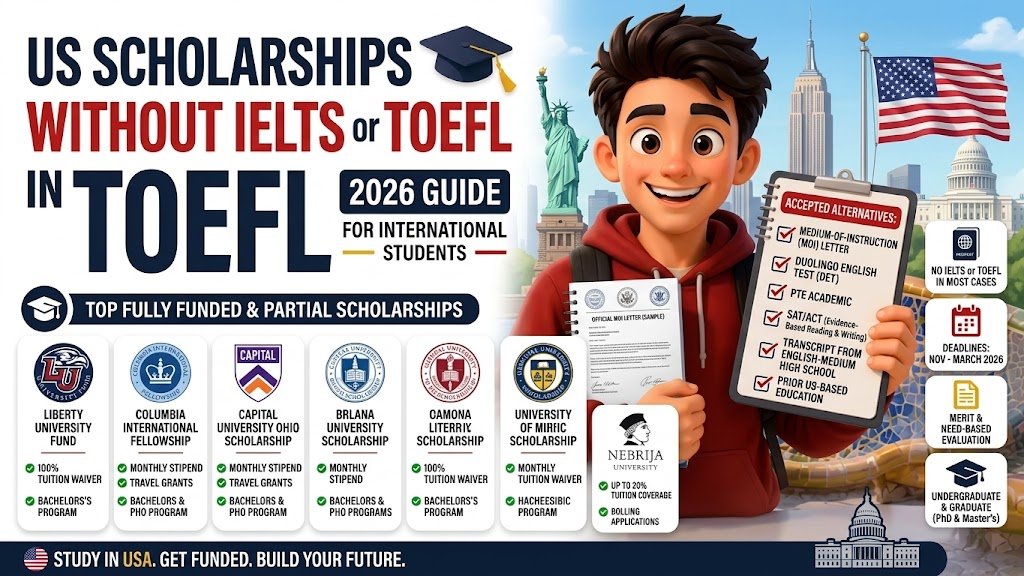
Yes, you can win a US scholarship without IELTS or TOEFL — but “no test” almost always means “different proof,” not “no proof at all.” Universities that waive standardized English exams still need evidence you can study in English: a medium-of-instruction (MOI) letter, a Duolingo English Test score, PTE Academic, SAT/ACT results, or a transcript from an English-medium high school. This guide walks through which waivers are real, which universities and scholarships use them, and how to build an application that doesn’t get flagged for missing documentation.
Why Some US Scholarships Skip IELTS and TOEFL
Universities require English proficiency proof for one reason: they need confidence you can follow lectures, write papers, and pass exams in English. IELTS and TOEFL are just two ways to demonstrate that. Over the last several admissions cycles, a growing number of US institutions have accepted alternative evidence instead — partly because testing centers aren’t accessible everywhere, and partly because standardized test scores don’t always correlate with classroom readiness.
The Medium-of-Instruction (MOI) Waiver Explained
If your previous degree — high school, a bachelor’s, or a diploma — was taught entirely in English, many US schools will accept a letter from that institution confirming it, instead of a test score. This is usually called an MOI letter, and it needs to:
- Be printed on official letterhead
- Be signed by a registrar or academic dean
- State explicitly that English was the sole language of instruction
Not every university accepts this route for scholarship consideration, and some only waive the admissions requirement while still expecting a test score for merit scholarship review. Always confirm this distinction directly with the financial aid office, not just the admissions office — the two departments sometimes apply different rules.
Duolingo English Test as an Accepted Alternative
The Duolingo English Test (DET) has become one of the most common substitutes for IELTS and TOEFL at US schools. It’s taken online, costs a fraction of a traditional exam, and returns results within 48 hours. A large number of US colleges — including several in the Ivy League — now list DET as an accepted score for both admission and scholarship review. Score requirements vary by school, typically falling somewhere between 100 and 130, so check each university’s published minimum rather than assuming one number applies everywhere.
SAT, ACT, and Prior US-Based Education
If you’ve completed high school in the US, or scored competitively on the SAT or ACT (particularly the Evidence-Based Reading and Writing section), several universities treat that as sufficient proof of English ability on its own. This route is more common for undergraduate merit scholarships than graduate funding.
How to Qualify for a Test Waiver Without Hurting Your Scholarship Chances
A waiver only helps if it’s documented correctly. Scholarship committees reject incomplete waiver requests more often than they reject low test scores — because an incomplete file looks unprepared, not exempt.
Documents You’ll Actually Need
- MOI letter (if applicable), dated within the last 6–12 months
- Academic transcripts showing language of instruction
- Alternative test score report (DET, PTE) sent directly from the testing body
- A short statement, if requested, explaining your English-language background
Common Mistakes That Get Waivers Rejected
- Submitting a personal statement claiming English proficiency instead of an official letter
- Assuming a waiver for admission automatically applies to scholarship review
- Missing the scholarship-specific deadline while waiting on a delayed MOI letter
- Sending a DET or PTE score after the scholarship’s document deadline, even if the application itself is still open
US Scholarships and Universities Known for Flexible English Requirements
Policies shift year to year, so treat this as a starting list to verify directly on each school’s international admissions page — not a guaranteed roster.
Related reading: check out our complete directory on Fully Funded Scholarships for International Students
Automatic Merit Scholarships With Flexible Language Rules
Some universities fold the scholarship decision into the admission decision itself, with no separate scholarship form. In these cases, the English proficiency requirement (and any waiver) is decided once, at the admission stage, and the scholarship follows automatically. Capital University in Ohio and Boston University are two examples that have historically applied this model for eligible international undergraduates, though exact terms change by intake — confirm current-cycle requirements before applying.
Schools With Published DET or PTE Acceptance for Scholarship Applicants
A number of private US universities now list Duolingo or PTE explicitly alongside IELTS/TOEFL on their international scholarship pages, rather than treating them as a special exception. If a school’s financial aid page lists these tests side by side with IELTS/TOEFL (not in a separate “waiver” section), that’s usually a sign the alternative carries equal weight in the review.
State and Public Universities With MOI Acceptance
Public universities in states with large international student populations — including several in the Big Ten and state university systems — have MOI waiver policies for applicants from English-medium secondary or postsecondary systems. These policies tend to be well documented on the registrar’s or graduate admissions website, so they’re easier to verify than private-school exceptions.
Step-by-Step: Applying for a US Scholarship Without a Language Test
- Confirm the waiver applies to the scholarship, not just admission. Email the financial aid office directly and ask in writing.
- Request your MOI letter early. University registrars can take weeks, especially outside of peak enrollment periods.
- Register for DET or PTE as a backup, even if you expect an MOI waiver — a same-week rejection of your waiver shouldn’t cost you the scholarship deadline.
- Track scholarship-specific deadlines separately from admission deadlines. Many scholarships close weeks before the general application.
- Submit everything through the official portal, not by email attachment, unless the university explicitly instructs otherwise.
Timeline for Fall 2026 / 2027 Intake
Most US scholarship and admission cycles for Fall 2026 entry close between December 2025 and March 2026, with a smaller set of rolling or spring-intake scholarships open through mid-2026. If you’re targeting Fall 2027, plan to start MOI or test-alternative documentation at least six months ahead of your target university’s scholarship deadline.
Building a Strong Application Without a Test Score
Without a numeric test score to lean on, admissions and scholarship committees will weigh your transcripts, personal statement, and recommendation letters more heavily. A statement of purpose that reads clearly and specifically — not generically — does more work here than it would in a file that also includes a 110 DET score. Have a native or fluent English speaker review your writing before submission.
Frequently Asked Questions
Can I get a full scholarship to a US university without taking IELTS or TOEFL?
Yes, but you’ll typically need to supply an alternative — an MOI letter, a Duolingo or PTE score, or SAT/ACT results — rather than no proof at all. Fully funded scholarships that skip English testing entirely, with zero substitute requirement, are rare.
Do all US universities accept the Duolingo English Test for scholarships?
No. Acceptance varies by school and sometimes by program within the same school. Always check the specific scholarship’s English proficiency policy, not just the general admissions page.
Is an MOI letter enough on its own, or do I still need a test score?
It depends on the university. Some accept an MOI letter as full replacement for a test score; others use it only to waive the admission requirement while still asking for a score for merit scholarship review. Confirm in writing with the financial aid office.
Will skipping IELTS or TOEFL hurt my scholarship application?
Not if your alternative documentation is complete and submitted on time. Incomplete waiver paperwork, not the absence of a test score, is what usually causes rejections.
What’s the cheapest way to prove English proficiency for a US scholarship?
An MOI letter costs nothing beyond your registrar’s processing time. Among paid tests, the Duolingo English Test is generally the least expensive, at under $60, compared to IELTS or TOEFL, which typically run $200–$250.
Ready to find scholarships that match your profile?
Every university sets its own English proficiency and waiver rules, and they change by intake. Before you invest time in an MOI letter or a test-alternative, confirm the current-year requirement directly with the scholarship’s financial aid office — and start that process at least two months before the scholarship deadline, not the admission deadline.