
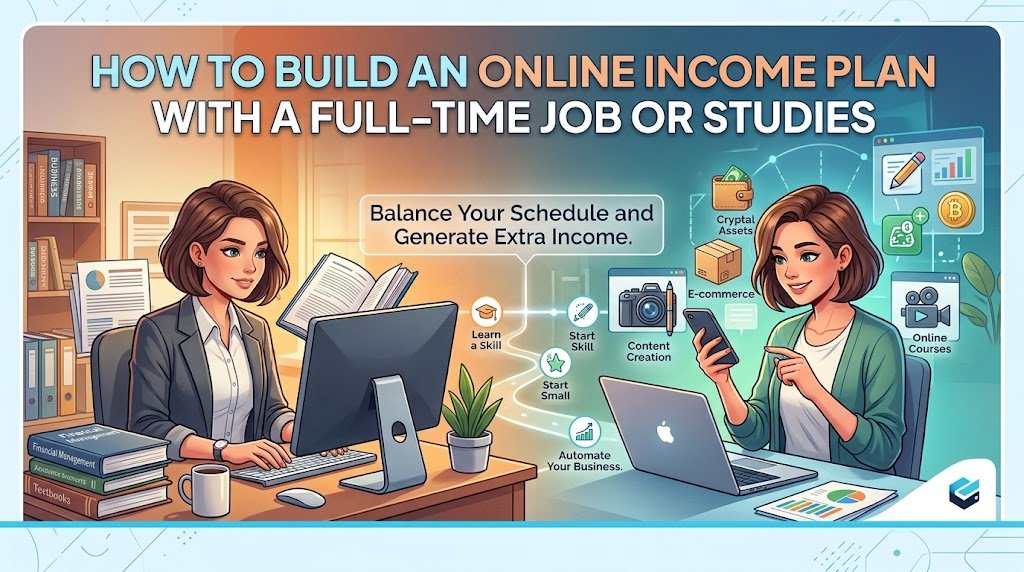
The best way to build an online income plan while working full-time or studying is to start small, protect your main responsibility, and focus on one income-producing skill. Instead of trying several side hustles at once, set a monthly target, reserve a realistic number of hours each week, learn one useful skill, and gradually turn that skill into paid work. For students, this can mean freelancing, tutoring, writing, design, or other flexible work; for employees, project-based online work can fit around evenings and weekends.
If you’re new to online earning, start with a broader Online Earning Guide to understand the different ways people make money online before choosing one specific method. The goal isn’t to make a huge amount of money immediately. A good plan should be sustainable enough that you can continue it for months without damaging your studies, job performance, sleep, or personal life.
Start With a Realistic Online Income Goal
Before choosing a website or learning a skill, decide what you actually want your online income to achieve. A target such as “I want to make money online” is too vague. A target such as “I want to earn an extra Rs. 20,000 per month within six months” gives you something you can measure.
Your first target should also match the amount of time you have available. Someone working eight hours a day shouldn’t plan for another six hours of online work every evening. Likewise, a student facing exams shouldn’t promise clients daily work that may interfere with assignments.
A simple starting framework is:
- Month 1: Learn and practise one marketable skill.
- Month 2: Build samples and start looking for clients.
- Months 3–4: Take small paid projects and improve your service.
- Months 5–6: Increase rates, improve your portfolio, and seek repeat clients.
These aren’t guaranteed timelines. Your results will depend on your skill, available time, service, market, and ability to find clients.
Calculate How Much Time You Actually Have
Most people don’t have as much spare time as they think. Classes, commuting, meals, family responsibilities, assignments, work and sleep already consume much of the week.
Start by looking at your normal week rather than your ideal week. If you’re employed, you might have 60–90 minutes on four weekdays plus several hours on the weekend. If you’re studying, you might have shorter periods between classes and more time during weekends or semester breaks.
This is especially important for students, because academic deadlines can change from week to week. Building your earning schedule around your actual study timetable makes it easier to keep both responsibilities under control.
For example, a student with eight available hours could divide them like this:
|
Activity |
Weekly time |
|---|---|
| Skill learning | 3 hours |
|
Portfolio practice |
2 hours |
|
Client search |
1 hour |
| Paid work |
2 hours |
| Total |
8 hours |
The exact number of hours isn’t important. What matters is choosing a schedule that you can maintain consistently.
Choose One Online Skill Instead of Five
Your online income plan becomes much easier when you choose one service that people already pay for. Trying to learn graphic design, coding, writing, video editing and social media management simultaneously usually creates scattered progress.
Choose something based on three questions: What can you learn? What can you practise regularly? What service can you eventually sell?
For beginners, possible options include content writing, graphic design, short-form video editing, virtual assistance, WordPress work, online tutoring and basic social media services. If you’re unsure which ability to choose, comparing different Freelance Skills can help you identify an option that matches your existing strengths and available time.
You don’t need to become an expert before starting. But you should be able to produce work that is useful to another person.
Build a Portfolio Before Chasing High-Paying Clients
A portfolio gives potential clients evidence of what you can actually do. You don’t necessarily need previous clients to create one.
Suppose you want to become a content writer. Write three useful sample articles on different subjects. If you’re interested in design, create sample social media posts, banners or presentation slides. For video editing, produce a few short sample edits.
The important part is relevance. If you want restaurant clients, create samples that look like work for restaurants. If you want to write for technology websites, prepare technology-related samples.
This gives you something concrete to show when approaching clients on platforms such as Fiverr, Upwork or LinkedIn.
Pick an Income Method That Fits Your Schedule
Not every online earning method works well beside a job or degree. Your available hours should influence your choice.
Project-based freelancing is often easier to schedule because you can agree on a deadline instead of sitting online at a fixed time. Tutoring can work well if you have predictable evening or weekend availability. Content creation may fit people who can work consistently but don’t need immediate income.
If you prefer organised administrative work, becoming a Virtual Assistant can also be worth considering. Tasks may include email management, research, scheduling, customer support, data entry or basic administrative work, depending on the client.
| Method | Schedule flexibility | Suitable for beginners | Income speed |
| Freelancing | High | Moderate | Medium |
| Online tutoring | Medium–high | High if skilled | Relatively quick |
| Content writing | High | Moderate | Medium |
| Video editing | High | Moderate | Medium |
| YouTube/content creation | High | Moderate | Usually slower |
The key is to choose based on your circumstances rather than chasing whichever method appears most profitable in social media posts.
Create a Weekly Schedule You Can Actually Maintain
A good online income plan should tell you when the work happens. Otherwise, your side project will always be pushed to “tomorrow.”
Someone with a full-time job might use Monday and Wednesday evenings for skill development, Friday for client outreach, and Saturday for paid work. A student might use two short weekday sessions for learning and reserve part of Sunday for portfolio or client work.
Keep your schedule flexible enough for busy periods. During exams, reduce freelance commitments rather than accepting work you can’t finish. During semester breaks, you can use the extra time to build your portfolio or take more projects.
Keep Your First Income Target Small
Your first goal doesn’t need to replace your salary or pay your university fees. It should prove that someone is willing to pay for your skill.
For example, your progression might look like:
First target: Rs. 5,000 per month
Next target: Rs. 10,000–20,000 per month
Later target: Rs. 30,000+ per month
These are planning examples, not promises. Your actual income can be lower or higher depending on your service and market.
Once you have several completed projects, you can improve your pricing, target better clients and seek repeat work. This is usually more sustainable than constantly searching for completely new learning methods.
Separate Learning Time From Earning Time
One common mistake is spending months watching tutorials without ever offering a service. Learning matters, but an online income plan needs a point where practice turns into market activity.
A useful split is to spend the early weeks mostly learning and practising. Once you can produce acceptable work, start contacting potential clients while continuing to improve.
For example, if you have five hours available each week, you might spend two hours improving your skill, two hours completing portfolio or client work, and one hour looking for opportunities.
That creates a simple cycle: learn → practise → show your work → find clients → deliver → improve.
Protect Your Job or Studies First
Online income should fit around your primary responsibility, not quietly replace it. If you’re employed, don’t let freelance deadlines affect your work performance. If you’re a student, don’t sacrifice classes or exam preparation for small freelance orders.
This is especially important when clients expect quick delivery. Set deadlines that match your actual availability. A student who knows exams are coming should not accept a project requiring daily work during exam week.
The same principle applies to a full-time employee. If you only have Saturday available, don’t accept a project that requires weekday meetings unless you know you can attend them.
Avoid Online Income Scams
A sensible plan also includes rules for what you won’t do. Be cautious of websites or individuals promising guaranteed income, unusually high returns for simple tasks, or large payments for paying an upfront “registration” or “training” fee.
Don’t give a stranger your banking passwords, verification codes or account credentials. Research a platform before committing your time or money.
You also don’t need to join every earning website you see. One legitimate platform plus a clear service can be more useful than ten accounts that you rarely maintain.
Track Income, Hours and Results
After each month, review three numbers: how many hours you worked, how much you earned, and where your clients came from.
Suppose you spent 20 hours on freelance writing and earned Rs. 10,000. That’s useful information because you now know your approximate starting return for that type of work. If another service produces better results with less time, you have evidence to adjust your plan.
Also track non-financial progress, such as completed portfolio pieces, proposals sent, client replies and repeat orders. These numbers help you see whether your process is moving forward even when income is still small.
A Simple Six-Month Online Income Plan
You don’t need a complicated spreadsheet to begin. A simple six-month roadmap is enough to give your effort direction.
Month 1: Choose one skill and learn the fundamentals.
Month 2: Create 3–5 strong portfolio samples.
Month 3: Create profiles and start contacting potential clients.
Month 4: Complete small projects and collect feedback.
Month 5: Improve your offer, portfolio and pricing.
Month 6: Focus more on repeat clients and the type of work producing the best results.
If you’re studying, use semester breaks to increase your workload. If you’re employed, use weekends and selected evenings rather than trying to work every spare minute.
Can Blogging Fit Into an Online Income Plan?
Yes, but Blogging usually works better as a long-term project than as a quick source of income. You can write about a subject you understand, publish useful articles and eventually explore income sources such as advertising, affiliate marketing or digital products.
The main difference is that blogging generally requires consistent publishing and time to build an audience. That makes it suitable for someone who can work patiently for several months without expecting immediate earnings.
For a person with a full-time job or studies, even one well-researched article each week can be a manageable starting schedule.
Final Thoughts
Building an online income while working full-time or studying is possible, but it works better as a gradual process than a race for quick money. Choose one skill, set a modest income target, schedule a limited number of hours, create useful samples and start looking for paid work once you’re ready.
Most importantly, protect the job or education that currently supports you. Your side income plan should give you another source of experience and money without creating a second full-time workload.
FAQs
Can I build an online income while working a full-time job?
Yes. Project-based freelancing, writing, design, editing, virtual assistance and other flexible services can be scheduled around evenings and weekends.
How many hours should I spend on online earning as a student?
Start with around 5–8 hours per week and adjust according to your classes, assignments and exam schedule. The right amount is one you can maintain without hurting your studies.
What is the easiest online income method for beginners?
There isn’t one method that is easiest for everyone. Online tutoring can suit people with strong subject knowledge, while freelancing can suit people willing to learn a sellable skill.
Can blogging be a good side income while studying or working?
Yes, but blogging generally takes longer to generate consistent income. It works best when you can publish useful content regularly and wait for traffic and audience growth.