
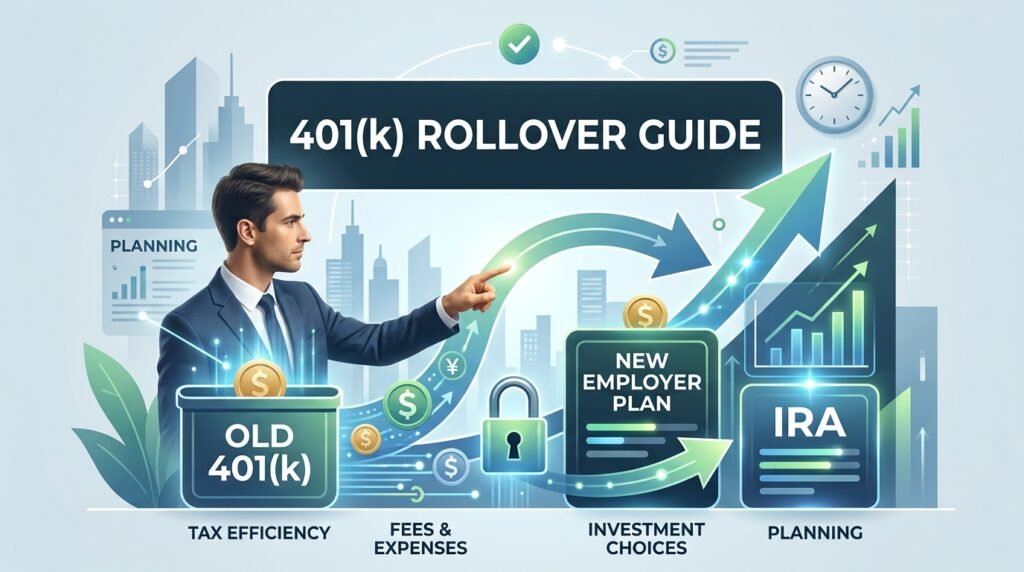
Changing jobs, retiring, or leaving an employer can raise an important financial question: what should you do with the money in your 401(k)? One option is a 401(k) rollover, which allows you to move eligible retirement savings from one retirement account to another.
A rollover can help you keep your retirement money organized and maintain its tax-advantaged status when the transfer follows the applicable rules. However, the process can involve taxes, fees, investment choices, and withdrawal restrictions.
Understanding how a 401(k) rollover works can help you compare your options and avoid costly mistakes before moving your retirement savings.
What Is a 401(k) Rollover?
A 401(k) rollover is the transfer of eligible retirement savings from a 401(k) plan into another eligible retirement account, such as an Individual Retirement Account (IRA) or another employer’s retirement plan that accepts rollovers.
People commonly consider rollovers after leaving a job, retiring, or deciding to consolidate retirement accounts from previous employers.
For example, imagine you have $25,000 in a 401(k) with a former employer. You may be able to move that money into a traditional IRA or a new employer’s eligible retirement plan without immediately paying federal income tax, provided the rollover meets the applicable requirements.
A rollover is different from withdrawing the money for personal spending. Taking a taxable distribution instead of completing a qualifying rollover may result in income taxes and potentially an additional early withdrawal tax.
Why Do People Roll Over a 401(k)?
There are several reasons someone might consider moving retirement savings.
1. Leaving a Previous Employer
When you change jobs, your former employer’s plan may allow you to leave your savings where they are, roll them into another eligible account, or take a distribution. The available options depend on the plan’s rules and your account balance.
2. Consolidating Retirement Accounts
If you have several 401(k) accounts from different employers, moving eligible funds into one account may make retirement planning and investment tracking easier.
However, consolidation is not always necessary. Compare account fees, investment choices, and benefits before deciding.
3. Accessing Different Investment Options
An IRA may offer a broader range of investment choices than a particular employer-sponsored plan. On the other hand, some workplace plans provide low-cost investments, institutional pricing, or features that may not be available in an IRA.
The differences depend on the specific accounts involved.
4. Simplifying Retirement Planning
Having fewer accounts may make it easier to review your overall retirement savings, update beneficiaries, and monitor your progress toward long-term financial goals.
If you are checking your progress, our guide to retirement savings by age explains common savings benchmarks and why individual retirement targets can vary.
What Are Your Options for a 401(k) Rollover?
Before moving your money, compare the main options available to you.
Roll Over Into a Traditional IRA
Moving eligible pre-tax 401(k) funds into a traditional IRA through a properly completed rollover generally preserves their tax-deferred status.
An IRA may offer more investment choices, but you should compare management fees, investment expenses, and account services before transferring your money.
Roll Over Into a New Employer’s 401(k)
If your new employer’s plan accepts incoming rollovers, you may be able to transfer your old 401(k) balance into the new plan.
This can keep your retirement savings within an employer-sponsored plan. However, investment options and plan fees vary.
Leave the Money in Your Former Employer’s Plan
Depending on your balance and the plan’s rules, you may be permitted to keep your retirement savings in your former employer’s 401(k).
This option may make sense if the plan offers competitive fees and investments. Remember to keep your contact information and beneficiary details updated.
Roll Over Into a Roth IRA
You may be able to move eligible pre-tax 401(k) funds into a Roth IRA. However, this is generally a taxable conversion because pre-tax retirement money becomes Roth money.
You should understand the potential tax bill before choosing this route.
Direct vs. Indirect 401(k) Rollovers
One of the most important decisions is how the funds will be transferred.
Direct Rollover
With a direct rollover, the retirement plan transfers eligible funds directly to the receiving retirement account or institution.
Because the money does not pass through your personal bank account, this approach generally reduces the risk of missing the rollover deadline or accidentally spending retirement funds.
A direct rollover is often a practical option for people who want to preserve the tax-advantaged status of eligible retirement savings.
Indirect Rollover
With an indirect rollover, the plan distributes the money to you first, and you then deposit the eligible amount into another retirement account.
For many eligible distributions from an employer plan paid directly to you, the plan generally must withhold 20% for federal income tax. To roll over the full eligible distribution, you may need to replace the withheld amount from other funds.
You generally have 60 days after receiving the distribution to complete an eligible rollover. Missing the deadline can make the distribution taxable, and an additional tax may apply in some circumstances.
Because the rules can be complicated, review the distribution paperwork carefully before choosing an indirect rollover.
What Taxes Apply to a 401(k) Rollover?

Taxes depend on the type of money being moved, the destination account, and how the rollover is completed.
A qualifying rollover from a traditional 401(k) into a traditional IRA or another eligible employer plan generally does not create immediate federal income tax.
However, moving pre-tax funds into a Roth IRA generally creates taxable income for the year of conversion. You should consider how that income may affect your tax bracket and overall tax liability.
Roth 401(k) funds have different tax treatment from pre-tax funds. Combining different types of retirement money without checking the rules may lead to unexpected consequences.
State tax rules may also matter. If you are unsure how a proposed transfer will affect your tax return, consider speaking with a qualified tax professional.
Common 401(k) Rollover Mistakes to Avoid
A rollover can be straightforward, but several mistakes can create unnecessary costs.
Ignoring Fees and Investment Choices
Do not assume that every IRA or employer plan is automatically cheaper or better suited to your needs. Compare account maintenance charges, investment expense ratios, available funds, and service fees.
Missing the Rollover Deadline
If you receive an eligible distribution directly, failing to complete the rollover within the applicable deadline can create tax consequences. A direct rollover can reduce this risk.
Forgetting About Employer Stock
Some employer plans hold company stock that may qualify for special tax treatment under certain circumstances. Selling or rolling over these holdings without reviewing the rules could affect potential tax benefits.
Seek professional tax advice before making decisions involving significant employer-stock holdings.
Cashing Out Instead of Rolling Over
Taking retirement money for everyday expenses may trigger income taxes and potentially an additional early withdrawal tax. It also reduces the amount available for future retirement expenses.
Keeping retirement savings invested for the long term can help support future financial needs. Our guide to compound interest and growing savings explains how returns can accumulate over time, although investment returns are not guaranteed.
How to Complete a 401(k) Rollover
A careful process can make the transfer easier to manage.
- Review your former employer’s plan rules and distribution options.
- Compare the receiving IRA or employer plan, including fees and investments.
- Confirm that the receiving account accepts your type of rollover.
- Request a direct rollover when appropriate.
- Follow the instructions provided by both financial institutions.
- Keep transaction confirmations and tax documents for your records.
- Review the receiving account to confirm the funds arrived correctly.
Avoid making investment or withdrawal decisions until you understand how the transfer will be handled.
Final Thoughts
A 401(k) rollover can help you manage retirement savings after changing jobs or reviewing your financial plans. You may be able to move eligible funds into a traditional IRA, a new employer’s plan, or another permitted retirement account while preserving tax advantages.
Before proceeding, compare fees, investment choices, tax implications, and account rules. A direct rollover can help reduce the risks associated with handling the money yourself, while a Roth conversion requires particular attention to potential taxes.
Taking time to review your options can help you make an informed decision about your retirement savings and keep your long-term financial goals on track.