You compare two loan offers, pick the one with the lower interest rate, and feel confident you made the cheaper choice. Then the funded amount arrives short of what you expected. The gap is often loan origination fees — a charge deducted from your loan before you ever see the money, and one that rarely gets the same billboard treatment as the advertised interest rate.
Here’s exactly what origination fees are, why lenders structure them this way, and how to make sure they don’t quietly cost you more than the rate difference you were comparing in the first place.
What Are Loan Origination Fees?
A loan origination fee is a charge from the lender for processing, underwriting, and funding a loan, typically calculated as a percentage of the total loan amount. Depending on the lender and loan type, this fee usually falls somewhere between 1% and 8% of the amount borrowed.
Unlike interest, which accrues over the life of the loan, an origination fee is usually a one-time charge, either deducted directly from the loan proceeds before you receive them, or added to the total balance you’re required to repay.
Why Lenders Don’t Advertise Loan Origination Fees Prominently
The Interest Rate Is the Number That Gets Marketed
Advertised interest rates are the headline figure lenders use to compete for borrowers, since a lower rate looks immediately attractive in comparison shopping. Loan origination fees, by contrast, are often disclosed only in the detailed loan terms, buried well past the number most people compare at a glance.
A Lower Rate With a Higher Fee Can Look Like the Better Deal
Some lenders structure offers with a lower advertised rate paired with a higher origination fee, which can make the loan appear cheaper on the surface while actually costing more overall once the fee is factored in. This is precisely why comparing rate alone, without factoring in loan origination fees, can lead to choosing the more expensive option.
Fees Are Sometimes Rolled Into the Loan Itself
When an origination fee is added to the loan balance rather than deducted upfront, it becomes easy to overlook, since it doesn’t show up as a separate line-item cost you have to write a check for — it simply increases the total amount you’re repaying, quietly, with interest now accruing on the fee itself.
How Loan Origination Fees Actually Reduce Your Funds
This is the detail that catches many borrowers off guard: if a fee is deducted from the loan proceeds, you don’t receive the full amount you were approved for.
A Simplified Example
Say you’re approved for a $10,000 personal loan with a 5% origination fee. If the fee is deducted upfront, you’d actually receive $9,500 — but you’re still responsible for repaying the full $10,000 plus interest. Effectively, you’re paying interest on money you never received.
If you needed the full $10,000 for a specific expense, you’d need to borrow more than that amount to account for the fee, which itself would carry additional interest — a compounding cost that’s easy to miss when just comparing advertised rates.
Which Loan Types Typically Include Origination Fees
Personal Loans
Origination fees are common on personal loans, particularly from online lenders, and can vary significantly based on your credit profile — often lower for borrowers with stronger credit, and higher for those with weaker credit, similar to how interest rates scale with risk.
Mortgages
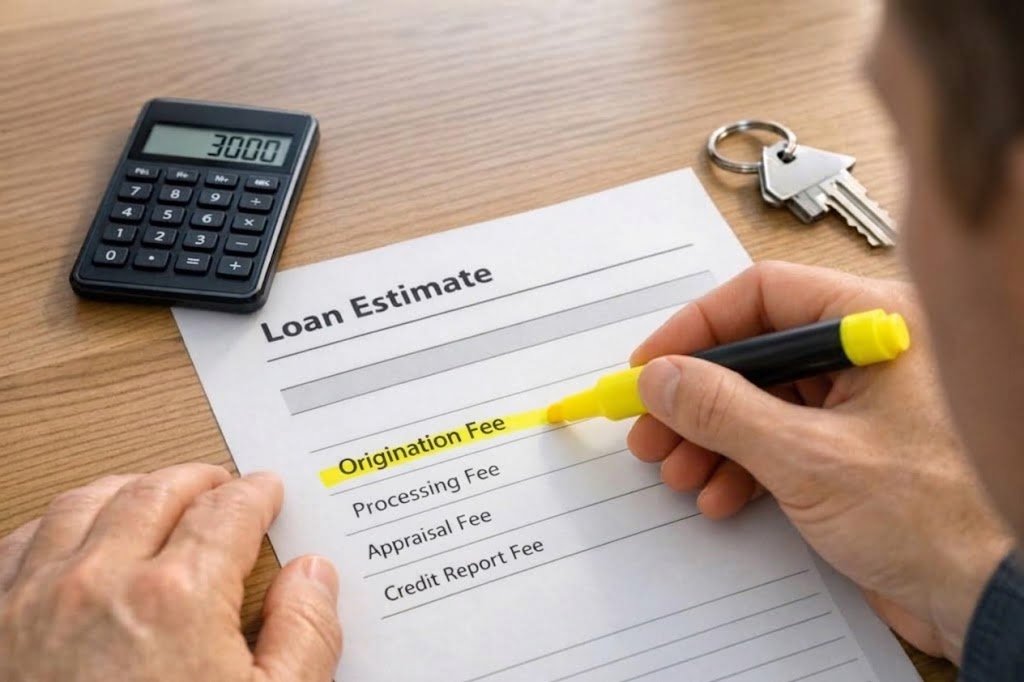
Mortgage origination fees are standard and typically disclosed as part of your total closing costs, alongside other fees like appraisal and title costs. Federal disclosure rules require these to be itemized clearly in your Loan Estimate and Closing Disclosure documents.
Student Loans
Some federal and private student loans carry origination fees as well, deducted from the disbursed amount, which is worth factoring in if you’re borrowing an amount intended to cover a specific tuition or expense total.
Auto Loans
Origination fees are less common on auto loans than on personal loans or mortgages, but they do appear with some lenders, sometimes labeled as a “processing fee” or “documentation fee” instead.
How to Actually Compare Loan Offers With Origination Fees Factored In
Use APR, Not Just the Interest Rate
The Annual Percentage Rate (APR) is designed to reflect the total cost of borrowing, including most fees, not just the interest rate alone. Comparing APR rather than the advertised rate gives a far more accurate picture of which offer actually costs less once loan origination fees are included.
Calculate the Effective Amount You’ll Actually Receive
Before accepting an offer, ask the lender directly how much money you’ll actually receive after any fees are deducted, rather than assuming the full approved amount will land in your account.
Factor Fees Into Your Total Borrowing Need
If you need a specific amount for a purchase or expense, calculate backward from that number to determine how much you actually need to request, accounting for any fee that will be deducted upfront.
Ask If the Fee Is Negotiable
Origination fees are sometimes negotiable, particularly for borrowers with strong credit or larger loan amounts. It rarely hurts to ask directly before signing, since some lenders have room to adjust the fee to win your business.
How Loan Origination Fees Interact With Other Loan Terms
They Can Compound With a Prepayment Penalty
An origination fee paid upfront is a sunk cost regardless of how quickly you repay the loan. If the same loan also carries a prepayment penalty, paying it off early doesn’t recover the origination fee and may add an additional charge on top — worth checking both terms together rather than evaluating them separately.
They Affect the True Cost Comparison Between Loan Types
When weighing a secured versus unsecured loan, origination fees should be part of that comparison too, since a secured loan’s lower interest rate can be partially or fully offset by a higher origination fee, depending on the lender.
They Matter Just as Much When Consolidating Debt
If you’re taking out a loan specifically to consolidate existing balances, an origination fee reduces how much of the loan actually goes toward paying off your old debt. This is worth factoring into whether a debt consolidation loan genuinely saves money once the fee is included in the total cost comparison.
What Federal Guidance Says About Origination Fees
The Consumer Financial Protection Bureau confirms that origination fees are a common cost of borrowing across multiple loan types and specifically recommends comparing APR, rather than interest rate alone, as the more accurate way to evaluate the true cost of a loan once fees are included.
Final Thoughts
Loan origination fees aren’t hidden in the sense of being illegal or undisclosed — they’re required to appear in your loan documents — but they’re rarely as visible as the interest rate that gets advertised upfront. That gap is exactly where borrowers end up paying more than they expected, simply by comparing the wrong number.
Before accepting any loan offer, compare APR rather than the advertised rate alone, confirm exactly how much money you’ll actually receive after fees, and factor the fee into your total borrowing need. A slightly higher rate with no origination fee sometimes costs less overall than a lower rate paired with a steep one — the only way to know for certain is running the full comparison yourself.