
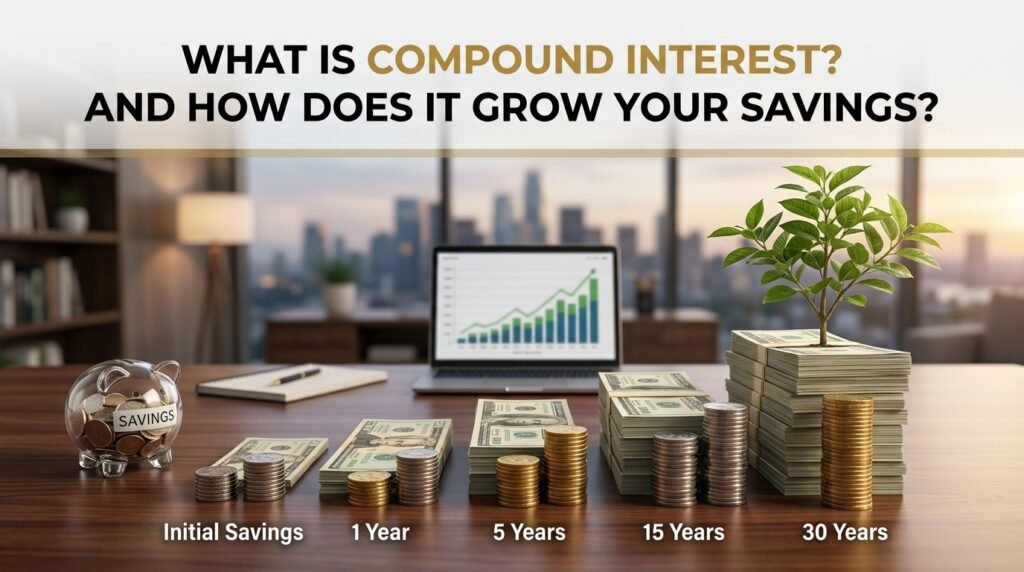
Compound interest is one of the most important concepts to understand when you are building long-term savings. It allows your money to earn interest, while the interest you have already earned can also begin earning interest.
This creates a compounding effect that can help savings grow faster over time. The longer you keep money invested or deposited in an interest-bearing account, the more opportunity there is for compound growth to build.
Understanding how compound interest works can help you make better decisions about savings accounts, certificates of deposit, retirement accounts, and other financial products that generate returns over time.
What Is Compound Interest?
Compound interest is interest earned on both your original money and the interest that has accumulated previously.
With simple interest, interest is calculated only on the original amount. With compound interest, the balance can grow because previously earned interest becomes part of the amount that can generate additional interest.
For example, suppose you deposit $1,000 into an account that earns interest. After the first period, the account earns interest on the $1,000. If you leave that interest in the account, the next calculation can be based on a larger balance.
Over many periods, this process can produce significant growth.
How Does Compound Interest Work?
Compound interest generally involves three important factors:
- The amount of money you start with
- The interest rate
- The amount of time your money remains invested or deposited
The more time your money has to compound, the more opportunity there is for the interest to build on itself.
For example, imagine you deposit $5,000 into an account earning a hypothetical 5% annual return and leave the money untouched.
After the first year, the balance could grow to approximately $5,250.
The following year, interest is calculated on the larger balance rather than only the original $5,000.
This is the basic idea behind compound growth.
Compound Interest vs. Simple Interest
The main difference between compound and simple interest is how interest is calculated.
With simple interest, the return is based on the original principal.
With compound interest, the return can be based on the original principal plus accumulated interest.
For example, if you have $10,000 earning 5% simple interest for one year, the interest would be $500.
With compound interest, the exact result depends on how frequently the interest compounds. If interest is compounded more frequently and remains in the account, the balance can grow differently.
This is why understanding the account’s compounding method is important when comparing financial products.
How Often Does Interest Compound?
Interest can compound at different frequencies depending on the financial product.
Common compounding schedules include:
- Daily
- Monthly
- Quarterly
- Semiannually
- Annually
More frequent compounding can produce a slightly higher effective return when the stated rate and other conditions are otherwise comparable.
However, you should not compare compounding frequency alone. The advertised APY, fees, minimum balance requirements, and other account terms can also affect the overall value.
For savings accounts, APY is especially useful because it incorporates the effect of compounding into an annualized yield.
Why Time Matters So Much
Time is one of the biggest factors behind compound growth.
Consider two people who each save the same amount of money but start at different ages. The person who starts earlier has more time for interest and previous earnings to compound.
This does not mean everyone needs to save large amounts immediately. Consistent contributions over a long period can also contribute significantly to growth.
For example, regularly adding $100 to a savings or investment account gives each new contribution its own opportunity to earn returns over time.
The earlier the money enters the account, the longer it potentially has to compound.
How Regular Contributions Can Increase Growth
Compound interest becomes even more powerful when you regularly add money to your savings.
Suppose you start with $1,000 and then contribute $100 every month.
Your account can potentially grow from three sources:
- Your original $1,000
- Your additional monthly contributions
- Interest earned on your balance and previous interest
This combination can accelerate growth compared with leaving the original deposit untouched.
Regular contributions also make saving a habit. Instead of relying on occasional large deposits, you gradually increase your balance over time.
Compound Interest and Savings Accounts
Savings accounts can provide an accessible way to earn interest on money you are setting aside.
For example, a high-yield savings account may offer a higher APY than a traditional savings account, although rates can change over time.
The interest you earn can remain in the account and contribute to future growth.
If you are deciding how to use extra cash, understanding the relationship between savings interest and debt costs is also important. Our guide on high-yield savings vs. paying off credit card debt in 2026 explains some of the factors to consider when comparing these two financial priorities.
Compound Interest and Long-Term Savings
Compound growth becomes particularly relevant when you are saving for long-term goals.
These could include:
- Retirement
- Education
- A future home purchase
- Long-term wealth building
- Other major financial goals
The longer your money remains invested or deposited and continues generating returns, the greater the potential compounding effect.
However, actual investment returns are not guaranteed, and investments can lose value. Savings accounts and other deposit products also have different rates and conditions.
Always consider the type of financial product you are using and the level of risk involved.
Compound Interest for Short-Term Savings Goals
Compound interest is not limited to retirement or very long-term goals.
You can also earn interest while saving for expenses that are only months or a few years away.
For example, you might create a separate savings goal for:
- Holiday expenses
- Annual insurance payments
- Car maintenance
- Home repairs
- A vacation
- A new appliance
A sinking fund is one way to prepare for these predictable expenses by saving smaller amounts over time. You can learn more in our guide on how sinking funds help prepare for big expenses without debt.
Keeping these savings in an interest-bearing account can allow your money to earn some interest while you continue contributing toward the goal.
What Is the Rule of 72?
The Rule of 72 is a simple estimation tool that can help you understand how long it may take money to double based on a fixed annual return.
You divide 72 by the annual interest rate.
For example:
72 ÷ 6 = 12
At a hypothetical 6% annual return, the Rule of 72 suggests that money could take approximately 12 years to double.
This is only an estimate and does not account for taxes, fees, changing rates, additional contributions, or changes in investment returns.
It is useful as a quick way to understand the potential impact of time and compound growth.
What Can Reduce the Benefits of Compound Growth?

Compound growth can work in your favor when you are earning interest, but several factors can reduce your actual results.
These include:
- Low interest rates
- Account fees
- Taxes on taxable interest
- Withdrawals
- Inconsistent contributions
- Changes in savings rates
- Investment losses when using market-based investments
For savings accounts, comparing APYs and account fees can help you understand the potential net benefit.
For investments, market performance can vary significantly, so historical returns should not be treated as guaranteed future results.
How to Make Compound Interest Work for You
You do not need a complicated strategy to take advantage of compound growth.
Start by saving consistently and giving your money time to grow.
You can also:
- Start saving as early as possible
- Make regular contributions
- Keep earned interest in the account when appropriate
- Compare savings account APYs
- Avoid unnecessary account fees
- Automate transfers into savings
- Increase contributions when your income rises
- Avoid withdrawing savings unnecessarily
The most important factor is consistency. Even smaller contributions can become meaningful when they are made regularly over a long period.
Frequently Asked Questions
What is compound interest in simple terms?
Compound interest means you can earn interest on your original money as well as interest that has already accumulated.
Does compound interest make savings grow faster?
It can. When earned interest remains in the account, it can become part of the balance that earns additional interest.
How often does compound interest occur?
It depends on the financial product. Interest may compound daily, monthly, quarterly, semiannually, or annually.
Is compound interest guaranteed?
The concept of compounding is straightforward, but the return itself depends on the financial product. Savings accounts may have variable rates, while investments involve market risk and can lose value.
Can I earn compound interest by adding money every month?
Yes. Regular contributions can increase the amount of money available to earn interest or investment returns, depending on the account or investment.
Final Thoughts
Compound interest allows your money to potentially grow on top of previous interest earnings. While the effect may seem small at first, time and consistent contributions can make compound growth increasingly significant.
The key factors are the amount you save, the rate you earn, how often returns compound, and how long you leave the money to grow.
Whether you are building an emergency fund, saving for a planned expense, or working toward a long-term financial goal, understanding compound interest can help you appreciate why starting early and saving consistently can matter.
The goal is not necessarily to start with a large amount of money. It is to give your savings enough time and consistency to benefit from the power of compounding.