
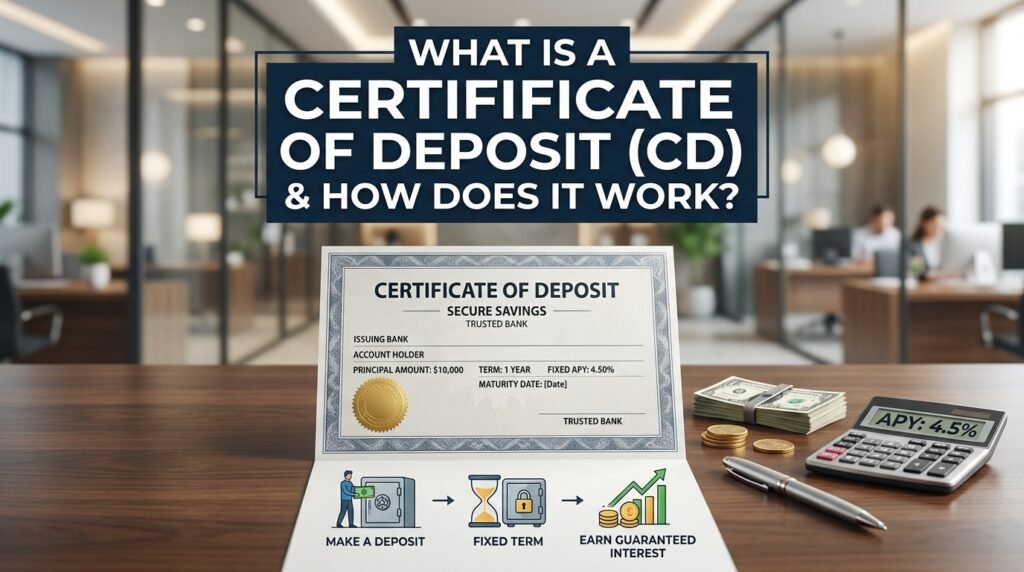
A certificate of deposit, commonly called a CD, is a savings product that allows you to deposit money for a specific period in exchange for interest. Unlike a regular savings account, a CD typically requires you to leave your money deposited for an agreed term.
CD terms can range from a few months to several years. In exchange for keeping your money in the account for the agreed period, the financial institution generally pays interest according to the CD’s terms.
Certificates of deposit can be useful for people who have money they do not expect to need immediately and want to earn a predictable return. However, accessing the money before the CD matures may result in an early withdrawal penalty, depending on the product.
What Is a Certificate of Deposit?
A certificate of deposit is a type of deposit account offered by banks and credit unions. When you open a CD, you deposit a specific amount of money and agree to leave it there for a predetermined period.
For example, you might open a 12-month CD with $5,000. If the CD offers a fixed 4% APY and you keep the money in the account until maturity, you can generally expect the account to earn interest according to the disclosed terms.
The exact return depends on the CD’s APY, deposit amount, term length, compounding, and account conditions.
Unlike investments such as stocks, a traditional bank CD does not expose the principal to normal market price fluctuations in the same way. However, there are still important rules and limitations to understand before opening one.
How Does a CD Work?
The basic process is straightforward.
First, you choose a CD based on its term, APY, minimum deposit, and other conditions.
Next, you deposit your money into the account.
The financial institution holds the money for the agreed term and pays interest according to the CD’s terms.
When the CD reaches its maturity date, you can generally receive your original deposit plus the interest earned. Depending on the CD, you may be able to withdraw the money, renew the CD, or move the funds to another account.
For example, suppose you deposit $10,000 into a hypothetical one-year CD offering a 4% APY. If the APY remains applicable for the full term and there are no withdrawals or other changes, the account could earn approximately $400 over a year.
Actual earnings can vary based on the product’s terms and how interest is calculated.
What Is a CD Term?
The CD term is the length of time you agree to keep your money deposited.
Common CD terms can include:
- 3 months
- 6 months
- 9 months
- 12 months
- 18 months
- 24 months
- 36 months
- 60 months
Shorter-term CDs generally provide access to your money sooner, while longer-term CDs may offer different rates or conditions.
The appropriate term depends on when you expect to need the money.
For example, if you know you will need $5,000 in one year for a planned expense, a 12-month CD could align with that timeline. If you may need the money next month, locking it into a longer-term CD may not fit your needs.
What Is a CD Maturity Date?
The maturity date is the date when the CD term ends.
Suppose you open a 12-month CD on January 1. If the terms specify a 12-month maturity period, the CD would generally mature around January 1 of the following year, subject to the institution’s specific rules.
At maturity, you may have several options depending on the account:
- Withdraw the money
- Transfer the money to another account
- Renew the CD
- Allow the CD to automatically renew
Some CDs automatically renew if you do not provide instructions during the applicable grace period.
It is important to understand the maturity and renewal rules before opening the account.
How Does CD Interest Work?
CD interest is generally based on the amount deposited and the rate or APY offered by the financial institution.
For example, imagine a $5,000 CD offering a hypothetical 4% APY.
A simplified annual calculation would be:
$5,000 × 4% = $200
This means the account could generate approximately $200 over a year under the simplified assumption that the APY remains unchanged and the funds stay deposited for the full period.
The actual interest calculation depends on the CD’s terms and compounding schedule.
When comparing CDs, APY can be useful because it reflects the effect of compounding.
Fixed-Rate vs. Variable-Rate CDs
Many traditional CDs offer a fixed interest rate for the entire term.
With a fixed-rate CD, the rate generally remains unchanged from the time you open the account until maturity.
This can provide predictability because you know the stated rate at the beginning of the term.
Other deposit products may have variable rates. The rate on these products can change according to their specific terms.
If you are comparing a CD with a savings account, remember that savings account rates can change over time. Our guide on how higher interest rates can affect savings and other financial products explains why changes in interest rates can matter for savers.
What Happens If You Withdraw Money Early?
One of the biggest differences between a CD and a traditional savings account is access to your money.
Many CDs impose an early withdrawal penalty if you take money out before the maturity date.
The penalty can vary depending on the financial institution, CD term, and account agreement.
For example, an institution might charge a certain amount of interest for withdrawing funds before maturity.
Because of this, you generally should not place emergency savings into a CD unless the product provides an appropriate withdrawal option.
Before opening a CD, make sure you understand the early withdrawal rules and potential costs.
CD vs. Savings Account

Both CDs and savings accounts can help you save money, but they work differently.
A savings account generally provides easier access to your money. You can usually make withdrawals or transfers according to the account’s rules.
A CD typically requires you to commit your money for a specific period.
A savings account may be more suitable for money you might need soon, while a CD may be considered for funds that can remain untouched until a specific future date.
Interest rates also differ between products and can change over time depending on the account.
Can a CD Be Used for Short-Term Goals?
Yes. A CD can potentially be used for certain short-term financial goals if the maturity date matches when you expect to need the money.
For example, suppose you are saving for a large expense that will occur in 12 months. You could consider a CD with a term that ends around the time the money is needed.
However, you should avoid locking away money that may be required unexpectedly.
For expenses that are predictable but occur periodically, a savings strategy can also help. A sinking fund can help you prepare for large planned expenses without relying on debt.
What Is a CD Ladder?
A CD ladder is a strategy that involves spreading money across multiple CDs with different maturity dates.
For example, instead of putting $12,000 into one 12-month CD, you could divide it among several CDs with different maturity schedules.
As each CD matures, you can decide whether to use the money or reinvest it.
The goal of this approach is to create more regular access to funds while still using CDs with potentially longer terms.
The exact structure depends on your savings goals, cash-flow needs, and the rates available when you open the CDs.
Are CDs Safe?
Traditional bank CDs are generally considered deposit products rather than market investments.
In the United States, deposits at FDIC-insured banks are generally insured up to applicable limits. Credit union deposits may have separate federal insurance through the National Credit Union Administration, subject to applicable rules and limits.
However, deposit insurance does not mean every CD or financial product is automatically covered. Before opening an account, verify the institution’s insurance status and applicable coverage limits.
You should also understand that inflation can reduce the purchasing power of money over time, even when a CD earns interest.
What Should You Check Before Opening a CD?
Before opening a certificate of deposit, review:
- APY
- CD term
- Minimum deposit
- Early withdrawal penalty
- Maturity date
- Automatic renewal rules
- Grace period
- Interest payment options
- Deposit insurance coverage
- Account fees, if applicable
The highest advertised APY is not necessarily the only factor to consider.
For example, a CD with a slightly higher rate may not be appropriate if its term does not match your financial timeline or its early withdrawal penalty is too restrictive.
Frequently Asked Questions
Is a CD better than a savings account?
Neither is automatically better for everyone. A CD may offer a fixed rate and a defined term, while a savings account generally provides more flexibility and easier access to your money.
Can you lose money in a CD?
A traditional bank CD generally does not fluctuate in market value like a stock, but withdrawing money early can result in a penalty. Inflation can also reduce the purchasing power of your returns.
Do CDs pay interest monthly?
CD interest may be paid or credited according to the institution’s terms. Some CDs may allow interest payments during the term, while others may add interest to the account.
What happens when a CD matures?
At maturity, you generally have an opportunity to withdraw the money, transfer it, or renew the CD, depending on the institution’s rules.
Can I withdraw from a CD before maturity?
You may be able to, but many CDs charge an early withdrawal penalty. Always review the account agreement before opening one.
Final Thoughts
A certificate of deposit is a savings product that allows you to deposit money for a predetermined period while earning interest according to the account’s terms.
The main advantage of a CD is predictability. You generally know the term and stated rate when you open the account, especially with a fixed-rate CD. The main trade-off is reduced flexibility because accessing your money before maturity may result in a penalty.
Before opening a CD, compare the APY, term, early withdrawal rules, minimum deposit, maturity options, and deposit insurance coverage. Most importantly, make sure the money you put into the CD is money you can reasonably leave untouched for the full term.
When the CD’s timeline matches your savings goal, it can be one option for earning interest while keeping your savings in a structured deposit product.