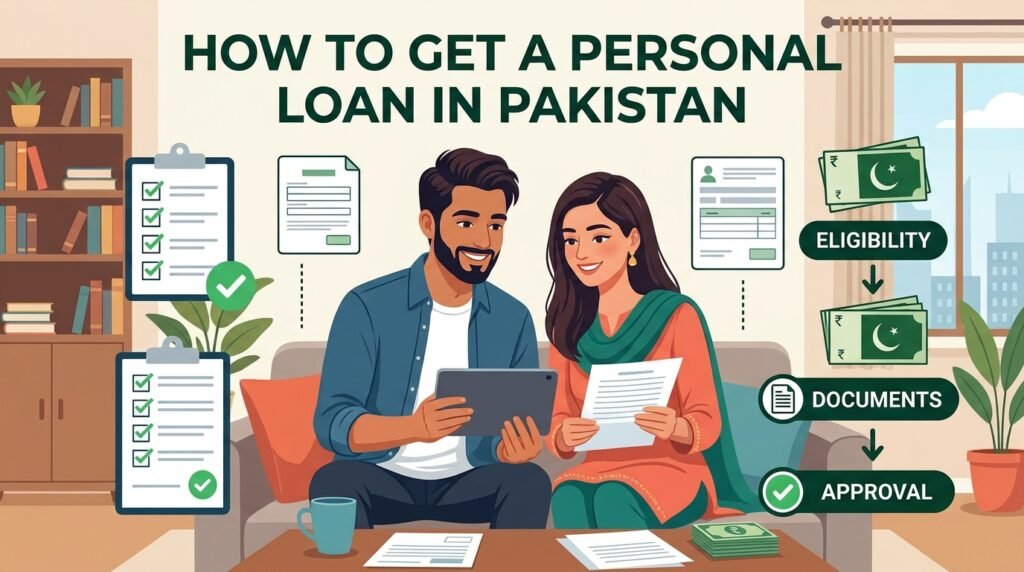
Do you need money for a wedding, a medical bill, school fees, or a home repair? Many people in Pakistan turn to a bank for help. But banks have rules, and most people don’t know them until their application is rejected.
This guide explains how to get a personal loan in Pakistan in simple words. You will learn what a personal loan is, who can apply, which documents to bring, and what steps to follow. Let’s begin.
What Is a Personal Loan in Pakistan?
A personal loan is money you borrow from a bank and pay back in small monthly payments. These payments are called installments. You also pay extra money on top, called markup or interest. This is the bank’s fee for lending to you.
Here is a simple example. If you borrow Rs. 200,000 for two years, you don’t just pay back Rs. 200,000. You pay back the loan plus the markup, spread across 24 months.
Most banks in Pakistan give personal loans without asking for any security. This means you don’t have to put your house, car, or gold as a guarantee.
Types of Personal Loans in Pakistan
Not every personal loan is the same. Here are the main types.
Salaried Personal Loan
This is for people who work at a company, government office, or organization and get a monthly salary.
Self-Employed Personal Loan
This is for business owners, shopkeepers, doctors, lawyers, and other professionals who earn their own income.
Pension Personal Loan
Some banks give loans to retired people who get a monthly pension. For example, HBL lists a pension-based loan with a minimum pension of Rs. 35,000 and a maximum age of 65 at the end of the loan. It also lists a maximum loan of PKR 1 million for this product.
Islamic Personal Finance
Some Islamic banks offer personal finance that follows Shariah rules. It works a little differently, but the idea is the same: you get money now and pay it back slowly.
Personal Loan Requirements in Pakistan: Who Can Apply?
Every bank has its own rules, but most ask for the same basic things. Here are the personal loan requirements you should check before you apply.
1. Age Limit
You must be an adult, and you must not be too close to retirement age when the loan ends.
- Askari Bank: The minimum age is 21 for salaried people and 23 for self-employed people. The maximum age at the end of the loan is 60 for permanent salaried employees and 65 for the self-employed.
- Allied Bank (ABL): Salaried applicants should be between 21 and 59 years old, and self-employed applicants between 21 and 64.
- Standard Chartered: You need to be at least 21 if you are salaried, or at least 25 if you are self-employed.
2. Minimum Monthly Income
Banks want to be sure you earn enough to pay the monthly installment. The minimum income changes from bank to bank.
- Askari Bank: Salary limits start at Rs. 35,000 for permanent government employees and go up to Rs. 70,000 for people at non-approved companies.
- Allied Bank (ABL): Salaried people need at least Rs. 25,000 a month if their salary account is with ABL, or Rs. 35,000 if it is with another bank.
- Standard Chartered: The minimum monthly income is Rs. 40,000.
- Bank Alfalah: Salaried applicants need at least Rs. 50,000 a month.
3. Job or Business History
Banks like stable people. If you change jobs every few months, the bank may say no.
- Allied Bank (ABL) asks salaried people for a permanent or direct-contract job with at least 2 years of employment. For self-employed people, the business should be 2 to 3 years old.
4. Pakistani CNIC and Phone Number
You need a valid Pakistani CNIC. Some banks, like Standard Chartered, also ask for a working Pakistani mobile number and an active email address.
5. A Bank Account
Many banks want you to have a bank account for some time first. For example, ABL asks for at least 6 months of banking history for salaried applicants.
6. A Good Credit History
Banks check your record in a system called the credit bureau (eCIB in Pakistan). If you paid old loans and credit card bills late, or never paid them, your chance of approval drops a lot.
7. A Safe Debt Level
Banks look at how much of your income already goes to other loans. As a general rule in Pakistan, all your monthly debt payments together should stay at or below about half of your income. If you already have a car loan and a credit card balance, a new loan may be harder to get.
Important: Rules and limits change often. Always check the bank’s website or call them before you apply.
Documents Required for a Personal Loan in Pakistan
Bring all your papers before you go to the bank. Missing papers is one of the biggest reasons for delays. Here are the documents required for a personal loan at most banks.
Documents for Salaried People
- A filled application form with your signature
- A clear copy of your CNIC (some banks want it attested or verified)
- Your latest salary slip or a salary certificate from your employer
- A 6-month bank statement showing your salary coming in. Askari Bank asks for this from salaried applicants.
- A contract letter, if you are a contract employee
- An employer letter, if the bank asks for it. HBL lists a verified CNIC, a verified salary slip, and an employer letter if needed for branch applications.
Documents for Self-Employed People
- Application form and CNIC copy
- A 12-month bank statement. Askari Bank asks for 12 months for businesspeople.
- Business proof, such as your NTN, tax returns, or a bank certificate. Bank Alfalah lists tax returns, NTN, and a bank certificate as examples of business proof.
Documents for Pensioners
- CNIC copy
- Pension book copy
- Proof that your pension goes into the bank account
Tip: Keep clear photocopies and scanned files ready. Blurry papers can slow you down.
How to Get a Personal Loan in Pakistan: Step-by-Step Guide
Now for the main part. Here is exactly how to get a personal loan in Pakistan, one step at a time.
Step 1: Decide How Much Money You Really Need
Write down the exact amount. Don’t borrow more than you need. A bigger loan means bigger monthly payments and more markup.
Step 2: Check Your Monthly Budget
Ask yourself: “How much can I pay every month without stress?” Look at your salary, rent, food, school fees, and other bills. Only take a loan if the installment fits comfortably.
Step 3: Check Your Credit Record
Make sure you have no unpaid loans or overdue credit card bills. If something is wrong, try to fix it before you apply.
Step 4: Compare Different Banks
Don’t walk into the first bank you see. Compare these things:
- Markup rate (how much extra you will pay)
- Processing fee (a one-time charge for handling your file)
- Loan amount limit
- Repayment time
- Early payment rules (can you pay the loan off early, and is there a penalty?)
- Insurance charges
For example, Standard Chartered offers personal loans from PKR 30,000 up to PKR 4 million, depending on your income and ability to repay. Askari Bank’s loan time is 1 to 4 years.
Step 5: Read the Key Facts Statement
Banks must give you a “Key Facts Statement” (KFS). It lists all costs in one place. Read it slowly and ask about anything you don’t understand.
Step 6: Gather Your Documents
Use the lists above. Put everything in one folder.
Step 7: Fill In the Application
You can apply in three ways:
- Visit a branch and talk to a bank officer
- Apply online on the bank’s website
- Use a mobile app. HBL says no documents are needed if you apply through its mobile app, though this depends on your profile.
Step 8: Wait for Verification
The bank will check your papers, your job or business, and your credit record. They may call your office or your phone. Answer calls and be honest.
Step 9: Get Approval and Sign the Agreement
If the bank approves you, they will send you an offer. Read the agreement carefully before you sign. Check the amount, markup, installment, and total cost.
Step 10: Receive the Money and Start Paying
The money goes into your bank account. Then you pay your installment every month, usually taken automatically from your account. Keep enough money in your account on the due date.
How Long Does It Take to Get a Personal Loan?
It depends on the bank and how complete your papers are. Some banks approve within a few days. Others take one to two weeks. If your papers are clear and your record is good, the process is usually faster.
Common Reasons a Personal Loan Gets Rejected
Many people are turned down for simple reasons. Avoid these mistakes:
- Your income is too low for the loan amount
- You already have too many loans or credit card debts
- You paid earlier loans late or missed payments
- Your papers are missing or unclear
- You changed jobs recently
- You gave wrong or different information than what the bank found
- You applied to many banks at once, which can look risky
Tips to Improve Your Chances of Bank Loan Approval
Want a “yes” from the bank? Try these tips.
- Pay all your bills on time for at least six months before applying.
- Keep your salary going into one bank account. A clear history helps.
- Pay off small loans first to lower your monthly debt.
- Apply at the bank where you already have your account. They already know you.
- Ask for a smaller amount. A loan you can easily repay is more likely to be approved.
- Add a second income proof if you have one, such as rent or a side business, but only if you can show papers for it.
- Be honest. Never give fake papers. It can lead to rejection and legal trouble.
Costs to Watch Out for Before Taking a Loan
The markup rate is not the only cost. Ask the bank about:
- Processing fee
- Insurance charges (often required)
- Late payment charges
- Early settlement fee
- Stamp duty and other government charges
Add up everything so you know the real total cost.
Safer Choices: Avoid Loan Scams
Some fake apps and agents promise “instant loans with no papers.” Be careful:
- Never pay money upfront to get a loan approved
- Don’t share your CNIC, OTP, or PIN with strangers
- Use only banks and lenders approved by the State Bank of Pakistan (SBP)
- Avoid apps that ask for access to your contacts and photos
A real bank will never ask you to send money first to “release” your loan.
Final Words: Your Personal Loan in Pakistan Made Easy
Getting a personal loan in Pakistan is not hard when you know the rules. Check the personal loan requirements, gather all the documents required for a personal loan, compare banks, and read every paper before you sign. Borrow only what you can pay back, and keep your credit record clean. If you follow the steps in this guide on how to get a personal loan in Pakistan, you will have a much better chance of approval and a smoother experience.
Disclaimer: This article is for information only and is not financial advice. Bank rules, rates, and fees change often. Please confirm the latest details with your bank before applying.