
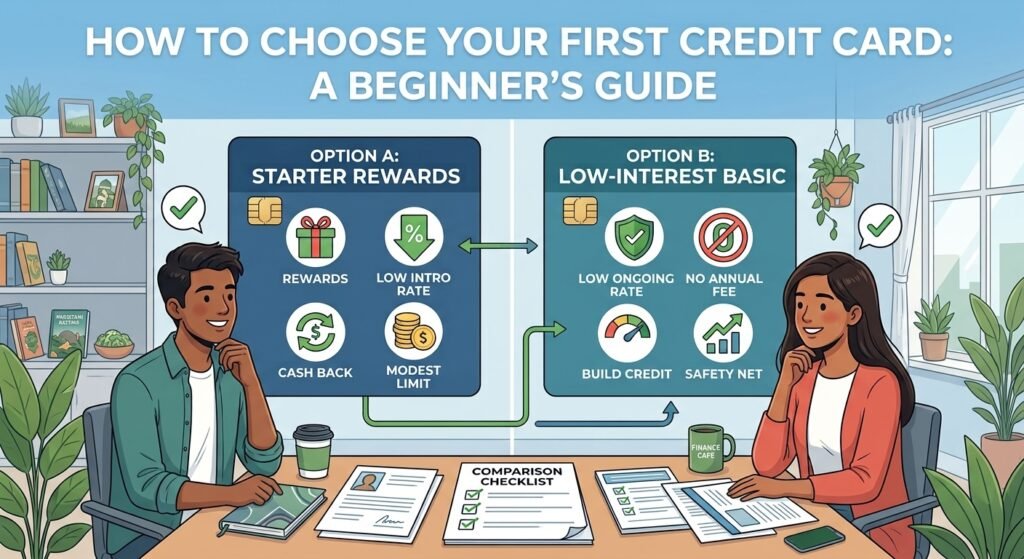
A credit card can be a great tool. It helps you pay for things now and build a good money record for the future. But it can also lead you into big debt if you pick the wrong one or use it the wrong way.
This guide shows you how to choose your first credit card in simple steps. No hard words, no confusing math. Let’s start.
What Is a Credit Card?
A credit card lets you borrow money from a bank for a short time to pay for things. You don’t use your own money at the moment you buy. Later, the bank sends you a bill.
Here is the key part:
- If you pay the full bill on time, you usually pay no extra money (no interest).
- If you pay only part of the bill, the bank charges you interest on what is left. This can get expensive very fast.
Think of it like borrowing a friend’s bicycle. If you return it on time, great. If you keep it too long, your friend starts charging you rent.
Credit Card vs Debit Card: What’s the Difference?
Many beginners mix these up.
- Debit card: You spend your own money that is already in your bank account.
- Credit card: You spend the bank’s money and pay it back later.
A credit card helps you build a credit history, which is a record showing that you pay back what you borrow. A debit card does not do this.
Why Do You Need a Credit Card?
You don’t have to have one. But here is why many people get a first credit card:
- Build a credit score. A good record helps you get loans later, like a car or home loan.
- Handle emergencies. It can help when you need to pay for something urgent.
- Shop online safely. Credit cards often have extra protection against fraud.
- Earn rewards. Some cards give cashback, points, or discounts.
- Enjoy extra services. Some cards offer travel or airport perks.
Things to Check Before You Choose Your First Credit Card
Now the important part. Before you pick a card, look at these things one by one.
1. Check the Interest Rate (Markup or APR)
The interest rate tells you how much extra you pay if you don’t clear your bill in full. Credit card rates are usually much higher than loan rates. A lower rate is better, but the best plan is to pay the full bill every month so the rate never matters.
2. Look at the Annual Fee
Many cards charge a yearly fee just for owning the card. Some cards charge nothing, especially in the first year. For a beginner, a card with low or no annual fee is usually smarter.
3. Learn About Other Fees
The annual fee is not the only one. Ask the bank about:
- Late payment fee: what you pay if you miss the due date
- Cash advance fee: what you pay when you take cash out with your card (this is usually costly)
- Over-limit fee: what you pay if you spend more than your limit
- Foreign transaction fee: what you pay when you spend in another currency
- Replacement fee: what you pay if you lose your card
4. Understand the Credit Limit
The credit limit is the most money you can spend on the card. First-time users often get a small limit. That is a good thing. A small limit helps you avoid spending too much.
5. Know the Grace Period
The grace period is the time between your purchase and the due date, during which you pay no interest if you clear the full bill. It can be about 45 to 55 days on some cards. A longer grace period gives you more time to pay.
6. Compare Rewards and Benefits
Some cards give:
- Cashback: a small part of your spending comes back to you
- Reward points: points you can use for shopping or gifts
- Discounts: offers at restaurants, shops, or online stores
- Travel perks: things like airport lounge access
For a beginner, simple rewards like cashback are easier to understand than complicated point systems. But never spend extra just to earn rewards.
Types of Credit Cards for Beginners
Different cards suit different people. Here are the most common types.
Basic Credit Card
This is a simple card with a standard limit and few extras. It is good if you just want to build credit and keep things easy.
Secured Credit Card
You put some money in the bank as a deposit, and that becomes your limit. It is easier to get, so it suits people with no credit history or a poor one.
Cashback Credit Card
You get a small percentage of your spending back. This suits people who already spend on groceries, fuel, or bills and always pay on time.
Student Credit Card
Some banks offer cards for students or young adults with low limits and low fees.
Islamic (Shariah-Compliant) Credit Card
Some banks offer cards that follow Islamic rules and avoid interest in the usual way. If this matters to you, ask the bank how the card works and what fees apply.
Step-by-Step: How to Choose Your First Credit Card
Follow these simple steps.
Step 1: Decide Why You Want a Credit Card
Ask yourself: “Do I want it to build credit, shop online, or handle emergencies?” Your answer helps you pick the right type.
Step 2: Check If You Are Eligible
Most banks have rules like these:
- A minimum age (often 21 or older)
- A regular income, such as a salary or business income
- A valid ID (like a CNIC in Pakistan)
- Some proof of income, like a salary slip or bank statement
Rules differ by bank, so check before you apply.
Step 3: Set a Monthly Spending Plan
Decide how much you will spend on the card every month, and make sure you can pay all of it when the bill comes. A good habit is to only use the card for things you have already budgeted for.
Step 4: Compare At Least Three Cards
Look at cards from three different banks. Compare the annual fee, interest rate, late fees, rewards, and grace period. Write them side by side so it’s easy to see.
Step 5: Read the Fine Print
Read the terms and conditions. Look for hidden charges. Ask the bank officer to explain anything you don’t understand. Never sign something you haven’t read.
Step 6: Apply and Wait for Approval
Apply online or at a branch. The bank will check your papers and your credit record. This can take a few days.
Step 7: Activate the Card and Set Up Alerts
When the card arrives, activate it, sign the back if there is a signature strip, and turn on SMS or app alerts. This helps you spot strange purchases right away.
Smart Rules for Using Your First Credit Card
Choosing the card is only half the job. Using it well matters even more. Follow these easy rules.
- Pay the full bill every month. This is the number one rule.
- Never miss the due date. Set a phone reminder or auto-pay.
- Spend far below your limit. Try to use less than one third of your limit.
- Don’t take cash out. Cash advances usually come with high fees and instant interest.
- Keep it for planned spending. Don’t buy things just because you have a card.
- Check your statement every month. Look for mistakes or charges you don’t recognize.
- Keep your card details private. Never share your PIN, CVV, or OTP with anyone.
Common Mistakes Beginners Make With a First Credit Card
Avoid these traps:
- Paying only the minimum. This keeps you in debt for a long time and costs a lot in interest.
- Applying for many cards at once. This can hurt your credit record.
- Choosing a card only for rewards. High-reward cards often have high fees.
- Ignoring the fees. Small charges add up.
- Maxing out the limit. Using all your limit makes you look risky to banks.
- Forgetting the due date. One missed payment can cost you a fee and hurt your record.
How a Credit Card Helps Build Your Credit Score
Your credit score is like a school report card for money. Banks use it to decide if you are safe to lend to. You build a good score by:
- Paying on time, every time
- Keeping your balance low compared to your limit
- Keeping your card for a long time, because a longer history looks better
- Not opening too many cards too quickly
Even a small, well-used card can build a strong record in a year or two.
Frequently Asked Questions
What is the best credit card for beginners?
There is no single best card. The best first card has low fees, a small but useful limit, clear terms, and simple rewards. A basic or cashback card from a bank you trust is often a good start.
Can I get a credit card with no credit history?
Yes. Some banks offer beginner cards, student cards, or secured cards for people with no history. Bring proof of income or other documents the bank asks for.
How much should I spend on my first credit card?
Spend only what you can pay back in full when the bill arrives. A good goal is to use less than 30% of your limit.
Does applying for a credit card hurt my credit score?
A bank may check your record when you apply, and too many applications in a short time can look risky. Apply only when you are ready and have compared your options first.
What happens if I can’t pay my credit card bill?
The bank will charge late fees and interest, and your credit record can suffer. If you are in trouble, contact the bank early and ask about payment plans instead of ignoring the bill.
Is it a good idea to have a credit card at all?
It can be, if you are disciplined. If you know you tend to overspend, start with a debit card and a strict budget first.
Final Words: Choose Your First Credit Card With Confidence
Learning how to choose your first credit card is simple when you take it one step at a time. Know why you want it, compare fees and rewards, read the fine print, and pick a card that fits your budget. Then use it wisely: pay the full bill on time and keep your spending low. Do this, and your first credit card will help you build a strong credit history and a bright money future, instead of leading you into debt.
Disclaimer: This article is for education only and is not financial advice. Card terms, fees, and eligibility rules change often and differ by bank and country. Please confirm the latest details with your bank before you apply.